
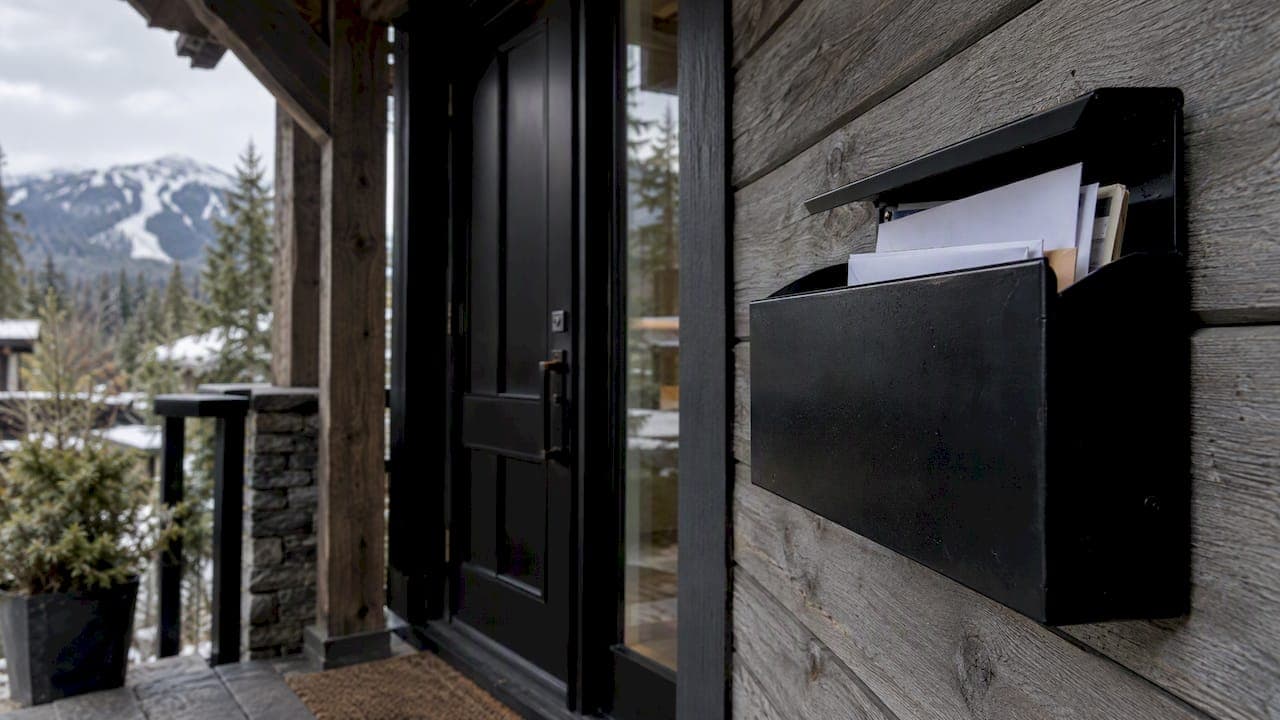
For a vacation home in Canada, mail forwarding through Canada Post handles eligible letter mail well, but it does not cover parcels. It also does not tell you what has happened at the property. The most reliable approach combines the right Canada Post service with direct address updates for parcel senders and, for a high-value residence, a local person who checks the mailbox and documents what they find.
This guide explains how each option works, what it costs as of October 2026, where it falls short, and how to choose for a short trip, a winter away or a second home in British Columbia that sits empty for months.
TL;DR
- Absent a few weeks: Canada Post Hold Mail stores your mail at a Canada Post facility. It starts to work about 3 business days after you order, so do not leave it until the day you travel.
- Away for months (snowbirds, long stays abroad): Temporary relocation forwarding starts at $61.50 for three months within the province, and it excludes parcels.
- Parcels, courier items and anything sensitive need separate handling: update senders directly, and do not assume a forwarding order covers them.
- For a second home of real value, postal services are one control among several. Documented mailbox checks and a named local contact close the gaps.
Table of Contents
- Forwarding, holding or collecting: choose the right job
- Canada Post temporary forwarding: how it works
- Hold Mail for shorter absences
- The gaps that matter for a vacation home
- If you are in Canada but receive U.S. mail
- Before you leave: a mail checklist for a second home
- Our perspective: mail is a signal about the house
- Combining mail handling with property oversight
- How Veil can help
- FAQ
- Sources
Forwarding, holding or collecting: choose the right job
Most problems with mail at a vacation home begin when the wrong service is chosen. There are three different jobs, and each has its own tool.
| Your situation | Best-fit approach | Main limitation |
|---|---|---|
| Away up to a few weeks, returning to the same home | Hold Mail | Mail waits at a facility; nobody reviews it |
| Away 3 to 12 months, need mail to reach you | Temporary relocation forwarding | Excludes parcels; destination cannot be changed once started |
| Second home, empty for long stretches | Local mailbox checks plus selective forwarding | Requires a trusted, accountable person |
| Permanent move | Permanent change of address | Not meant for a home you will keep |
If you keep the residence and expect to return, you are in temporary territory. Canada Post describes temporary relocation forwarding as suited to snowbirds, renovations, temporary jobs and extended vacations, where you remain associated with the original Canadian address.
Canada Post temporary forwarding: how it works
Temporary forwarding redirects personal mail from your Canadian address to another address in Canada or elsewhere in the world. The original address must be in Canada.
What it costs
As of 21 October 2026, Canada Post lists residential temporary relocation pricing as follows. Three months is the minimum term.
| Destination | First 3 months | Each additional month |
|---|---|---|
| Within the same province | $61.50 | $20.50 |
| Across provinces | $77.25 | $25.75 |
| U.S. or international | $114.00 | $38.00 |
For example, a British Columbia owner spending six months in Arizona would pay $114.00 for the first three months and $38.00 for each of the next three, so $228.00 in total at the listed rates.
What you need to set it up
You need a Canada Post account and government-issued photo identification. If you are acting for someone else, you also need proof of authorization. Online service can begin as early as 5 days after purchase, and buying at a post office can allow a start as early as 3 days after purchase. The online steps are to sign in or register, enter address and identification details, select the duration, pay by credit card, and visit a post office with the barcode if required.
Rules that catch owners out
- Parcels are not forwarded. Prepaid envelopes, third-party newspapers and flyers, and some institutional or privately administered mailbox mail are also excluded.
- Addresses are fixed. Canada Post states that changing the original or destination address after service begins requires buying a new service. Cancellation after the start date is not refundable.
- Terms can be extended before they expire, for up to 12 months per service.
- Senders do not learn your new address. Banks, insurers, utilities and the government still send to the old one, and the redirect is only a safety net while you update them.
If forwarding seems not to work, check the obvious causes first. The item may be a parcel, the start date may not have arrived yet, or the mail type may be excluded. Canada Post's support article on forwarded mail covers missing, partly missing and misdelivered items, and gives its support centre as the route to escalate.
Hold Mail for shorter absences
If you are only gone for a few weeks, forwarding is usually the wrong tool, since its minimum term is three months. Hold Mail suspends delivery and keeps your mail at a Canada Post facility until you return.
The residential price is $24.25 for 10 weekdays or less, plus $12.00 for each additional five weekdays. Up to four names at the address are included, and extra names cost $5.00 each. Service typically starts 3 business days after you order. You need a Canada Post account and photo identification.
The practical cost of a three-week absence is therefore $24.25 for the first 10 weekdays, plus $12.00 for each further block of five weekdays you need. Renewals must be requested before the service expires.

Hold Mail is simple and inexpensive, but it has a blind spot. Nobody looks at the mail while it is held. If a notice from a municipality, strata council or insurer arrives, you will see it only on your return.
The gaps that matter for a vacation home
A postal order moves letters. A vacation home has other mail-related exposures.
Parcels and courier deliveries
Canada Post's forwarding service excludes parcels, so online orders and courier deliveries still land at the property. A package left on a porch is a visible sign that nobody is home, and it can also be stolen. Before you leave, identify recurring senders and redirect parcels directly. Pause subscriptions and deliveries you do not need.
Annual and infrequent mail
Canada Post recommends a 12-month term for permanent moves because annual or infrequent items can include tax documents, vehicle-licence renewals, financial statements and membership renewals. The same reasoning applies to a second home. The item that matters most is often the one that arrives once a year.
Sensitive items
Cheques, identity documents, replacement cards and legal notices should not simply be redirected and left to circulate. Decide in advance which senders will switch to electronic delivery, and which items someone you trust should collect and log.
The wrong service type
Choosing a permanent move for a temporary absence, or the reverse, is a common error. Because addresses cannot be changed after service starts, a mistake means buying a second order and paying again.
Notices tied to the property
The mailbox of an empty house often receives time-sensitive correspondence: municipal notices, contractor letters, insurer questions. If the home is subject to vacancy rules or insurance conditions, a record of regular attendance at the property matters. Our guide to avoiding the Vancouver vacancy levy with concierge evidence explains how documented visits support an owner's position.
If you are in Canada but receive U.S. mail
Many Canadian owners also hold U.S. addresses or receive U.S. mail. USPS rules are not interchangeable with Canada Post rules. The USPS international mail manual says qualifying mail may be forwarded to another country only if that country accepts the classification, and treatment differs for letters, periodicals and parcels. Confirm the specific item and destination before relying on it.
Parcels that cross the border can also bring customs, duties and taxes, which ordinary postal forwarding does not remove.

For a U.S. vacation property, the pattern mirrors the Canadian one. USPS Hold Mail is free and pauses delivery for a minimum of 3 days and a maximum of 30 days. For longer absences, USPS points customers toward forwarding, and its Premium Forwarding Service Residential is available for periods from two weeks up to a year, sending most mail weekly by Priority Mail.
Before you leave: a mail checklist for a second home
- Decide the length of absence. Under about a month, choose Hold Mail. Three months or more, consider temporary forwarding.
- List every recurring sender. Include banks, insurers, utilities, strata or condo management, municipal tax offices and professional bodies.
- Move what you can online. Statements, invoices and renewal notices are safer as electronic delivery.
- Redirect parcels at the source. Update shipping addresses on retail accounts or pause deliveries.
- Choose who handles sensitive items. Name one accountable person and agree what they collect, how they record it and who they call.
- Order postal services early. Allow at least 5 days for online forwarding and 3 business days for Hold Mail.
- Set a review date. Extend before expiry, since extension must be requested before the service ends.
- Keep records. Note start and end dates, confirmation numbers and the destination address.
Our perspective: mail is a signal about the house
We look after secondary and luxury residences across Vancouver, the Lower Mainland and Whistler, and we see mail as more than correspondence. A mailbox that is overflowing is a visible message that a home is unattended. A single missed notice can become an insurance or compliance question months later.
For that reason we treat postal forwarding as one control in a wider oversight plan, not the plan itself. Canada Post handles eligible letter mail. It does not handle parcels, and it does not tell you what condition the property is in. A local representative can collect what arrives, keep it secure, log it, and escalate anything time-sensitive to you, wherever you are.
Our view is that owners should not forward everything automatically. Choose what is redirected, what is moved online, and what a trusted person collects under a documented process. Your residence should be attended to as if you never left.
— Veil
Combining mail handling with property oversight
Mail handling works best when it is tied to scheduled visits. A person who is at the property anyway can clear the mailbox, retrieve packages and check the interior, then record all of it. Our articles on absentee homeowner services in Vancouver and on an insurer-ready vacation home inspection describe what regular attendance typically involves, and our property inspection checklist shows how a visit is structured.
Seasonal timing matters too. If you leave for winter, mail handling belongs in the same plan as insurer-ready winterization. When you return, the summer home opening sequence helps you bring the house back into use safely. If a vehicle stays at the property, see what to expect from vehicle oversight at second homes.
What a local representative adds
| Task | Postal service alone | With a local representative |
|---|---|---|
| Eligible letter mail | Forwarded or held | Collected, sorted, logged |
| Parcels | Not covered by forwarding | Retrieved and stored securely |
| Time-sensitive notices | Seen when you read them | Flagged to you promptly |
| Condition of the property | Not covered | Checked on scheduled visits |
| Record of attendance | None | Documented visit logs |
How Veil can help
Veil Concierge is a Vancouver-based concierge and private lifestyle management company serving Vancouver, the Lower Mainland, Whistler and surrounding areas of British Columbia. Our property oversight services can include scheduled residence checks, maintenance coordination, housekeeping, contractor supervision, vehicle checks, arrival and departure preparation, and mail and package management for secondary or luxury residences.
If you want one accountable contact for your home while you are away, see our property oversight service, or review the service levels on our membership packages. We do not publish package prices, so reach out to discuss what fits your residence.
FAQ
How much does Canada Post mail forwarding cost for a vacation home?
As of 21 October 2026, temporary relocation forwarding costs $61.50 for three months within the province, $77.25 across provinces and $114.00 to the U.S. or internationally. Additional months are $20.50, $25.75 and $38.00 respectively. Three months is the minimum term, so it is not suited to a short trip.
How do I hold my mail while travelling in Canada?
Buy Canada Post Hold Mail online or at a post office, using your account and photo identification. The residential price is $24.25 for 10 weekdays or less, plus $12.00 per additional five weekdays. Service typically begins 3 business days after you order, so order ahead.
Why isn't my Canada Post forwarding working?
The most common reasons are that the item is a parcel, which is excluded, that the start date has not arrived, or that the mail type is excluded. If none of those applies, contact the Canada Post support centre about missing or misdelivered forwarded items.
Can I forward mail from a second home to another country?
Yes, Canada Post forwards eligible personal mail from a Canadian address to addresses worldwide, at $114.00 for three months to the U.S. or internationally. Parcels are still excluded, and customs and duties may apply to items that cross borders. Update senders directly for anything important.
Is mail forwarding enough for a vacation home that sits empty?
For a short absence with little at stake, it may be. For a high-value second home, it leaves parcels, sensitive items and the property's condition unattended. Pairing it with documented mailbox checks by a trusted local contact covers those gaps.
Sources
- Canada Post: Mail forwarding
- Canada Post: Mail forwarding features
- Canada Post: Forwarding mail support
- Canada Post: Temporarily stop mail delivery (Hold Mail)
- USPS: International Mail Manual, forwarding
- USPS: Hold Mail, the basics
- USPS: Premium Forwarding Services