
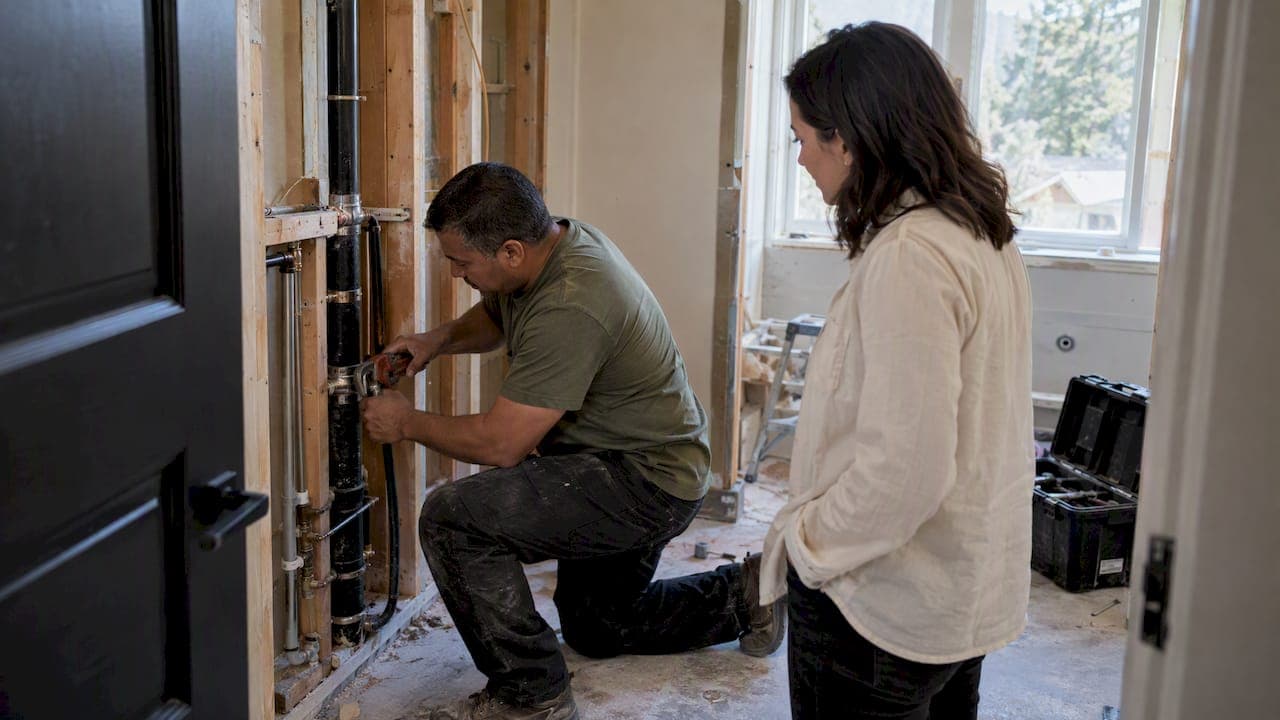
You can manage contractors from a distance if you control four things: who is hired, what the written scope says, who can enter the home and when, and how you receive proof of progress. Most remote projects go wrong because one of those is left to goodwill. This guide covers each in order, with the Canadian and British Columbia rules that apply, and shows where a local representative on the ground changes the outcome.
TL;DR
- Hire on paper: compare at least three written quotes built on the same specifications, check insurance and references, and sign a detailed contract before any work starts.
- Name one decision-maker and one point of contact, and hold a fixed weekly update with a written status note, a look-ahead schedule and a list of decisions due.
- Treat access as a written control first and a technology question second: time-limited codes, notice before each visit and a trusted person who can physically attend.
- Put every change to cost or timeline in writing, pay as work progresses, and keep your own file of quotes, invoices and messages.
- A concierge or property oversight team can supervise visits, log them and act in the moment, which cameras and apps cannot do.
Table of Contents
- Why remote contractor work fails
- Find and vet contractors when you cannot meet them
- Write the contract as if you will never visit
- Set up one chain of communication
- Secure access when you are away
- Confirm the work matches the scope
- Keep records and protect yourself
- If work is late, costs rise or quality falls short
- Our perspective
- What a concierge can take off your plate
- A remote project checklist
- FAQ
- Sources
Why remote contractor work fails
A contractor working in an occupied home is watched by the people who live there. Small problems get caught early: a wrong tile, an unannounced subcontractor, a door left unlocked. When you are in another city or country, that informal supervision disappears, and the problems are found at the end.
The typical failures are predictable:
- Vague scope. The quote says "bathroom renovation" and the argument starts at the first change.
- Unclear access. Keys are passed around, codes are never changed, and nobody knows who was in the house on Tuesday.
- Silent changes. A substitution or an extra charge is agreed on a phone call you cannot remember.
- No one on site for you. A leak or an open window on a Friday afternoon has no one to deal with it.
Each has a fix, and none requires you to be present. They do require more paperwork and more structure than a project you can walk through every evening.
Find and vet contractors when you cannot meet them
Start with a written list of what you want done, in as much detail as you can manage. Canada's Office of Consumer Affairs advises comparing quotes prepared to the same specifications, and checking labour, extra charges, taxes, the project description and at least a partial cost breakdown. It also advises checking recent references, confirming certification, and asking about liability insurance or workers' compensation where required.
The Canada Revenue Agency's renovation toolkit suggests written estimates from at least three contractors. Each should include the job description, the full price with taxes, payment terms, the work schedule and proof of insurance, followed by a written and signed contract.
For remote clients, a few additions matter:
- Do the reference calls yourself, by video if needed. Ask each reference whether the contractor communicated well without being chased, not only whether the work was good.
- Ask how they report. A contractor who already sends dated photos and a short weekly note will suit you better than one who says "just call me."
- Confirm trade credentials and insurance in writing. The Insurance Bureau of Canada recommends a contractor who is reliable, experienced, in good standing with relevant trade or business associations and holds an appropriate business licence, with quotes and guarantees in writing.
- Be wary of cash-only offers. The CRA warns that an under-the-table deal can leave you without warranty or recourse and exposed to liability if someone is injured on the job.
If the work follows an insurance claim, remember that you choose the contractor, even when the insurer suggests preferred vendors. The IBC advises confirming with the adjuster how much the insurer's estimate will cover before you sign.
Write the contract as if you will never visit
When you cannot be there to clarify, the contract does the clarifying. Consumer Protection BC notes that renovation contracts are often future-performance contracts and should clearly state supplier information, date, services, costs, taxes, payment terms, total price, cancellation rights and any limitations or conditions.
The Canadian Home Builders' Association homeowner guide adds practical items that are easy to forget: access to water and electricity, washroom use, material delivery and storage, waste containers, disruption expectations and clean-up. It also says contractors should carry third-party liability insurance, and it recommends contacting your own insurer before work begins or if the home will be vacated.
For a remote owner, add these clauses yourself:
- Named site contact. Who speaks for you, and who speaks for the contractor.
- Access terms. Working hours, notice before each visit, who may enter, and how entry is recorded.
- Reporting. Weekly written update, photo evidence at set milestones.
- Change orders. No change to price or schedule without written approval from you.
- Permits. Who applies for them. The Office of Consumer Affairs says permits are not the contractor's responsibility unless the contract expressly assigns it, and that you should contact your municipal building-inspection department to learn what is required. Natural Resources Canada likewise says homeowners remain responsible for obtaining necessary building and utility permits.
In older houses, the contract review is also the moment to ask whether hazardous materials need testing before demolition. A clear explanation of the asbestos removal process in Canada helps you judge whether a contractor's quote has accounted for testing and safe removal, or has quietly left it out.
Deposits and payment
Consumer Protection BC cautions that an unusually large deposit or a cash-only request may be a warning sign, and recommends asking whether deposits are refundable and what happens if the contractor cannot perform. For direct-sales contracts in BC, a down payment cannot exceed $100 or 10% of the total price, whichever is less. Not every renovation contract is a direct-sales contract, so confirm which rules apply to yours.
The IBC recommends paying as work progresses rather than upfront. For a remote owner, tie each payment to a milestone you can verify with dated photos or an independent visit, not to the calendar.
Set up one chain of communication
Remote projects stall when three people give instructions and nobody owns the decisions. Appoint one decision-maker, whether that is you, your spouse or a representative, and one person the contractor calls. Everything else goes through them.
A fixed weekly rhythm replaces the hallway conversation. A useful weekly agenda covers:
- Safety and site conditions
- Work completed since the last update
- Work planned for the next 7 to 14 days
- Open questions
- Change orders and budget status
- Decisions you owe, with the date the contractor needs each one
Ask for it in writing: a short status note, a look-ahead schedule and a decision list. This is the format a homeowner and general contractor can both follow, and it gives you a record. Consumer Protection BC puts it simply: keep communication open and consistent, and put timeline or cost changes in writing so expectations are clear.
Coordinating several trades
When electricians, plumbers, flooring installers and painters all work in one house, sequence matters. A change to one trade's work often moves the others. Before approving any change, ask for its cost and its effect on the schedule, and have the answer in writing. Keep one shared calendar that shows every vendor, including the routine ones: cleaners, landscapers, window washers, pool and HVAC servicing. Overlaps between a routine visit and a renovation crew are a common cause of lost days.
Secure access when you are away
Giving a contractor access to an empty home is the point of greatest risk. The CHBA's renovation contract guide frames it well: a contract can set reasonable advance notice before work starts and before you move back in, and can agree a move-out and move-back schedule. In other words, secure access starts as a written control. Define notice, permitted access, vacancy and return conditions first, then choose the technology.
| Method | What it does | Limit to plan around |
|---|---|---|
| Smart lock or alarm codes | Compatible systems can create, disable and time-limit door codes, lock or unlock remotely, and notify you when doors change state | Needs a working network and a code policy |
| Garage door control | myQ opens and closes a compatible garage door remotely, sends open/close alerts and supports guest profiles with limited, scheduled access for people such as repair workers | Only covers the garage entry |
| Lockbox | Simple, no power needed | Code must be changed after the job, and entries are not logged |
| A trusted person on site | Meets the contractor, opens, locks, checks and records | Must be reliable, briefed and reachable |
Technology alerts, people respond
Best Buy Canada's travel guidance recommends testing cameras, locks and sensors before you leave and enabling entry, motion, smoke and leak notifications. It also makes the key point: smart devices generally cannot intervene, so keep someone you can call when a pipe breaks or a window is left open.
CAA-Quebec's away-from-home checklist is a good template for that person. Give them a duties list and a property tour, a temporary alarm code, and add their name and number to the alarm company's emergency contacts. It also says to notify people filmed by a camera system and to tell your insurer if the home will be unoccupied for more than 30 consecutive days. That checklist comes from Quebec, so check your own policy wording for the threshold that applies to you.
After the project, change every code you issued and remove every guest profile. Keep the access log with your project file.

Confirm the work matches the scope
Photos are the foundation. Ask for dated photos at fixed milestones: before walls are closed, after rough-in, after waterproofing, and at completion. Photos taken before drywall goes up are the only record of what is behind it.
Photos from the contractor are useful but self-reported. For anything structural, mechanical or expensive, have someone independent look. That can be a trusted person walking the site with your checklist, a video walkthrough on a set day, or a professional inspection at key stages. The concierge approach, below, covers this with documented visit logs.
Check progress against three things: the scope in the contract, the schedule in the look-ahead, and the payment milestone. If the three do not agree, pause the payment and ask in writing.
Keep records and protect yourself
The IBC recommends keeping your own inventory of communications, documents, contractor quotes and invoices, and staying in contact with the adjuster when the repair scope changes. For a remote project, the file should hold:
- Signed contract and every change order
- Quotes you compared and why you chose the winner
- Certificates of insurance and trade credentials
- Permits and inspection sign-offs
- Access log and the list of codes issued and cancelled
- Weekly status notes and milestone photos
- Invoices and proof of each payment
If you are also an owner of a secondary property in Vancouver, an organized file helps with other obligations too. Our guide on the Vancouver vacancy levy explains how documented property care supports your position.
If work is late, costs rise or quality falls short
First, raise it in writing with the contractor and ask for a corrected plan with dates. The IBC advises asking the contractor to rectify deficient work first, and using the insurer's escalation process when a preferred contractor is involved.
If the issue is not resolved and work has started, Consumer Protection BC says recourse is through the courts: the Civil Resolution Tribunal handles claims up to $5,000 and Small Claims Court up to $35,000, according to its renovation guidance. Your written record is what makes that path workable. Check the current limits before filing, as they can change.
Our perspective
We manage residences for owners who are often not in the country. What we see is that remote projects rarely fail on skill. They fail on supervision. The contractor was competent, but nobody checked the entry log, nobody questioned the invoice, and nobody was there when the plumber arrived early.

So our approach is simple. We act as a single point of contact between you and every trade. We schedule and attend the visits, record who arrived and when, photograph progress, and report in writing. Your residence, attended to as if you never left. Where a decision belongs to you, we bring it to you with the cost and the timeline, so you approve with the facts in front of you.
We also believe owners should keep control of the contract. We can coordinate, supervise and document, but you should always have your own copy of the quotes, change orders and invoices. That is the cleanest protection for everyone.
— Veil
What a concierge can take off your plate
If you would rather not run this yourself, our property oversight service covers scheduled residence checks, maintenance coordination, contractor supervision, housekeeping, vehicle checks, and mail and package management for second homes and luxury residences across Vancouver, the Lower Mainland and Whistler. Our membership packages set the level of ongoing care, and we can discuss a single project as well. Contact us and we will tell you what fits your property.
Before a contractor starts, a baseline inspection helps. Our property inspection checklist shows what we record at onboarding, and our absentee homeowner guide explains how regular oversight works day to day. After the work, our post-construction cleaning checklist covers dust control and handover.
A remote project checklist
Before work
- Write the scope and get three comparable written quotes.
- Verify insurance, credentials and references.
- Confirm permit responsibility with the municipality and in the contract.
- Tell your insurer about the project and any extended vacancy.
- Sign a contract with access, reporting and change-order clauses.
During work
- Hold the weekly update and keep the written note.
- Approve changes in writing, with cost and schedule impact.
- Release payments against verified milestones.
- Review the access log and photos weekly.
After work
- Walk the finished work against the contract, in person or by someone you trust.
- Collect permits, sign-offs, warranties and final invoices.
- Cancel every code and guest profile.
- Archive the project file.
FAQ
How do I give a contractor access without being there?
Use time-limited codes or guest profiles on a compatible smart lock or alarm system, and agree notice and working hours in the contract. Keep a trusted person available to meet the contractor and to respond if something goes wrong, since devices alert but cannot intervene. Cancel all access when the job ends.
How many quotes should I get?
At least three, all prepared to the same written specifications so the prices can be compared fairly. Both the Office of Consumer Affairs and the CRA recommend this. Look at what each quote includes, such as taxes, extra charges and payment terms, not just the total.
How much deposit is reasonable?
No single figure fits every contract. Consumer Protection BC warns that very large or cash-only deposit requests may be warning signs, and notes a limit of $100 or 10% of the price, whichever is less, for direct-sales contracts. Ask whether the deposit is refundable, and tie later payments to completed milestones.
What if the contractor goes quiet or the work is poor?
Put your concern in writing and ask for a dated plan to fix it. Keep your records in order. If that fails, claims in BC can go to the Civil Resolution Tribunal or Small Claims Court, depending on the amount.
Sources
- Home renovations, Office of Consumer Affairs
- Canada Revenue Agency renovation toolkit
- Renovating or rebuilding your home, Canada Revenue Agency
- Choosing the right contractor, Insurance Bureau of Canada
- Severe weather insurance help, Insurance Bureau of Canada
- After the Storm, Insurance Bureau of Canada
- Doing a reno? Contract details, Consumer Protection BC
- Contract deposits, Consumer Protection BC
- Renovating for energy efficiency, Natural Resources Canada
- Homeowner guide to renovation contracts, CHBA
- Residential renovation contracts, CHBA
- myQ Smart Home, Chamberlain Canada
- Alarm.com, Canadian Monitoring Services
- Home security checklist, CAA-Quebec
- Monitor your home remotely, Best Buy Canada
- The asbestos removal process in Canada