

A house manager is the operational lead of a private residence, responsible for vendors, staff schedules, provisioning, and preventive maintenance so the homeowner never has to run those details personally. Their core value is ownership: someone accountable for the home functioning smoothly, day after day. If you're logging more than a few hours a week on scheduling repairs, coordinating cleaners, or chasing deliveries, that's usually the signal you need one.
TL;DR:
- A house manager typically oversees vendor relations, maintenance scheduling, staff supervision, household logistics, and project coordination, requiring proactive management skills.
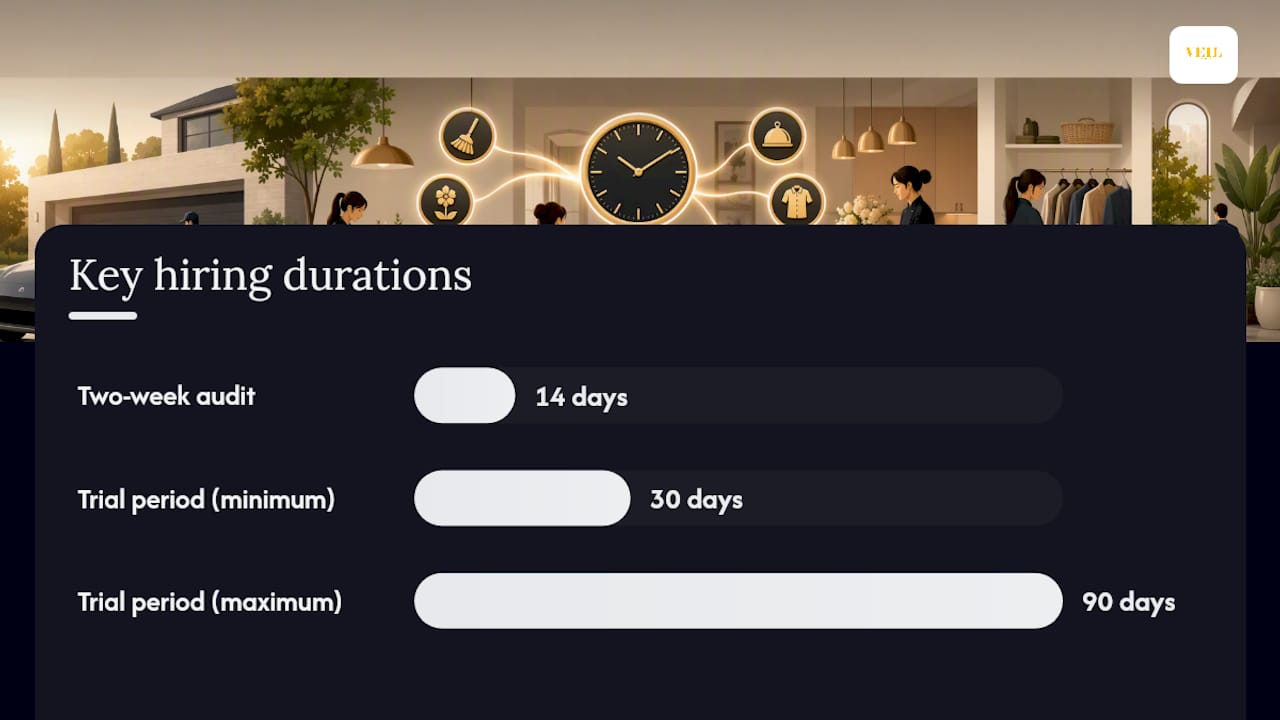
- Hiring decisions should be based on a two-week audit of time spent on household tasks, with part-time roles suited for under 15 hours weekly and full-time for over 25 hours.
- A retained concierge service can fulfill these duties through documented routines, vendor backups, and centralized records, especially beneficial during frequent travel or seasonal occupancy.
- Legal responsibilities include ensuring proper permits, safety compliance, and insurance coverage, along with managing confidentiality through strict information security measures.
- Digital management platforms and smart home systems support ongoing oversight, while detailed emergency plans are essential for crisis response and continuity.
Table of Contents
- What are the core duties of a house manager?
- How is a house manager different from a housekeeper or estate manager?
- When should you hire a house manager, and what does it pay?
- How do you scope and hire a house manager?
- How does a retained concierge deliver these same duties?
- What legal and compliance responsibilities fall on a house manager?
- What technology helps a house manager stay on top of everything?
- What is a house manager's role in an emergency?
- How does a house manager handle privacy and confidentiality?
- How does a house manager communicate across the household?
- Where conventional hiring advice on this topic falls short
- A turnkey alternative to hiring in-house
- Sources
What are the core duties of a house manager?
Every house manager role breaks down into a handful of task clusters, and understanding them helps you scope a job description or evaluate whether your current staff already covers the ground.
Vendors and maintenance sit at the centre of the job. This means building and running a preventive maintenance calendar, sourcing and supervising contractors, and doing on-site checks so small issues get caught before they become expensive ones. EstateSpace's breakdown of household manager duties lists vendor coordination and preventive maintenance among the role's core responsibilities, alongside staff supervision and budget oversight.
Staff coordination covers hiring, scheduling, cover plans when someone is sick or on leave, and ongoing performance oversight of housekeepers, gardeners, or drivers.
Household calendar and logistics means managing family scheduling, prepping for travel and homecoming, and tracking deliveries so nothing sits on a porch for three days.
Provisioning and inventory covers groceries, household supplies, wine collections, linens, and keeping records of assets and warranties so nothing gets lost when something breaks.
Projects and events bring it all together: renovations, dinner parties, and seasonal changeovers that need a single person driving the timeline.
In practice, the operational rhythm looks something like this:
- Daily — check-ins with on-site staff, mail and package triage, and a walk-through of active projects.
- Weekly — vendor scheduling, grocery and supply restocking, and a review of the household calendar against upcoming travel.
- Monthly — maintenance calendar review, budget reconciliation, and inventory audits on high-value items.
Pro Tip: Ask any house manager candidate to walk you through their preventive maintenance calendar from a previous role. Vague answers usually mean the role was reactive, not proactive.
How is a house manager different from a housekeeper or estate manager?
Confusing these three roles is the most common mistake homeowners make when hiring, and it usually leads to an underpaid housekeeper doing operational work she was never scoped for.
- Housekeeper: hands-on cleaning, laundry, and tidying. No vendor or staff authority.
- House manager: operational oversight of a single residence, including staff, vendors, and schedules. Oplu's overview of the role describes the house manager as the operational head who sits above daily staff and acts as the principal's interface for the home.
- Estate manager: strategic oversight across multiple properties, often including capital projects and larger staff structures reporting up through them.
A single property with two or three staff usually needs a house manager, not an estate manager. Hybrid arrangements are common. Document boundaries in writing early, because "who handles the pool guy" is exactly the kind of question that causes friction later.
When should you hire a house manager, and what does it pay?
Run a two-week audit before you hire anyone. Log every hour spent scheduling contractors, restocking supplies, coordinating staff, or handling household admin. Household management guides recommend this exact exercise as the clearest way to determine whether you need help at all, and whether that help should be part-time or full-time.
If your audit lands under 15 hours a week, part-time coverage usually makes sense. Cross 25 to 30 hours and full-time becomes the more efficient choice.
- Part-time house managers are typically paid hourly or on a modest retainer.
- Full-time live-out roles carry a salary plus benefits in most markets.
- Live-in arrangements trade a lower cash salary for housing, which changes the calculation significantly.
- Employment model matters: direct hire means payroll, insurance, and liability sit with you; a retained service shifts that administrative weight elsewhere.
Pay bands vary widely by region and household complexity, so treat any number you see online as a starting point for negotiation, not a fixed rate.
How do you scope and hire a house manager?
Hiring the right person starts with the same two-week audit used to decide whether you need one at all. Convert those logged hours into duty buckets, vendors, staff, calendar, provisioning, projects, and you have the skeleton of a real job brief.
- Write the brief. Include specific duties, expected hours, required skills, the level of discretion and confidentiality involved, and how success will be measured.
- Set reporting lines. Decide who the house manager answers to and how often they'll check in.
- Interview for judgment, not just experience. Ask how they'd handle a burst pipe at 11 p.m., how they vet a new contractor, and what their preventive maintenance process looks like.
- Test discretion directly. Ask how they've handled sensitive household information in past roles.
- Onboard with structure. Hand over inventories, warranty records, vendor contact lists, passwords and household processes, and a written emergency plan.
- Run a trial period. Thirty to ninety days is standard before making the arrangement permanent.
Recruiter resources for house manager roles note that specifics shift depending on household size, staff count, and whether childcare is folded into the position, so build your brief around your actual household, not a generic template.
Pro Tip: Put "trial period" in writing before day one. Verbal agreements about a probationary window rarely survive a disagreement three weeks in.
How does a retained concierge deliver these same duties?
A retained concierge service applies the same discipline as an in-house house manager, without the payroll, benefits administration, or coverage gaps that come with a single employee. A retained concierge structures property oversight around duty buckets such as scheduled inspections, trades and repair coordination, mail and package management, and arrival preparation before a homeowner returns.
- Preventive maintenance calendars are documented and tracked, not improvised.
- Vendor relationships come with backups, so a contractor being unavailable doesn't stall a repair.
- One point of contact coordinates everything, instead of the homeowner juggling five vendor phone numbers.
Operational continuity comes from centralized records, vendor backups, and documented routines that let a home keep running through staff turnover or long absences, not from any one person's memory.
A retained model tends to fit better than an in-house hire when travel is frequent, the property sits empty for stretches, or seasonality makes year-round staffing inefficient. Veilconcierge's home management services are built around exactly that gap.
What legal and compliance responsibilities fall on a house manager?
A house manager who supervises staff or oversees contractor work touches several compliance areas, even in a private residence. Employment obligations apply if staff are hired directly rather than through an agency, including payroll withholding and workers' compensation coverage where applicable in your province.
Permits matter for renovation and construction projects. A house manager coordinating a kitchen remodel or a pool installation needs to confirm the contractor has pulled the correct municipal permits before work starts, since liability for unpermitted work can fall back on the homeowner.
Safety regulations cover everything from smoke and carbon monoxide detector placement to pool fencing requirements, and a good house manager tracks these against local bylaws rather than assuming they're covered.
Insurance is the piece most often overlooked. Homeowner's insurance policies frequently have clauses around staff on-site, vacant-property periods, and high-value item coverage. A house manager should confirm that policy limits match the home's actual contents and that any contractor working on-site carries their own liability coverage before the job begins. None of this requires legal training, but it does require asking the right questions before signing off on a project or a hire.
What technology helps a house manager stay on top of everything?
Digital tools have replaced the binder-and-spreadsheet approach for most well-run households, and the shift matters because it turns institutional knowledge into something that survives staff turnover.
Household management platforms now track maintenance schedules, vendor contacts, warranty documents, and inventory in one place, so a new house manager or a temporary substitute can pick up the role without a lengthy handoff conversation. Shared calendars sync family schedules, staff shifts, and vendor appointments so nobody double-books a contractor visit against a dinner party.
Smart home systems add another layer. A house manager who controls HVAC scheduling, security access codes, and irrigation timing through a single app can catch problems, like a thermostat malfunctioning while the family is travelling, before they turn into a burst pipe or a spoiled wine cellar.
Communication tools matter just as much as scheduling software. A shared messaging channel between the house manager, staff, and the homeowner cuts down on the "did anyone confirm the plumber" back-and-forth that eats up hours every week. The best setups treat technology as documentation, not just convenience: every vendor call, every maintenance visit, and every access code change gets logged somewhere searchable, so continuity doesn't depend on one person's memory.
What is a house manager's role in an emergency?
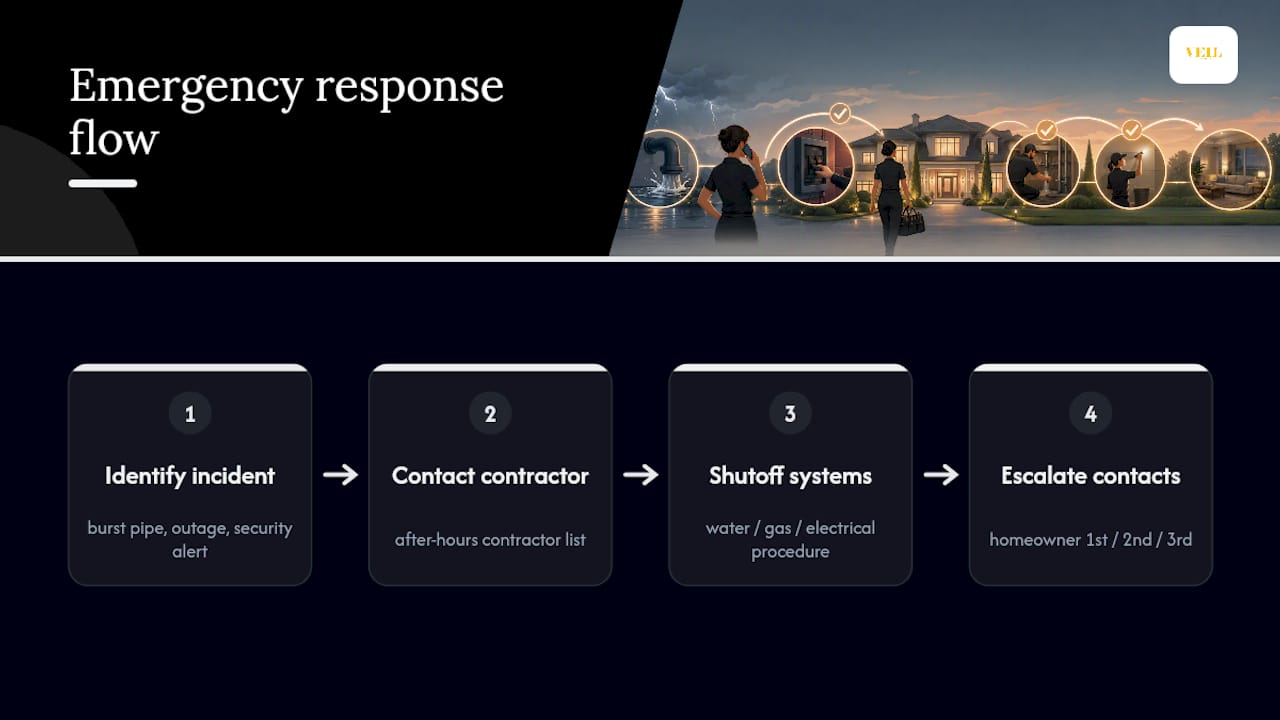
A burst pipe, a power outage, or a security alert at 2 a.m. tests a house manager's value more than any routine week does. Their job in a crisis is to have a plan already written before the emergency happens, not to improvise one while water is spreading across a hardwood floor.
A solid emergency plan includes an updated list of emergency contractors (plumbers, electricians, restoration companies) who can respond outside business hours, a documented shutoff procedure for water, gas, and electrical systems, and a clear chain of command for who gets called first, second, and third.
Weather events deserve their own protocol. A house manager overseeing a property in a flood-prone or wildfire-adjacent area should have a pre-storm checklist: securing outdoor furniture, testing sump pumps, and confirming insurance documentation is accessible remotely, not locked in a filing cabinet inside the house that might need to be evacuated.
Security incidents follow a similar logic. Knowing which alarm company to call, having a secondary contact for the homeowner if they're unreachable, and understanding when to involve local authorities versus handling something internally are all part of the job description, even when they never make it onto a formal task list.
How does a house manager handle privacy and confidentiality?
Confidentiality isn't a nice-to-have in this role. It's foundational, because a house manager sees financial documents, family schedules, security details, and personal habits that most employees never encounter.
Non-disclosure agreements are standard practice for house manager roles in affluent households, and they should cover not just what happens during employment but what stays confidential afterward. A house manager who moves to a new position shouldn't be discussing a former employer's household details, security setup, or family dynamics with anyone.
Discretion extends to how information gets stored, too. Passwords, alarm codes, and financial account details need secure handling, whether that's a password manager with restricted access or a locked physical record, not a notes app on a phone that could be lost or stolen.
Staff supervision adds another layer. A house manager overseeing housekeepers, drivers, or a private chef is responsible for making sure those employees also understand confidentiality expectations, since a loose comment from a driver can undo the discretion a house manager works hard to maintain.
How does a house manager communicate across the household?
The best house managers spend as much time managing conversations as they do managing tasks. That means adapting communication style depending on who's on the other end: a homeowner needs a brief, decision-ready update; a contractor needs precise technical detail; a teenager's school needs a different tone entirely.
Clear reporting rhythms prevent small issues from becoming surprises. A weekly summary, whether it's a five-minute verbal check-in or a written recap, keeps the homeowner informed without requiring them to ask. Vendors and contractors respond better to a house manager who communicates expectations clearly upfront: timelines, budget limits, and access instructions, rather than one who leaves details vague and corrects course later.
Conflict comes up more than people expect, whether it's a scheduling clash between two staff members or a contractor pushing back on a quoted price. A house manager who can de-escalate calmly, without immediately involving the homeowner in every dispute, is worth significantly more than one who forwards every problem upward.
External parties, insurance adjusters, building management, delivery services, all deal with the house manager as the single point of contact. That single-contact model is precisely why the role exists: it removes the coordination burden from the homeowner entirely.
Where conventional hiring advice on this topic falls short
Most guidance on house manager duties treats the role as a checklist: manage staff, coordinate vendors, track inventory, done. That framing misses the actual skill being hired for, which is judgment under ambiguity. A contractor cancels an hour before a dinner party, a smart lock stops responding while the family is in Europe, a housekeeper and a driver disagree about scheduling. None of that shows up on a task list, and it's exactly where a mediocre hire and a great one diverge.
The other place conventional advice falls short is the false binary between "hire someone" and "manage it yourself." A two-week audit usually reveals a middle ground: enough recurring work to justify professional oversight, but not enough volume or unpredictability to justify a full-time salary, benefits, and the liability that comes with direct employment.
If there's one thing worth prioritizing above all else, it's writing the job brief before interviewing anyone. Homeowners who skip that step end up hiring for a personality rather than a scope, and scope creep follows within months. Define the duty buckets first. The right hiring decision, whether that's an employee or a retained service, becomes obvious once the actual workload is on paper.
— Veil
A turnkey alternative to hiring in-house
There are alternatives to hiring and managing a house manager yourself, offering single-contact solutions that replace payroll paperwork, vendor coordination, and coverage gaps from a single employee being unavailable. These services fit homeowners who travel often, split time between multiple residences, or prefer a trusted contact handling everything from minor repairs to last-minute arrival preparations.

The service maps directly onto the duty buckets covered above. Property inspections and preventive maintenance run on a documented schedule. Trades and repair coordination happen through vetted vendor relationships with backups already in place. Arrival preparation and home setups get handled before you land, not after. For homeowners who are planning renovations or building out asset inventories, understanding how probate and estate titles work in Canada is worth a look alongside your own record-keeping.
Review Veilconcierge's comprehensive home management services and book a consultation to find out what a retained concierge model would look like for your property.
Sources
- Household Manager guide: what they do & how to hire one (Beverly)
- Household manager: duties & professional operations (EstateSpace)
- What is a house manager? The UHNW household role (Oplu)
- House manager job description (Household Staff Agency)