
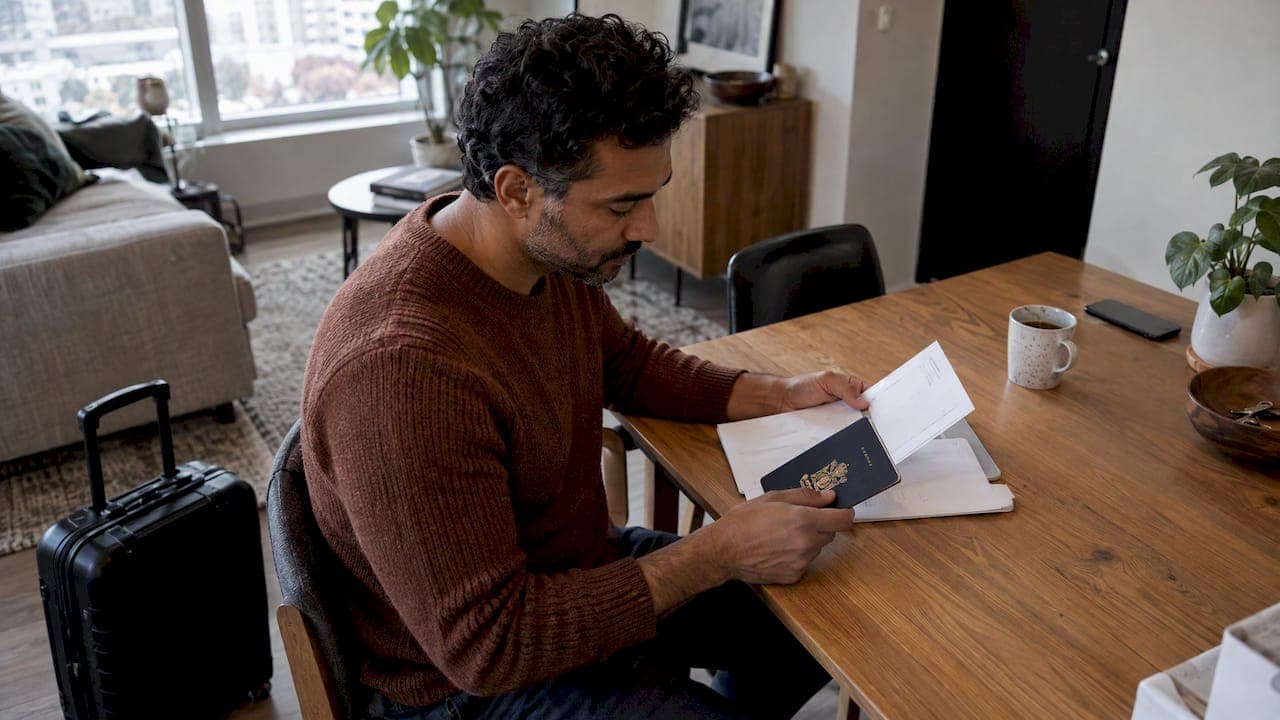
A trip that must happen within days is a logistics problem before it is a booking problem. Flights and hotels are the easy part. The hard part is everything around them: valid documents, a car at the right door at the right hour, a home left secure, and someone who can answer the phone when a connection fails. This guide sets out what to do in the first 24 hours, what to check before you pay, and where a single trusted contact in Vancouver changes the outcome.
TL;DR
- Confirm your passport and entry documents first. Everything else depends on them.
- A reservation is not a ticket. Check that payment is confirmed and a ticket is issued, and check the name against your passport.
- Allow two hours at YVR for domestic flights and three for U.S. and international departures, even when the trip was arranged this morning.
- Arrange ground transport and your home's care at the same time as the flights, not afterwards.
- Know your rights under Canada's air passenger rules before something goes wrong.
Table of Contents
- The first 24 hours: an order of operations
- Start with documents, not fares
- A reservation is not a ticket
- Know your rights before you need them
- Getting through YVR on short notice
- Ground transport is where short-notice trips succeed or fail
- Flying private, or flying commercial?
- Commercial flight or private charter: a short comparison
- Multi-city trips on short notice
- Hotels, villas and dining when everything looks full
- The part most guides leave out: your home while you are away
- Our perspective: one contact, one accountable plan
- How Veil can help on short notice
- A last-minute checklist
- FAQ
- Sources
The first 24 hours: an order of operations
On short notice, sequence matters more than speed. Work in this order and you avoid the most expensive mistakes, which are the ones made in a hurry and discovered at the airport.
- Documents. Passport validity, visas or electronic travel authorizations, and any documents for children travelling with you.
- Routing. Decide the departure airport, the date window and how much flexibility you have, before you look at fares.
- Ticketing. Book, then audit the confirmation.
- Ground transport. Departure from your door and arrival at the other end.
- Accommodation and reservations. Hotel, villa, dining, and any access you need on arrival.
- Your residence and vehicles. Who is checking the house, the mail, the car.
Each step is covered below, with the details that tend to be missed.
Start with documents, not fares
The Government of Canada's travel documents page describes a passport as the only reliable and universally accepted travel identification document. Canadians are advised to check that a passport is valid well beyond the travel dates, because some destinations require validity for months after you plan to leave. Read the entry rules for your destination before you pay for anything non-refundable.
If you are flying out with children, a second passport holder, or someone whose name has changed, confirm that each traveller's name will be entered exactly as it appears on their passport. A mismatch is one of the most common causes of trouble at check-in, and it is far easier to correct before ticketing than after.
Visitors coming to Vancouver at short notice
If you are travelling into Canada rather than out of it, entry requirements depend on your citizenship. U.S. citizens can read the current entry requirements for U.S. citizens travelling to Canada, including the rules for air and land crossings and for children. Other nationalities should confirm their own requirements with the Government of Canada before booking.
A reservation is not a ticket
This is the point most travellers learn at the worst moment. The Canadian Transportation Agency's guidance on tickets, tariffs and reservations explains that airlines may charge fees to change flights and dates, and that those costs depend on the type of ticket purchased, the availability of new flights and the cost of the new flights plus taxes and fees.
In practice, once you book, check these items immediately:
- A ticket number has been issued, not just a booking reference.
- The name matches the passport exactly.
- The fare conditions: changeable, refundable, or neither.
- Baggage allowance on every segment, particularly if two airlines are involved.
- The total price. Under Canada's rules, advertised air fares must show the total price including taxes, fees and charges, so compare like with like.
If any of these is wrong, correct it while the booking is fresh. Changes on a ticket purchased minutes ago are simpler than changes made at the check-in counter.
Know your rights before you need them
Short-notice itineraries leave little slack, so a delay or cancellation matters more. Under the Air Passenger Protection Regulations, when a cancellation or lengthy delay is outside the airline's control, the airline must rebook you on the next available flight, operated by it or a partner, within 48 hours. If it cannot, you choose between a refund and rebooking, and refunds must be provided within 30 days of the request.
Oversold flights are a separate matter. The agency's page on bumping and denied boarding explains what happens when more checked-in passengers with valid tickets arrive at the gate than there are seats. Last-minute bookings can be more exposed here, so check in early and keep your confirmation accessible.
What your rights look like depends on the airline's size, the cause of the disruption and where you are flying, so read the agency's guidance for your specific situation rather than relying on a summary.

Getting through YVR on short notice
A late booking does not change how long security takes. Vancouver International Airport recommends arriving two hours before domestic flights and three hours before U.S. and international flights. Treat that as the minimum, not a target to cut close.
Two habits help:
- Check in online first. YVR's winter travel tips begin with finalizing booking details and documents, and checking in through the airline's website or app, making sure the check-in details are correct.
- Check the airport's own updates. YVR publishes look-ahead travel updates and reminders around busy periods. Holiday weeks, long weekends and major events behave differently from an ordinary Tuesday.
If your departure is in the early morning or the late afternoon, assume the terminal will be busier and plan your departure from home accordingly.
Ground transport is where short-notice trips succeed or fail
A good flight can be undone by a poor transfer. On short notice, the common problems are predictable: no vehicle available at the hour you need, a driver who cannot find the correct terminal door, a departure time set without allowing for traffic on the Oak Street or Knight Street bridges, or luggage that does not fit the vehicle booked.
A few practical points:
- Work backwards from the check-in deadline, not forwards from your door. If you need to be at YVR three hours before an international departure, set the pickup time from that, then add a margin for the route.
- Confirm the vehicle type against the party and the luggage. Skis, golf bags and multiple large cases change what you need.
- Arrange the return leg now, even if the date is uncertain. A held vehicle is easier to release than to find.
- Plan for Whistler separately. The Sea to Sky Highway is a different journey from a city transfer, particularly in winter.
Our chauffeur services are priced from $128.13 to $410 CAD per hour, depending on the vehicle. If you would rather drive yourself, we also arrange luxury car rentals. For etiquette points that help a first-time rider, including access rules and custom requests, see our guide to chauffeur etiquette in Canada.
Flying private, or flying commercial?
When the schedule is tight, some travellers consider a charter. It is not the right answer for every trip, and it helps to be clear about when it is. Our guide to private jet versus airline travel in Canada looks at the point at which a charter begins to pay for itself for a group of four or more. If you have not chartered before, the first-timer's charter checklist explains what to have ready, and the notes on private jet etiquette cover how to avoid departure delays.
Charter is most useful when you have several passengers, tight timing, an airport that commercial schedules serve poorly, or a need for privacy. For a single traveller on a well-served route, a changeable commercial fare is usually the more sensible choice.
Commercial flight or private charter: a short comparison
| Consideration | Commercial airline | Private charter |
|---|---|---|
| Departure time | Fixed by schedule | Set around your timing |
| Group of 4 or more | Priced per seat | Cost shared across the cabin |
| Airport arrival time | Two to three hours at YVR, per YVR's guidance | Set with the operator |
| Changes after booking | Depend on fare type and fees | Depend on the operator's terms |
| Best for | Solo or couple travel on busy routes | Groups, tight itineraries, privacy |
We do not publish charter pricing, because it depends on the aircraft, route and date. Our private jet charter page is the place to start a request.
Multi-city trips on short notice
A trip with several stops is the most fragile kind to build quickly. The sequence that tends to work: book the flights first, because they set the dates; then fit hotels and transfers around them. We set this out in our guide to multi-city itinerary planning for three to five nights. The same principle holds for executives moving between meetings, covered in our practical guide to travel coordination for executives.

Hotels, villas and dining when everything looks full
Public booking sites show what is on sale to the public. Rooms, villas, tables and experiences are often held outside those channels, and a person with relationships can sometimes reach them where a website cannot. That is the practical value of a local representative on a short-notice trip. It is not a guarantee of availability, and we will tell you plainly when something cannot be done.
For accommodation and itineraries, our travel advisory team arranges five-star hotels and resorts, private villas and residences, cruise and yacht voyages, and bespoke itineraries. For arrival, we can coordinate private dining and chefs, restaurant reservations, wellness and beauty appointments, and entertainment, so that the first evening is settled before you land.
If your short-notice trip is tied to a large event, see our page on FIFA World Cup concierge and travel services in Vancouver.
The part most guides leave out: your home while you are away
Leaving in a day leaves little time to think about the house. The questions that matter are simple. Who has a key? Who will notice a leak, a failed furnace or a burst pipe? Who collects the parcels and the mail? Is the vehicle in the garage started and checked?
For a Vancouver or Whistler residence left on short notice, a reasonable minimum before you go is:
- Name one accountable contact with access, and tell your building or neighbours.
- Set heating or cooling to a sensible level for the season.
- Arrange for mail and packages to be collected and logged.
- Arrange scheduled residence checks with a written record of each visit.
- Share the contact details of your preferred trades, in case something needs repair.
We provide property oversight for secondary and luxury residences, including scheduled checks, maintenance coordination, housekeeping, contractor supervision, vehicle checks, and mail and package management. For wider household needs, see our comprehensive home management page. Arriving at a property rather than leaving it? Veil Home Setups prepares a residence for your arrival.
Our perspective: one contact, one accountable plan
We have seen the same pattern many times. A traveller books the flight within an hour, then spends the next two days chasing the rest: a car, a table, a key-holder, a reply from a hotel. Each piece is small. Together they are the trip.
Our view is that short-notice travel should be treated as a single plan with a single owner. That owner confirms the documents, checks the ticketing, schedules the transfers, makes sure the residence is attended to, and stays reachable when plans shift. We work through a vetted network of local operators, which means we know who to call and who will answer. We do not promise the impossible, and when a request cannot be met, we say so early and offer the nearest alternative.
Discretion matters as much as speed. Travel dates, addresses and household routines are sensitive, and they stay with the people who need them to do the work.
— Veil
How Veil can help on short notice
If you are planning a trip within days and want one contact to coordinate the flights, transport, accommodation and the care of your home, contact us through our travel and concierge services. For ongoing needs, our GOLD, PLATINUM and DIAMOND packages set out membership options, and our cancellation policy and terms and conditions explain how bookings work.
A last-minute checklist
Before you book
- Passport valid well beyond your return date
- Entry requirements checked for every country on the route
- Names recorded exactly as on the passport
Within an hour of booking
- Ticket number issued, not only a reservation
- Fare rules, baggage and change fees understood
- Online check-in completed where available
Before you leave home
- Door-to-door transport confirmed, return leg held
- Arrival plan confirmed: hotel, villa, dining
- Residence, mail and vehicles assigned to a named contact
- Departure time set from YVR's recommended arrival window
FAQ
What counts as a last-minute trip?
There is no formal definition. In practice it means a trip arranged in days rather than weeks, where you have little time to correct errors. The shorter the window, the more the details above matter.
Can I still change a flight booked at the last minute?
Often, but not always, and usually at a cost. The Canadian Transportation Agency notes that change fees depend on the type of ticket, the availability of new flights and their cost. Check the fare conditions before you pay.
How early should I arrive at YVR?
YVR recommends two hours for domestic flights and three hours for U.S. and international flights. Allow more during holiday periods or early-morning and late-afternoon peaks.
Who looks after my home if I leave within a day or two?
You need one accountable contact with access, a plan for mail and packages, and a way to record each visit. We provide scheduled property checks, maintenance coordination and vehicle checks for residences in Vancouver, the Lower Mainland and Whistler.
Sources
- Air Passenger Protection Regulations, Canadian Transportation Agency
- Tickets, tariffs and reservations, Air Passenger Protection
- Bumping (denied boarding) and refusal to transport, Air Passenger Protection
- Travel documents, Government of Canada
- Vancouver International Airport urges travellers to arrive early for flights
- 10 Tips for a Seamless Winter Travel Journey Through YVR
- YVR two-week look ahead, winter travel updates and reminders
- Passport or Card for Canada: U.S. citizens' rules