

Sequence your cities by geography before anything else, then set 3 to 5 nights per stop, book your inbound, outbound, and any open-jaw flights first, and hold every detail in one itinerary source. For anything with more than four cities or tight corporate timing, a concierge who can rebook on the fly is often the more reliable option than a DIY spreadsheet.
TL;DR:
- Sequences should be based on geography and route shape, with linear, loop, or hub-and-spoke options fitting different trip types and city counts.
- Travel between cities should be chosen according to distance, cost, and convenience, favoring trains for under 500 miles and considering full transfer times.
- Allocate 3 to 5 nights per city, with major capitals needing more time, and plan for buffer days after long or overnight legs to recover from jet lag.
- Book flights first, prioritizing inbound, outbound, and open-jaw tickets, then arrange rail or regional flights, followed by lodging in high-demand destinations.
- Use comprehensive travel planning tools that incorporate live pricing, direct booking links, and mid-trip change handling to avoid fragmentation and last-minute surprises.
Table of Contents
- How do you sequence cities for multi city itinerary planning?
- Should you fly, take the train, or drive between cities?
- How many nights should you spend in each city?
- When should you book flights, trains, and hotels?
- Which tools actually handle multi-city coordination well?
- How do you handle delays or last-minute changes?
- When does a concierge make more sense than DIY planning?
- What most travellers get wrong about multi-city trips
- Let Veilconcierge plan and run your multi-city trip
- Sources
- FAQ
How do you sequence cities for multi city itinerary planning?
The single biggest mistake in multi-city itinerary planning is choosing cities before choosing a shape. A route with no geographic logic sends you criss-crossing a continent, burning a full day on a flight that a train could have covered in three hours. Fix the shape first, and the rest of the plan falls into place.
There are three route shapes worth knowing, and each fits a different kind of trip.
- Linear route. You fly into City A, travel overland or by air through B and C, and fly out of the final city. This works well when your destinations sit roughly along a line, like Lisbon to Porto to Madrid to Barcelona, and it pairs naturally with an open-jaw ticket that flies you into one city and out of another. Open-jaw bookings often save both time and money compared with backtracking to your starting point.
- Loop route. You start and end in the same city, circling through your stops in between. This suits regions with one major international gateway, such as flying into Tokyo, looping through Kyoto and Osaka, and returning to Tokyo for your flight home.
- Hub-and-spoke route. You base yourself in one city and take short round trips to nearby destinations. This works when one city has the best flight connections and the others are close enough for day or overnight trips, like basing in Rome and side-tripping to Florence and Naples.
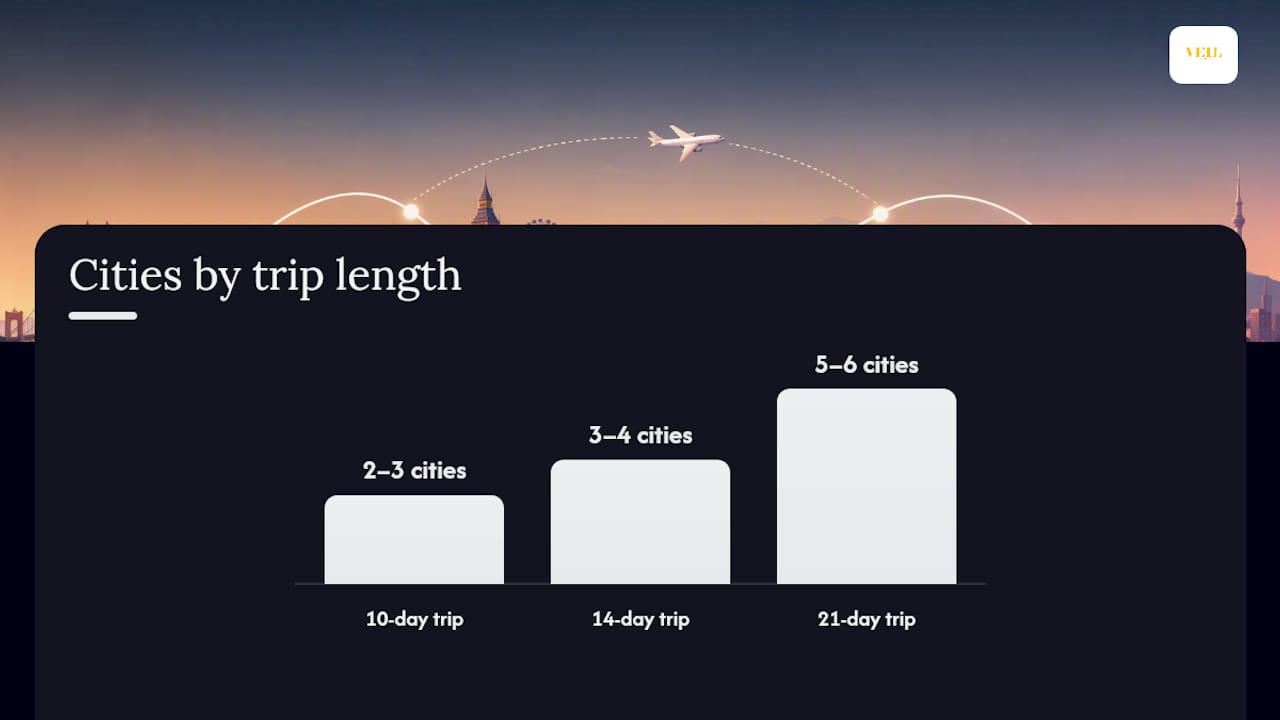
Once you pick a shape, map your city count to your trip length. A 10-day trip realistically supports 2 to 3 cities. A 14-day trip can handle 3 to 4. A 21-day trip opens up to 5 or 6, provided you are disciplined about pacing. Cramming 6 cities into 10 days is the number one cause of multi-city trips that feel like a blur of train stations rather than a vacation.
Before you touch a booking site, write down your non-negotiables: fixed dates, must-see stops, and which airports you can realistically fly into and out of. This constraint list becomes the backbone of your route, and it is far easier to sequence three confirmed cities around a wedding date than to try to retrofit a rigid schedule onto a route you have already committed to on paper. Sequencing your cities by geography before booking is the step almost every rushed itinerary skips, and it is the one that saves the most time later.
Should you fly, take the train, or drive between cities?
Once your route is set, each leg between cities needs its own transport decision. There is no universal answer here. The right choice depends on distance, cost, and how much of the trip you want to spend inside an airport security line.
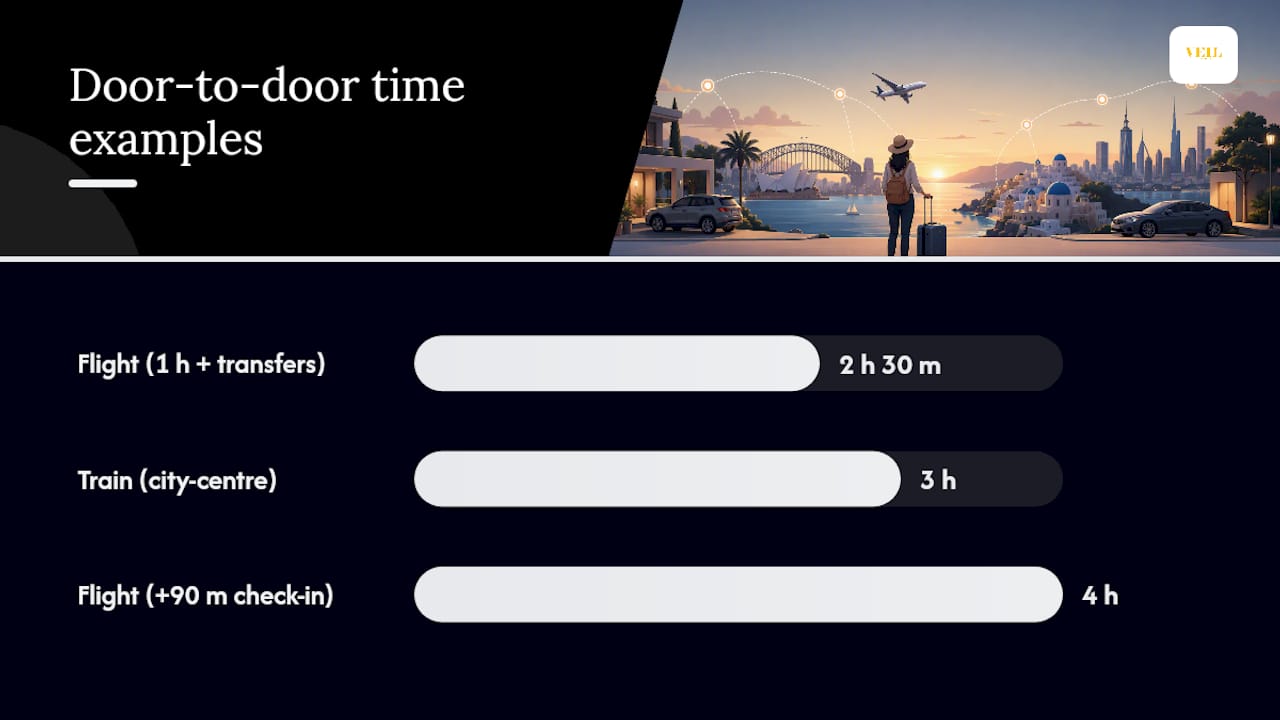
- Rail tends to beat flying for city-centre-to-city-centre trips under roughly 500 miles. Once you count the time getting to and from the airport, security, and boarding buffers, a high-speed train can be faster door-to-door than a flight on routes like Tokyo to Kyoto or Paris to Lyon.
- Flights make sense for long legs or wherever practical rail simply does not exist. Factor in the full cost of the leg, not just the fare: airport transfers, baggage fees, and the 90 minutes you lose to check-in and security often erase the price advantage of a budget carrier.
- Buses are worth considering when your budget matters more than your schedule. They are slower but often a fraction of the rail fare, and useful for legs where you have no fixed arrival time.
- Driving earns its place on scenic routes or in regions with sparse rail and flight options, but it adds logistics: fuel, tolls, parking, and potentially a one-way rental drop fee if you are not looping back to your pickup city.
Booking windows differ by mode too. Rail fares in many regions open earlier and reward booking a few weeks out, while flight prices swing more with demand and can spike or drop with little warning. Compare the total door-to-door cost and time for each leg, not just the ticket price, before locking anything in.
Pro Tip: Add up transfer time on both ends of a flight before comparing it to a train fare. A one-hour flight that requires a 45-minute airport transfer on each side often loses to a three-hour train that drops you in the city centre.
How many nights should you spend in each city?
Three to five nights per city is the baseline that keeps a multi-city trip feeling like travel rather than a checklist. Secondary cities like Porto or Ljubljana often need only 2 to 3 nights to feel complete, while major capitals like Paris, Tokyo, or Rome reward the full 4 to 5.
- Map nights to trip length realistically. A 10-day trip splits comfortably into two 4 to 5 night stops. A 21-day trip can support five stops averaging 4 nights each, with a buffer day built in somewhere in the middle.
- Split your budget with a simple rule of thumb. Aim for 50 to 60% on lodging, 15 to 20% on inter-city transit, 10 to 15% on food, 10 to 15% on activities, and 5 to 10% held as buffer for the unexpected.
- Add a transit-only night when a leg runs long. If you are covering an overnight train or a red-eye flight, do not schedule sightseeing the next morning. Build in a slower half-day to recover, especially across multiple time zones where jet lag compounds with every city change.
When should you book flights, trains, and hotels?
Booking order matters as much as the route itself. Lock in the bookings that are hardest to change first, and leave the flexible ones for later.
- Book your inbound, outbound, and open-jaw flights first. These frame the entire trip, and changing them later usually forces you to re-sequence everything else. This is the order most experienced multi-city planners follow: sequence cities, set nights per city, then book the flights that bookend the trip.
- Book inter-city rail or short regional flights next, once your framing flights are confirmed. Rail tickets in many regions open around 60 to 90 days out; short flights fluctuate more and are worth watching weekly rather than booking blind.
- Book lodging after transit, prioritizing your highest-demand cities first. A boutique hotel in Venice during festival season sells out long before a mid-week stay in a secondary city does.
- Use refundable holds where they are offered, particularly for the middle legs of your trip where your plans are still most likely to shift. A small deposit for flexibility is cheap insurance against a rebuild.
Which tools actually handle multi-city coordination well?
Most multi-city trip failures are not planning failures. They are fragmentation failures: three browser tabs, a confirmation email buried in your inbox, and a hotel address you can only find by searching your spam folder. Fixing this starts with picking the right category of tool for the job, then holding everything in one place.
Four categories cover most needs:
- Multi-city flight search engines that price an entire route at once rather than leg by leg, which surfaces open-jaw options you might not think to search manually.
- Rail booking platforms specific to your region, since national rail sites often beat third-party resellers on price and seat selection.
- Itinerary hub apps that consolidate flights, hotels, and activities into one day-by-day view.
- AI-assisted planners that pull live venue and transit data rather than relying on generic training knowledge, which produces more reliable day-by-day plans with actual booking links attached.
When you are evaluating any tool, check four things: does it use live pricing rather than cached estimates, does it let you book directly or at least link out to a real booking page, can it import your existing confirmations, and how well does it handle a mid-trip change without forcing a full rebuild? Trip-builder features that combine flights and ground transport in one search genuinely speed up the price-comparison step, which is where most people lose the most time.
Structure your single-source itinerary around a card per city: dates, confirmation numbers, transit legs in and out, and one emergency contact for that stop. Many day-by-day planners now insert a dedicated transit day between city changes, which prevents the classic error of scheduling a museum visit on the same afternoon as a five-hour train ride. If you use more than one tool, one purpose only, and export everything into a single document or app, so you are never hunting across four accounts to find your Tuesday hotel address.
Pro Tip: Before you finalize any leg, screenshot the confirmation and paste it into your master itinerary immediately. Apps close, subscriptions lapse, and the one time you need that booking reference is usually the one time the app will not load.
How do you handle delays or last-minute changes?
A multi-city trip is only as strong as its weakest connection, and something will eventually go sideways: a cancelled flight, a rail strike, a hotel that oversold your room. Building resilience in from the start saves a full day of panic later.
- Keep every confirmation and vendor contact next to its leg in your itinerary, not scattered across email threads. When a leg breaks, you need the phone number for that specific hotel or rail operator in seconds, not minutes.
- Have a local fallback ready for each leg, whether that is a second train option, a ride-share app installed before you land, or a backup hotel you have already screenshotted.
- Re-sequence only the affected leg, not the whole trip. A cancelled train from city B to C does not mean city D and E need touching; treat the disruption as isolated and patch around it.
- Follow a time-boxed recovery checklist on the day it happens. In the first 30 minutes, confirm the cancellation and check the next available option. Within 60 minutes, book the fallback and notify anyone meeting you. By 120 minutes, update your master itinerary and, if the trip is complex enough, escalate to whoever is coordinating logistics for you.
When does a concierge make more sense than DIY planning?
Some trips are simple enough to plan solo in an afternoon. Others carry enough moving parts, six cities, three countries, a corporate schedule layered on top of personal time, that the coordination itself becomes a job. That is where a dedicated concierge earns its cost.
A dedicated concierge often acts as a single point of contact for exactly this kind of complexity, working through a vetted network of local suppliers rather than a generic booking engine. In practice, that covers:
- Bespoke itinerary design that builds the route, sequencing, and pacing around your actual schedule rather than a template.
- Private transportation between cities and within them, including chauffeur arrangements and airport transfers.
- Five-star hotel and private villa bookings in high-demand cities where availability disappears fast.
- On-trip support and rebooking when a leg falls through, so you are calling one contact instead of three airlines.
Corporate travellers stacking meetings across multiple cities, families coordinating a multi-country milestone trip, and anyone who has been burned by a cancelled flight mid-itinerary tend to benefit most. A concierge does not replace your itinerary; it becomes the person who defends it when things go wrong.
What most travellers get wrong about multi-city trips
The itineraries that fall apart are almost always overambitious. Adding a sixth city to a 12-day trip because it looked close on a map is the single most common planning error, and the fix is not more efficiency. It is fewer stops and a buffer day you didn't think you needed until day 8.
The second trap is stacking too many different low-cost carriers across one trip. Each one has its own baggage rules, its own check-in cutoffs, and its own app to track. Three ultra-budget airlines on one route means three separate failure points instead of one.
For day-of clarity, keep confirmations, contacts, and backup options in a single place you can open without wifi, and treat that document as private. Trip details are personal information, and a shared cloud link with no password is not a filing system.
— Veil
Let Veilconcierge plan and run your multi-city trip
Veilconcierge is the alternative to piecing a multi-city trip together yourself across a dozen browser tabs. Instead of you sequencing flights, chasing rail booking windows, and holding confirmations in three different apps, one point of contact handles the route, the bookings, and the on-trip fixes when a leg goes sideways.

The travel planning and booking team builds bespoke itineraries across five-star hotels, private villas, and multi-city routing, then hands you a single plan instead of a folder of confirmations. Need ground transport between cities or airport transfers that show up exactly when your flight lands? The chauffeur service runs $128.13 to $410 CAD per hour, booked once and coordinated for every leg of the trip. For longer legs where a private jet makes more sense than another commercial connection, private jet charter arrangements are available on request.
If your route includes a corporate stretch, a coordinated private chef or dining reservation can be built into the days you actually have free, borrowing from the same meal-planning logic used in business travel scheduling. If a sea leg is part of the plan, coordinating a yacht charter alongside your land itinerary keeps every mode of transport under one plan, and readers preparing a vessel for international travel logistics will find the prep checklist useful before departure. To start, reach out through the Vancouver concierge services page and outline your route; the team will map it against real availability before you book a single leg.
Sources
- How to Plan a Multi-City Trip: A Complete Guide for 3+ Destinations | Vacation Planner Blog
- Tripagent
- Free AI Travel Itinerary Planner — Multi-City, Day-by-Day Routes | Before Vacations
- Plan multi-city travel with Trip Builder – KAYAK Canada Blog
FAQ
What is the best website to plan a multi-city trip?
There is no single best site for every trip. Multi-city flight search engines are strongest for pricing the flight legs, while dedicated itinerary hubs and AI planners that use live venue and transit data tend to produce more reliable day-by-day plans than generic templates. For a trip with more than four cities or a tight corporate schedule, a concierge service can absorb the coordination work entirely.
Is there an app that can help me plan a city trip?
Yes. Itinerary hub apps and AI-assisted planners can build a day-by-day route, insert transit days between city changes, and attach live booking links to each stop. The most useful ones let you import existing confirmations so your flights, hotels, and activities sit in one place instead of scattered across separate bookings.
How do you plan a multi-city trip step by step?
Start by sequencing your cities into a linear, loop, or hub-and-spoke shape based on geography, then set 3 to 5 nights per city depending on trip length. From there, book your inbound and outbound flights first, followed by inter-city rail or short flights, then lodging, prioritizing your highest-demand cities.
Is it cheaper to book multi-city flights together or separately?
It depends on the route. Booking one multi-city itinerary through a single search often surfaces open-jaw fares that beat the cost of separate round-trip tickets, since flying into one city and out of another avoids a wasted return leg to your starting point. That said, some regional legs price lower when booked directly through a local carrier or rail operator, so it is worth comparing both before committing.