

Private jet etiquette comes down to three things: arrive exactly when your itinerary says, follow every instruction the crew gives you, and never post real-time photos showing the tail number. Confirm your reporting time the night before, wait to be shown to your seat instead of choosing one, and double-check your luggage and pet paperwork are declared ahead of time. Get those right and the rest of the experience takes care of itself.
TL;DR:
- Confirm your reporting time with the FBO the night before and arrive exactly as scheduled, which may vary by operator and customs requirements.
- Provide accurate passenger and luggage details in advance, including oversized items and pet documentation, to avoid last-minute cargo rearrangements and delays.
- Never sit in the owner's seat unless invited, and wait for crew instructions on boarding and seating to respect safety and social norms.
- Limit device use and sensitive conversations during the flight since cabin acoustics transmit sounds broadly, and avoid posting real-time aircraft photos showing the tail number.
- Use professional concierge services to handle operational details, coordinate timely arrivals, and ensure all paperwork is completed to prevent disruptions during your trip.
Table of Contents
- What to prepare before your private jet flight
- Boarding and seating: who sits where
- Privacy, conversation, and devices onboard
- Catering, alcohol, and tipping norms
- Small habits that make departures smooth
- The Veil Concierge perspective on jet etiquette
- How Veil Concierge takes the guesswork out of flying private
- Sources
What to prepare before your private jet flight
Your final itinerary is the authority on timing, not general advice you read online. Most operators ask you to arrive about 30 minutes before scheduled departure, but that window shifts depending on the fixed-base operator (FBO) and whether you're clearing customs. Some FBOs simply don't support a 15-minute arrival, so treat the printed time as fixed, not negotiable.
Beyond timing, the details you provide before wheels-up matter more on a private jet than on a commercial flight, because there's no gate agent catching mistakes at the last minute. Give your broker or concierge:
- Legal names matching government-issued identification for every passenger
- Exact luggage dimensions and weight, especially for golf bags, skis, or other oversized items
- Pet breed, size, and required travel documentation if crossing borders
- Any medical, mobility, or dietary needs that affect seating or catering
- Wi-Fi and connectivity requirements, if working onboard matters to you
Operators need accurate passenger names and luggage or manifest details well in advance, and declaring oversized items at booking, rather than at the curb, avoids last-minute reshuffling of the aircraft's cargo hold. Soft-sided luggage is the safer default. It compresses into odd-shaped hold spaces that hard-shell cases can't.
Pro Tip: A concierge or broker who confirms FBO rules, manifest details, and reporting times on your behalf removes the single biggest risk to a smooth departure: showing up with information the operator didn't expect.
Boarding and seating: who sits where
You don't choose your seat on a private jet. You wait to be shown to it. The forward-facing club seat, typically on the right side of the cabin, is traditionally reserved for the aircraft's owner or the trip's primary passenger, and taking it without an invitation is one of the fastest ways to signal you don't know the room. Seating isn't only social convention, either. Crews sometimes assign seats based on weight and balance calculations that affect the aircraft's performance, so a seemingly arbitrary placement may be a safety decision, not an oversight.
Boarding etiquette follows a simple sequence:
- Wait for the crew or your host to invite you aboard and direct you to a seat.
- If you'd prefer a different seat, ask the crew first rather than moving on your own.
- Offer to help with bags or doors only if asked. Otherwise, let the crew and ground staff do their jobs.
Industry professionals are consistent on this point: never be late, and never sit in the owner's seat. Everything else is far more forgiving than first-timers assume.
Privacy, conversation, and devices onboard
Treat the cabin the way you'd treat someone's living room. That means moderate voices, headphones for calls or streaming, and no phone camera pointed at other passengers without asking first.
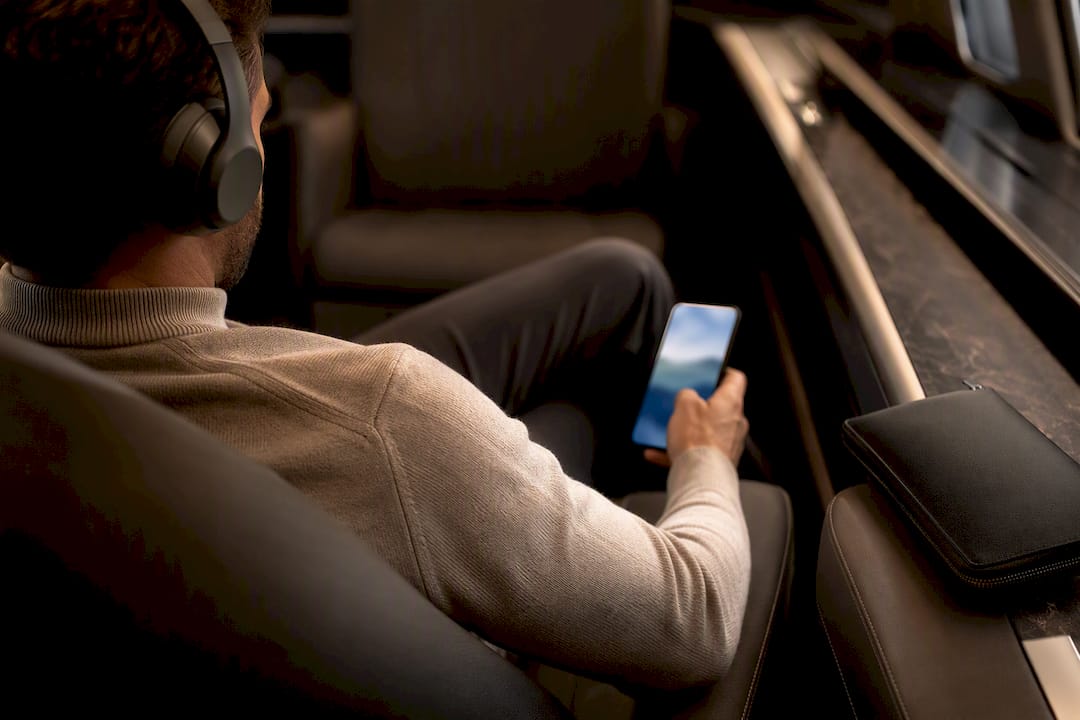
The one rule with real legal and security weight involves the tail number. Posting a photo or video that shows the aircraft's registration in real time lets anyone with a flight-tracking app follow the plane's exact route, because tail numbers are public identifiers that registries and tracking tools use to trace ownership and movement. This isn't a theoretical concern. High-profile cases involving tracked private aircraft have shown how quickly a single geotagged photo can expose a traveller's location to strangers.
A few habits keep you and your fellow passengers protected:
- Wait until after landing, or better, until well after the trip, before posting cabin photos.
- Never caption a photo with the departure or arrival airport in real time.
- Ask before photographing other passengers, even casually.
- Confirm Wi-Fi and device needs with your broker beforehand so you're not testing connectivity mid-flight.
Cabin acoustics carry further than people expect, too. Even a quiet, modern jet transmits conversation across the whole cabin, so sensitive discussions deserve the same discretion you'd use in any small, shared space. The crew retains final authority over device use and cabin conduct exactly as they do over safety matters generally, so if a flight attendant asks you to lower your volume or pause a call, that's not a suggestion.
Catering, alcohol, and tipping norms
Order your catering ahead of time and pick food that survives a flight intact. Experienced fliers often source meals from a trusted local restaurant or a premium grocer rather than defaulting to standard FBO catering, which tends to be pricier and less memorable. If you have allergies or dietary restrictions, disclose them at booking. There's no kitchen to improvise from at 40,000 feet.
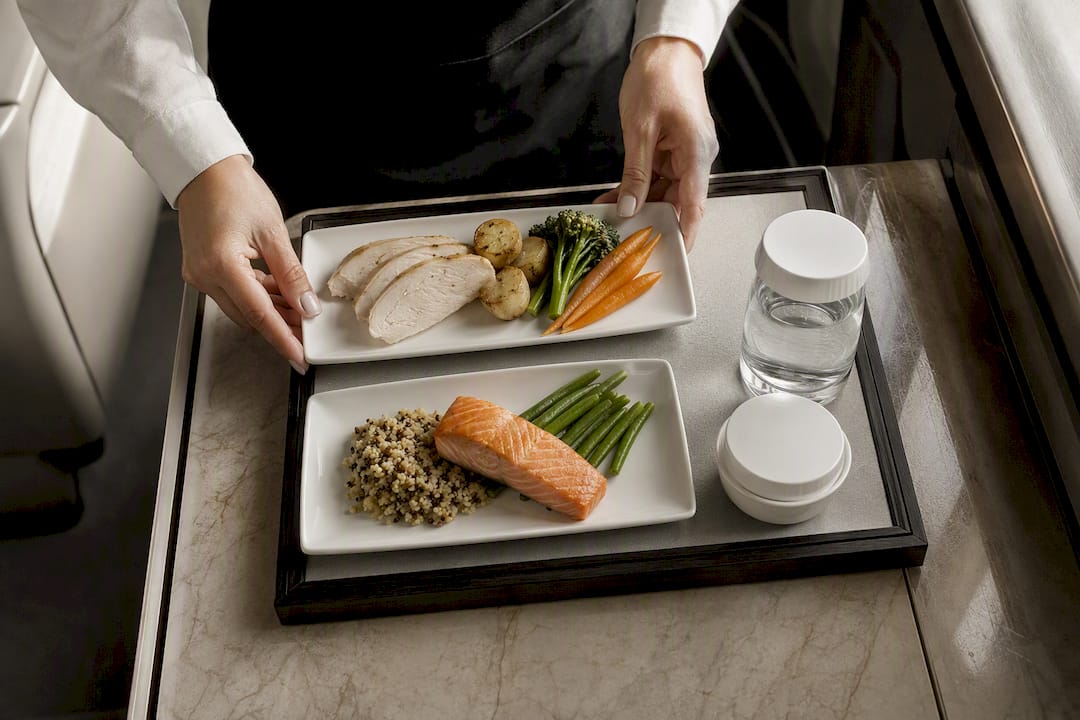
Keep alcohol consumption moderate. A private cabin feels relaxed, but crew are still responsible for passenger safety, and intoxication onboard can force the captain to make decisions you won't enjoy.
On tipping, there's no fixed rule. Charter etiquette treats gratuity as optional and dependent on region and operator policy. If you want to acknowledge good service:
- A cash gratuity is appreciated but never expected.
- A specific, genuine thank-you to the crew goes a long way.
- Positive feedback to the operator afterward can matter more than cash, since it affects that crew's standing.
Small habits that make departures smooth
The details that separate a polished traveller from a nervous one are almost always small. On short flights, use the FBO's bathroom before boarding rather than the aircraft's lavatory. Smaller jets have compact lavatory space not built for extended use, and if you do need it onboard, leave it exactly as tidy as you found it.
Follow this sequence to keep things moving:
- Let ground handlers and crew load and unload hold luggage. Don't touch bags that aren't your carry-on unless a crew member asks you to.
- After landing, gather your belongings quickly so the aircraft can be prepped for its next departure.
- Follow customs or immigration instructions exactly as given, even if they seem redundant on a private flight.
Pro Tip: If you're travelling with a pet or young children, pack a small kit with absorbent pads and wipes. Cabins are compact, and being prepared for a spill or an accident keeps the experience comfortable for everyone aboard.
Smoking is prohibited on virtually every private charter cabin in operation today, regardless of aircraft size or route length. If you smoke, plan around ground stops or expect to wait until you land.
The Veil Concierge perspective on jet etiquette
Most etiquette breaches we see aren't about bad manners. They're about missing information. A guest doesn't know the reporting time changed, a pet's paperwork wasn't filed for a border crossing, or catering never got confirmed with the FBO. That's where coordination, not etiquette coaching, actually prevents the awkward moment.
A concierge handles the operational layer behind a private flight: confirming reporting times directly with the FBO, building accurate manifests, pre-clearing catering orders, and managing pet documentation for cross-border trips. A concierge who confirms these details ahead of time removes the single most common disruption to a private trip: a late arrival or an undeclared item that stalls departure. Schedule changes and cross-border pet paperwork can be coordinated on tight timelines quietly, without the traveller ever seeing the friction behind the scenes.
For readers arranging their own trip, our private charter coordination and luxury transportation services exist to handle exactly this kind of detail.
— Veil
How Veil Concierge takes the guesswork out of flying private
You've just read what to get right on your own. Concierge services exist for travellers who'd rather have someone confirm details in advance instead of double-checking every detail themselves the night before a flight.

We coordinate the operational side of a private flight from start to finish: confirming reporting times directly with the FBO, building manifests with accurate names and luggage details, pre-clearing catering, and handling pet documentation for cross-border legs. Every request runs through a vetted network of local operators in Vancouver, the Lower Mainland, and Whistler, so the same team that books your flight can also arrange the ground transfer waiting for you on arrival. If your event or catering needs stretch beyond the aircraft itself, our event planning team can source it the same way.
Ready to remove the guesswork from your next trip? Book a private charter through Veilconcierge and have every detail confirmed before you set foot on the tarmac.
Sources
- Private Jet Etiquette - Canadian Private Aviation
- Unwritten rules for private jet travel (Travel + Leisure)
- Private jet etiquette: FBO, crew & tipping guide | Flyius
- Private jet etiquette: what to do (Observer)