
Private aviation sorts into six standard tiers plus one specialized niche: very light, light, midsize, super-midsize, heavy, ultra-long-range, and executive airliners. The selection rule that matters most is simple: choose the smallest category that carries your group, reaches your destination nonstop, and can land at your airport of choice. Everything else, including cabin comfort and cost, is a tie-breaker.
TL;DR:
- Very light jets are ideal for short regional trips with up to 7 passengers and a range of about 825 to 1,550 nautical miles.
- Cost per hour varies from around €2,600 for very light jets to €16,000 for ultra-long-range aircraft, depending on size and range.
- Selecting the correct jet depends primarily on passenger count, nonstop range, runway length, cabin needs, and budget constraints.
- Long-range jets feature advanced cabin technology, such as lower cabin altitude, to reduce fatigue on intercontinental flights.
- Veil Concierge offers end-to-end planning, including aircraft selection, ground transfers, customs, catering, and logistics, for seamless private travel.
Table of Contents
- Types of private jets, seat by seat and mile by mile
- How to pick the right jet category for your trip
- How Veil Concierge manages the category decision for clients
- What actually matters when you're choosing between jets
- Booking the right aircraft, without doing the legwork yourself
- Sources
Types of private jets, seat by seat and mile by mile
Aircraft categories exist because missions differ, not because manufacturers wanted more marketing labels. The industry's standard framework groups jets by cabin size, seat count, and how far they'll fly without stopping for fuel. Treat the ranges below as a working guide rather than a rigid rulebook. Manufacturers and brokers sometimes blur the lines between tiers, and the smartest buyers and charterers look at their actual trip requirements first.
Very light jets seat 4 to 7 passengers and fly roughly 825 to 1,550 nautical miles, according to The Flying Engineer's classification guide. Think short regional hops: a same-day meeting two states over, a weekend at a lake house that has no commercial service nearby. They're the most fuel-efficient category and often the only jet that can use a shorter regional runway.
Light jets step up to 6 to 11 seats and 800 to 2,165 nautical miles. This tier is the workhorse of North American business travel. It handles most domestic city pairs with room for a small team and enough range to skip a fuel stop on trips that would otherwise require one.
Midsize jets introduce a stand-up cabin, meaning passengers can walk the aisle without ducking. Seating runs 6 to 9, and range extends to roughly 1,500 to 3,340 nautical miles, enough for coast-to-coast domestic runs or short international hops into the Caribbean or parts of Europe from eastern gateways.
Super-midsize jets carry 8 to 12 passengers and reach nearly 4,000 nautical miles, putting most transcontinental routes within nonstop range. Many brokers consider this tier the value sweet spot: enough cabin and range for serious business travel without the premium of a heavy jet.
Heavy jets seat 8 to 19 and cover 1,746 to 6,000 nautical miles. Multi-zone cabins let passengers separate for work calls, meals, or rest, which matters on longer intercontinental legs where a group isn't doing the same thing for six hours straight.
Ultra-long-range jets are the flagship tier: 12 to 19 seats and up to roughly 8,200 nautical miles, enough for nonstop routes connecting nearly any two cities on Earth. This is where cabin technology earns its keep. Aircraft like the Gulfstream G700 advertise lower cabin altitude and multi-zone interiors specifically to reduce fatigue on long-haul legs, and newer engine designs deliver meaningful fuel-efficiency gains over previous generations.
Executive airliners, sometimes called bizliners, sit outside the standard six-tier system. These are converted commercial airframes reworked for 20 to 100-plus passengers, and they're chosen when group size or a bespoke interior layout outgrows even a heavy jet's cabin. Large delegations, extended family groups, or clients who want a private suite, conference space, and crew rest area in one aircraft fall into this category.
Turboprops and helicopters aren't part of this jet taxonomy, but they remain the right call for very short hops or landing at airfields that can't accommodate any jet at all.
Cost tracks range and cabin size fairly predictably. Representative European charter bands for 2026 put very light jets around €2,600 to €3,600 per hour, climbing through midsize and super-midsize tiers, up to €12,000 to €16,000 per hour for ultra-long-range aircraft. Treat these as illustrative bands rather than a Canadian quote. Actual pricing depends on operator, positioning costs, and route.
Runway access deserves its own line of thinking. A heavy jet that seats your entire board might be unable to land at the regional airport closest to your destination, forcing a longer ground transfer that erases the time you saved by flying private in the first place.
How to pick the right jet category for your trip
Work through this checklist before you call an operator or a concierge:
- Count passengers, including anyone joining last minute, and add realistic luggage volume, especially for ski trips or golf equipment.
- Confirm nonstop range between your actual departure and arrival airports, not just city-to-city distance.
- Check runway length at both ends of the trip against the aircraft's performance chart, not just its general capability.
- Decide cabin needs: does the group need to work separately, or is everyone travelling together for the same meeting?
- Set a budget band and compare it against the category's typical hourly rate, not the aircraft's sticker price if you're chartering.
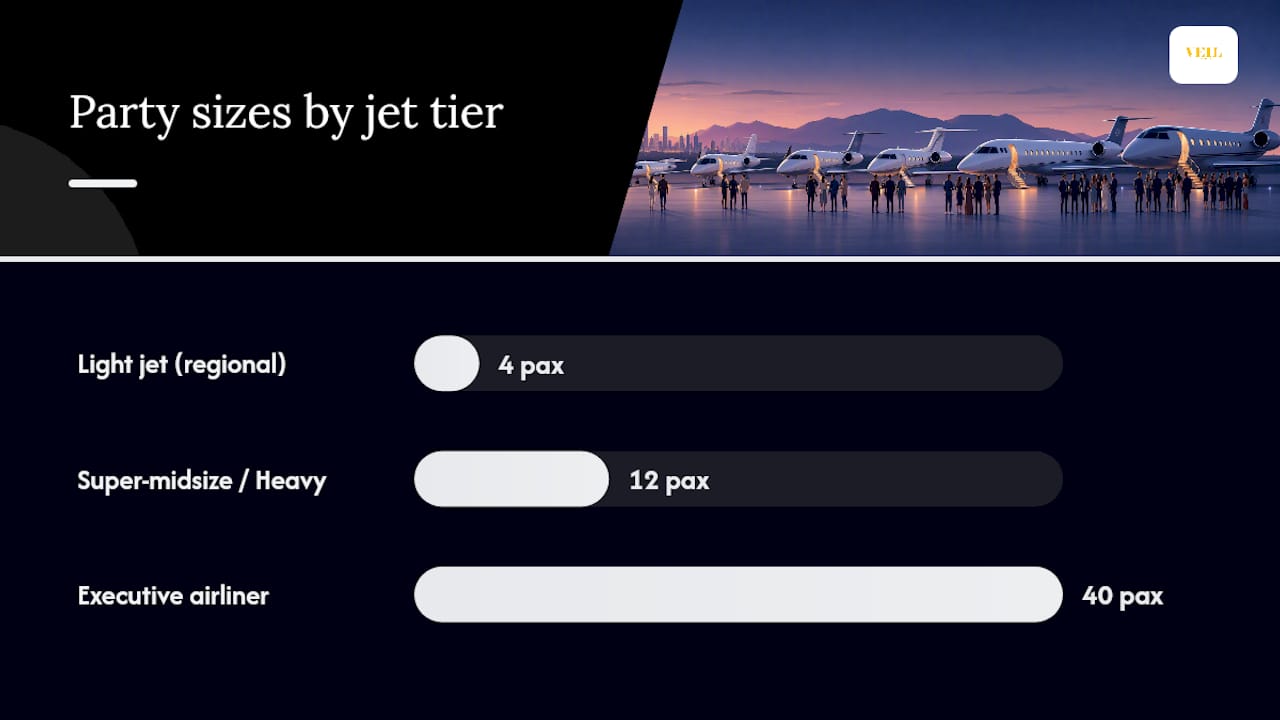
Three quick scenarios show how this plays out. A four-person team flying Toronto to a small regional airport for a same-day deal closes with a light jet. A twelve-person family heading to Europe for three weeks needs a super-midsize or heavy jet with real transatlantic range. A forty-person corporate retreat to a resort with limited jet access likely needs an executive airliner or a coordinated multi-aircraft charter.
When you're speaking with a broker or operator, ask directly about payload limits at full passenger count, alternate airports if weather closes your first choice, and whether the quoted aircraft has flown that exact route before.
Pro Tip: Always cross-check runway length and elevation at your destination against the aircraft's actual performance charts, not its general spec sheet. A jet rated for 5,000 feet of runway at sea level often needs considerably more at a high-altitude or hot-weather airport, and that gap has grounded more trips than any mechanical issue.
How Veil Concierge manages the category decision for clients
Choosing a jet category is only half the job. Turning it into a confirmed, discreet departure is the other half, and it's where most self-managed bookings run into friction.
Veilconcierge assesses mission-fit against passenger count, range, and airport suitability before recommending an aircraft, then coordinates everything downstream of that decision:
- Ground transfers timed to wheels-down, not a general arrival window
- Customs and border clearance coordination for international legs
- Catering aligned to dietary needs and departure time
- Vendor coordination with the operator, fixed-base facility, and crew
For a client relocating a family of six to a coastal property with a restricted runway, that means confirming aircraft performance at the destination airfield before a single seat gets booked.
What actually matters when you're choosing between jets
Cabin altitude deserves more weight than most buyers give it. A cabin held near 3,000 feet keeps passengers sharper and less fatigued on long legs, which matters if you're working en route. Fuel-efficient engine technology is becoming a real differentiator, not a footnote. Mission-fit still comes first: the right category is the one built for your actual trip, not the biggest one available.
— Veil
Booking the right aircraft, without doing the legwork yourself
Once you know the category that fits your trip, the harder part is confirming aircraft availability, vetting the operator, and coordinating everything from catering to ground transfer, without spending your week on phone calls. Veilconcierge exists for exactly that gap: one point of contact who handles mission-fit analysis, operator vetting, and logistics from departure to arrival, so you're not juggling brokers, caterers, and chauffeurs on your own.

Clients engaging Veilconcierge for a private charter can expect discreet, door-to-door coordination: aircraft selection matched to passenger count and destination runway, ground transportation arranged through Veilconcierge's luxury transportation service, and a single call if plans change. For larger delegations that push toward executive-airliner territory, Veilconcierge's event planning team coordinates multi-aircraft logistics and group travel. High-profile travellers with privacy concerns around trip disclosure often also work with specialized legal counsel to keep sensitive arrangements confidential. Clients who charter regularly can join Veilconcierge's membership program for ongoing access to preferred aircraft and priority scheduling. Reach out to Veilconcierge today to confirm availability for your next trip.
Sources
- Private jet types: Complete guide (2026) | The Flying Engineer
- 6 Types of private jets compared (2026 rates) | Flyius
- Gulfstream G700 | Gulfstream