
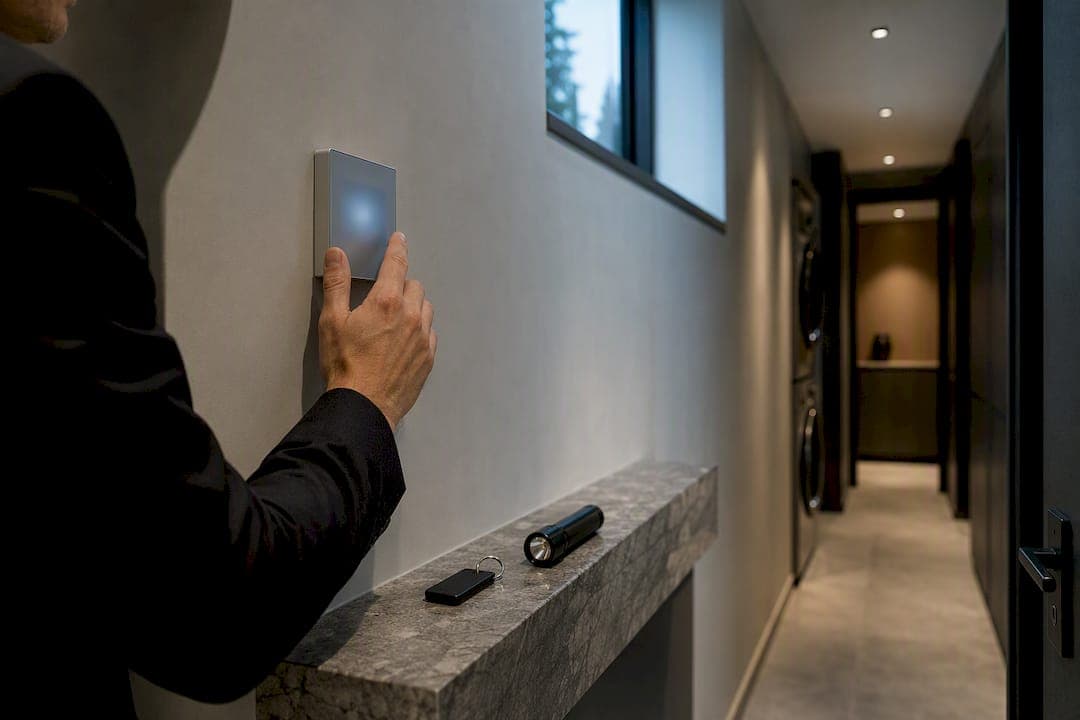
Smart home monitoring for a luxury or second home means retained, in-person concierge oversight: scheduled residence checks, vendor coordination, and a coordinated response when something goes wrong. It is not an electronic alarm subscription. For affluent owners with second homes or seasonal residences, the correct move is to retain a concierge who centralises visit logs and vendor management under one accountable contact.
TL;DR:
- Regular documentation of visits, including timestamped photos and logs, is essential to satisfy both insurance and tax requirements and should be retained for at least six years.
- Visitation frequency must adapt to the property's occupancy pattern, with weekly checks for occupied homes, every three days during winter, and immediate notification if vacant over 30 days.
- Concierge oversight should include vetting providers with verified local networks, insurance proof, strict access controls, and clear escalation procedures to manage high-value properties effectively.
- Electronic sensors serve as an early warning but require human verification; pairing them with a trusted concierge ensures appropriate response to alerts.
- Costs vary based on scope, with membership-style plans offering year-round coverage and project-based arrangements suited for specific short-term needs, but lower quotes often exclude critical supervision or emergency response features.
Table of Contents
- What does in-person concierge monitoring actually cover?
- What do insurers and the CRA expect from a vacant or second home?
- How often should a concierge check on your property?
- How do you choose the right concierge for property oversight?
- How do electronic monitoring systems compare to concierge oversight?
- What does concierge property oversight cost?
- What does installation and setup actually involve for a monitored property?
- How is your property data kept private?
- How does concierge oversight fit with a smart home setup?
- What support and response times should you expect?
- Veil Concierge perspective: why centralised oversight matters
- Property oversight built for how you actually live between visits
- Primary sources for owners and advisors
- Sources
- FAQ
What does in-person concierge monitoring actually cover?
Concierge oversight replaces the guesswork of asking a neighbour to "check on the place" with a documented, repeatable process. Each visit follows a defined scope, and each finding gets logged with a timestamp and photo, so there's a record if an insurer or a family member asks what happened and when.
A properly run monitoring arrangement typically includes:
- Scheduled residence checks covering interior rooms, exterior grounds, and mechanical systems (furnace, water heater, sump pump), each documented with photos and a written log entry.
- Mail and package management, including collection, forwarding, and secure storage, which also prevents an empty mailbox from signalling a vacant home to passersby.
- Arrival and departure preparation: airing out the residence, adjusting climate controls, restocking essentials, and confirming systems are ready before the owner lands.
- Vehicle checks for cars stored on-site, including battery maintenance and tire condition.
- Vendor coordination and supervised access, where a concierge meets contractors on-site, confirms the scope of work, and signs off before payment.
- Incident triage, which sorts problems into three tiers: minor issues handled on the spot, situations requiring emergency vendor dispatch, and events serious enough to escalate directly to the owner.
Uncoordinated maintenance is one of the most common ways luxury homes sustain preventable damage. When multiple trades show up without supervision, work gets duplicated, security gaps open, and nobody is accountable for what actually happened on-site, a pattern luxury property management research identifies as a leading driver of avoidable loss in high-value homes.
Pro Tip: Ask your concierge to timestamp every photo automatically rather than relying on manual notes. A dated image of a thermostat reading or a locked side gate is far more persuasive to an insurer than a verbal assurance months later.
What do insurers and the CRA expect from a vacant or second home?
Insurance and tax exposure are the two areas where "I'll check on it when I can" turns expensive fast. Both systems reward documentation and penalize gaps.
On the insurance side, Insurance Bureau of Canada guidance draws a hard line between an insured peril and a maintenance failure. A burst pipe caused by a sudden mechanical fault is often covered. The same burst pipe, traced back to weeks of nobody checking the thermostat during a cold spell, tends to get classified as a maintenance issue insurers won't pay for. Most policies also require notification once a property sits unoccupied past 30 days, and insurers frequently specify visit frequency during winter, sometimes as often as every three days, to keep coverage intact.
On the tax side, owners of Canadian residential property must determine their filing obligations under the federal Underused Housing Tax. Many second-home owners qualify for a vacation-property exemption, but qualifying is not automatic: a return must be filed to claim it, generally supported by at least 28 days of personal use during the year.
- Insurers want proof of regular, dated attention, not a promise that someone drops by "occasionally."
- CRA wants a filed return plus evidence, such as calendar records or visit logs, showing personal use.
- Both want records kept for years, not weeks.
Documented concierge visits solve both problems at once. A dated log with photos gives an insurer contemporaneous proof that the home was checked on a schedule, and gives an owner's UHT filing supporting evidence beyond a verbal claim. CRA advises retaining records for six years to support Underused Housing Tax filings, which lines up neatly with how long a good concierge service should be keeping its visit archive.
How often should a concierge check on your property?
A monitoring schedule should shift with the season and the property's occupancy pattern, not run on a single fixed interval year-round. Here is a workable framework built around insurer expectations and practical risk:
- Confirm the occupancy scenario. Is the home occupied part-time, closed for the season, winterised, or sitting vacant for an extended stretch? Each scenario carries a different risk profile.
- Set the visit cadence. Occupied-but-unattended homes generally warrant weekly checks. Seasonal closures during winter often call for checks every three days, matching common insurer requirements for cold-weather vacancy. Extended vacancies of a month or longer should trigger insurer notification regardless of season.
- Walk the interior. Check indoor temperature, confirm the furnace and water heater are running normally, look for signs of leaks around appliances and under sinks, and note the state of any smart thermostats or humidity readers.
- Walk the exterior. Inspect the roofline, gutters, exterior doors and windows, gates, and any signs of attempted entry or storm damage.
- Photograph everything relevant. A dated photo of the thermostat display, the furnace panel, and each entry point creates the kind of home inventory record insurance guidance recommends for reducing claim friction.
- Log the visit immediately. Record the date, time, name of the person who attended, and a summary of findings, good or bad.
- Escalate anything abnormal. A minor issue (a dripping tap) gets handled on the spot. A failed furnace in January gets an emergency vendor dispatched same-day, with the owner notified regardless of the hour.
- Retain the log. Keep records for at least six years to align with CRA's recommended retention window for UHT-related documentation.
Pro Tip: If your property sits empty for more than 30 days, notify your insurer before the vacancy starts, not after something goes wrong. Insurers are far more accommodating about coverage terms when they're told in advance.
How do you choose the right concierge for property oversight?
The gap between a reliable concierge and a risky one usually shows up in the interview, not the invoice. Ask direct questions before signing anything.
Look for a provider with:
- A verified local network of insured, licensed tradespeople, not a rotating cast of whoever answered the phone first.
- Proof of their own liability insurance, separate from any coverage on your home.
- A track record of supervising contractor access rather than simply handing over a key.
- A standardised logging and reporting system, ideally with photos and timestamps delivered after every visit.
- Verifiable references from other property owners, particularly other second-home or luxury-property clients.
During the interview, ask what happens at 2 a.m. if a pipe bursts. Ask how they decide when a repair needs your sign-off versus when they'll authorize it directly. Ask how quickly they can get a certified inspector on-site if a serious issue is suspected. CAHPI maintains a national certification and inspector directory worth referencing if your concierge doesn't already have a trusted inspector on call.
Before signing, confirm the contract specifies visit cadence, the scope of what's inspected, liability terms, who is authorized to access the property, and confidentiality provisions. A provider who is vague about escalation procedures, unwilling to share references, or reluctant to put visit frequency in writing is not equipped to manage a high-value residence.
How do electronic monitoring systems compare to concierge oversight?
Electronic systems, cameras, door sensors, leak detectors, and 24/7 alarm monitoring, solve a narrower problem than most owners assume. They detect an event and send an alert. They do not walk the property, verify a contractor's work, collect a package left on the porch, or judge whether a running dishwasher hose is a false alarm or a real leak in progress.
The most effective setups for high-value homes treat electronic sensors as an early-warning layer that feeds information to a human who can act on it. A water sensor that texts an alert at 3 a.m. is only useful if someone with keys and judgment can respond. Some owners run both: connected devices for continuous detection between visits, paired with concierge oversight for physical verification, vendor supervision, and the judgment calls a sensor can't make. Resources on smart home privacy and device coordination are useful reading if you're weighing which sensors are worth adding to a property that already has in-person oversight in place. The point isn't choosing one over the other. It's recognizing that a sensor network without a person to respond to it is an alert system with nobody listening.
What does concierge property oversight cost?
Pricing for concierge-based monitoring generally follows one of two structures: a retained membership covering ongoing property oversight alongside other lifestyle services, or a scoped, project-based arrangement for a defined set of visits and vendor coordination.
Retained arrangements tend to suit owners who want year-round predictability, particularly those managing a second home from a distance. A membership-style structure bundles property checks with related services like arrival preparation, vendor supervision, and travel coordination, so the same trusted contact who checks your furnace in January can also arrange your chef for a weekend in July.
Project-based pricing suits an owner who needs coverage for a specific window, such as a three-month winter closure or a period of travel, without committing to a longer retainer. Costs in either model typically scale with visit frequency, the complexity of vendor coordination required, and whether emergency response availability is included outside standard hours.
What should factor into any comparison is what's excluded from a low quote. A bargain rate that doesn't include photo logging, contractor supervision, or after-hours emergency dispatch isn't actually comparable to a full-scope offering, it's a stripped-down version that shifts risk back onto the owner.
What does installation and setup actually involve for a monitored property?
"Setup" in a concierge context looks different from bolting a camera to a doorframe. It starts with an onboarding walkthrough where the concierge documents the property's baseline: existing mechanical systems, entry points, known maintenance issues, and any specific instructions for climate control or security.
That walkthrough produces the reference file every future visit gets checked against. It typically includes a full photo inventory of the interior and exterior, a list of emergency contacts and authorized vendors, and instructions covering anything unusual about the property, a wine cellar with specific humidity needs, a boathouse, and a security gate code.

Setup also means establishing communication protocols before the first scheduled visit: how findings get reported, what triggers an immediate call versus a routine log entry, and who besides the owner is authorized to receive updates or approve emergency spending. Owners preparing a property for the first time, especially one that's newly purchased or newly vacant, often benefit from a dedicated setup service that gets these systems and instructions in place before ongoing monitoring begins.
How is your property data kept private?
Concierge oversight generates a meaningful paper trail: photos of interiors, access codes, vendor invoices, visit schedules that reveal when a home sits empty. That information needs handling with the same discretion an owner would expect from private banking or legal counsel.
A trustworthy provider limits who can view visit logs and photos to a small, named team, rather than routing everything through a shared inbox or a generic app account. Access codes and alarm codes should be stored separately from visit reports, never bundled into a single document that would expose both the property's schedule and the means to enter it if that document were ever compromised.
Confidentiality also extends to the fact of the arrangement itself. Owners of high-value second homes often prefer that vendors, and even neighbours, not know precisely when the property is unoccupied. A concierge who talks openly about a client's travel schedule or vacancy pattern, even innocently, is a liability regardless of how well they perform the physical checks. This is worth raising directly during the vetting conversation covered earlier: ask specifically who has access to your visit records and how long that data is retained.
How does concierge oversight fit with a smart home setup?
Most luxury properties already carry some electronic infrastructure: a smart thermostat, connected door locks, maybe a leak sensor under the kitchen sink. Concierge oversight doesn't replace those systems. It gives them a human backstop.
An alert from a connected device is only as useful as the response behind it. A smart thermostat reporting an unusual temperature drop still needs someone to physically confirm whether the furnace failed, a breaker tripped, or a window was left open. A concierge visit is the natural point to check that connected systems are reporting correctly, batteries in wireless sensors haven't died, and the Wi-Fi network they depend on hasn't dropped, all things that happen quietly and go unnoticed for months in an unattended home.
Where a property has an existing smart ecosystem, it's worth briefing your concierge on how to check it during a routine visit rather than treating the two as separate, unconnected systems. A five-minute review of the thermostat app and lock history, folded into the regular walkthrough, turns a passive alert system into an actively verified one.
What support and response times should you expect?
The value of any monitoring arrangement collapses the moment something goes wrong and nobody picks up. Before committing to a provider, get specific commitments in writing on response time, not general assurances.
A reasonable service level agreement should specify how quickly a concierge responds to an alert or a reported issue during business hours versus overnight, what counts as an emergency versus a routine matter, and who the backup contact is if the primary concierge is unreachable. It should also state how visit reports are delivered, whether that's same-day, within 24 hours, or on a fixed weekly schedule, so an owner knows exactly when to expect an update and can flag it immediately if one is late.
Ask what happens if a contractor no-shows or a repair runs over budget. A provider without a clear answer for either scenario is likely to leave you managing the problem yourself from a distance, which defeats the purpose of retaining oversight in the first place.
Veil Concierge perspective: why centralised oversight matters
Most damage to unattended luxury homes doesn't come from a single dramatic event. It comes from small gaps compounding, a missed vendor call-back, an unlogged visit, a contractor left unsupervised, until an insurer looks at the claim and sees a maintenance failure rather than a covered loss.
A concierge service exists to close those gaps by acting as the one accountable point of contact who organises vendors, supervises access, and documents every visit with the kind of contemporaneous record insurers and tax authorities both look for. That centralisation is the actual value, not the individual check itself, but the fact that every check, every vendor visit, and every finding lands in one accountable file instead of scattered across texts and half-remembered phone calls.
— Veil
Property oversight built for how you actually live between visits
A concierge gives second-home owners something a checklist alone can't: a single trusted contact who supervises the vendors, logs the visits, and makes the judgment calls an owner would make if standing in the driveway. That's the practical advantage over piecing together neighbours, apps, and ad-hoc contractors, one accountable coordinator instead of five disconnected ones.

Veil's Comprehensive Home Management service covers scheduled checks, vendor supervision, and documented reporting for luxury and second homes across the network Veil has vetted directly. Owners preparing a property for the first time can start with Veil Home Setups to establish the baseline records and protocols a monitoring plan depends on. For ongoing coverage bundled with the rest of your lifestyle needs, from chauffeured transportation to private chefs, the GOLD, PLATINUM, and DIAMOND membership packages fold property oversight into a single retained relationship. If you want to know exactly what a monitoring plan for your property would look like, reach out through Veil's Vancouver concierge services page to start the conversation.
Primary sources for owners and advisors
For UHT filing obligations and the vacation-property exemption, refer directly to CRA's exemption guidance, which sets out the personal-use threshold and filing requirement. For insurance expectations on unoccupied and seasonal homes, Insurance Bureau of Canada publishes the clearest guidance on notification thresholds and winter check frequency. For technical inspections, CAHPI maintains national certification standards and a directory of qualified inspectors worth consulting before hiring anyone to assess a property's mechanical condition.
Sources
- Canada
- Does my insurance cover damage caused by extreme cold? — IBC
- What is covered when I go on a March Break vacation? — IBC
- Canadian Association of Home & Property Inspectors (CAHPI)
FAQ
What is concierge smart home monitoring, exactly?
It's retained, in-person oversight of a residence, scheduled checks, vendor coordination, mail handling, and coordinated response to issues, rather than an electronic alarm subscription. Veil Concierge structures this as documented visits with photo logs and defined escalation procedures.
How often should a vacant second home be checked?
Frequency should match the season and vacancy length: weekly for occupied-but-unattended homes, roughly every three days in winter to satisfy typical insurer requirements, and immediate insurer notification for any vacancy stretching past 30 days.
Do I need to file taxes on a second home even if I'm exempt?
Yes. Owners must file an Underused Housing Tax return to claim a vacation-property exemption, generally supported by at least 28 days of personal use during the year. Filing is required even when no tax ends up owing.
Will my insurance cover damage if my home sits empty?
It depends on whether the damage is classified as an insured peril or a maintenance failure. IBC guidance notes that damage traced to a lack of regular checks, such as a frozen pipe during an unmonitored cold spell, is often treated as preventable maintenance rather than a covered loss.
What does Veil Concierge charge for property monitoring?
Pricing for Comprehensive Home Management and membership-based oversight is available directly from Veil Concierge rather than published as a flat rate, since scope varies by property and visit frequency. You can review membership options on the Veil Concierge memberships page.