

Punch list management is the living preventive-maintenance register an estate manager or concierge uses to log inspection findings, assign repairs, and track warranties across a residence. For high-value properties, a common industry standard involves regular visual inspections combined with periodic comprehensive systems checks. Veilconcierge builds its property oversight service around this exact cadence.
TL;DR:
- Punch lists must be systematically organized by category and prioritized to address safety, preservation, and presentation issues effectively.
- Regular weekly visual inspections and monthly system checks are essential, with detailed documentation to track issues and ensure accountability.
- Vendors should be vetted with clear scope agreements, warranties, and supervision, avoiding reliance on verbal commitments and minimizing contractor dependency.
- Automated sensors are helpful but cannot replace physical walk-throughs, which are necessary to catch slow-developing problems and aesthetic issues.
- The success of punch list management depends on continuous ownership, detailed records, and a dedicated oversight point to prevent unresolved issues from accumulating.
Table of Contents
- Why a living punch list matters for luxury homes
- What to include in a concierge punch list and how to structure it
- Inspection cadence, reporting rhythm and verification
- Vendor architecture and quality control for high-end finishes
- Workflows and technology that make punch list management reliable
- Onboarding a property and a starter punch-list template
- How Veilconcierge runs punch list management for high-net-worth clients
- Get your property on a real punch-list schedule
- Why most punch lists fail before the first repair happens
- Sources
Why a living punch list matters for luxury homes
A punch list only earns its keep when it's treated as a working document, not a one-time inspection form filed away after the initial walk-through. Condition-based maintenance protects capital. It catches the $400 fix before it becomes the $40,000 emergency.
High-end residences carry systems that fail expensively and quietly. HVAC drift shows up as a slightly warmer guest wing months before a compressor gives out. A slow leak behind a stone shower surround can ruin custom millwork long before anyone notices water on the floor. Pool equipment left unchecked over a shoulder season corrodes from the inside. Specialty finishes, hand-applied plaster, book-matched stone, integrated smart glass, don't fail all at once; they degrade in ways only a trained eye catches early.
That's where documentation earns its value beyond the repair itself:
- Photo-dated records prove when an issue was first flagged and how quickly it was addressed.
- Written status updates give owners a paper trail for insurance and warranty claims.
- Historical logs reveal recurring problems that point to a design flaw rather than wear and tear.
- Vendor sign-offs create accountability when work doesn't hold up.
Owners who travel frequently or split time between residences rely on this record to know their home is actually being cared for, not just visited.
What to include in a concierge punch list and how to structure it
A well-built punch list is organized by category, not by whichever issue happened to surface last. Comprehensive systems audits that establish baselines for HVAC, security, irrigation, pools, and specialty finishes give the entire list its structure.
Four categories cover most high-value residences:
- Critical systems — HVAC, electrical, plumbing, security, life safety.
- Seasonal items — irrigation startup and shutdown, gutter clearing, generator testing, pool opening and closing.
- Amenities — home theatres, wine storage, gyms, smart-home controls, outdoor kitchens.
- Warranties and documentation — manufacturer warranties, extended service contracts, appliance registrations, vendor certifications.
Each entry on the list should carry the same fields every time, so nothing gets logged inconsistently: location, a short description of the issue, priority level, warranty status, recommended inspection cadence, assigned vendor, current status, dated photos, and the date the item was opened and closed.
Priority follows a strict order. Safety and operational issues, a tripped breaker, a failing sump pump, come first, always. Preservation issues, a hairline crack in stucco, a slow-draining gutter, come second, because they threaten the asset if ignored but aren't urgent today. Presentation issues, a scuff on baseboard trim, a light bulb out in a rarely used room, come last. Confusing these tiers is the most common punch list mistake: an estate manager who treats every item with equal urgency ends up chasing cosmetic fixes while a real risk sits unresolved.
Pro Tip: Colour-code priority tiers on your digital punch list, red for safety, amber for preservation, green for presentation, so a five-second scan tells you exactly what needs attention today versus what can wait for the next scheduled visit.
Inspection cadence, reporting rhythm and verification
The inspection schedule for a high-value residence isn't a matter of preference; it's a baseline. The recognized standard for homes with significant mechanical systems is a weekly visual inspection paired with a monthly systems check, and anything looser leaves too much room for slow-developing problems to go unnoticed.
A weekly visual check should cover:
- Entry points, perimeter security, and signs of attempted access.
- Visible water intrusion, staining, or unusual odours.
- Mail, packages, and general signs of occupancy or disturbance.
- A dated photo log and an access record showing exactly who was on the property and when.
The monthly systems check goes deeper: HVAC filter and refrigerant checks, generator load tests, pool water chemistry and equipment inspection, irrigation controller verification, and battery backup testing on security and smart-home systems. Each system gets a pass or fail threshold, not a vague "looks fine."
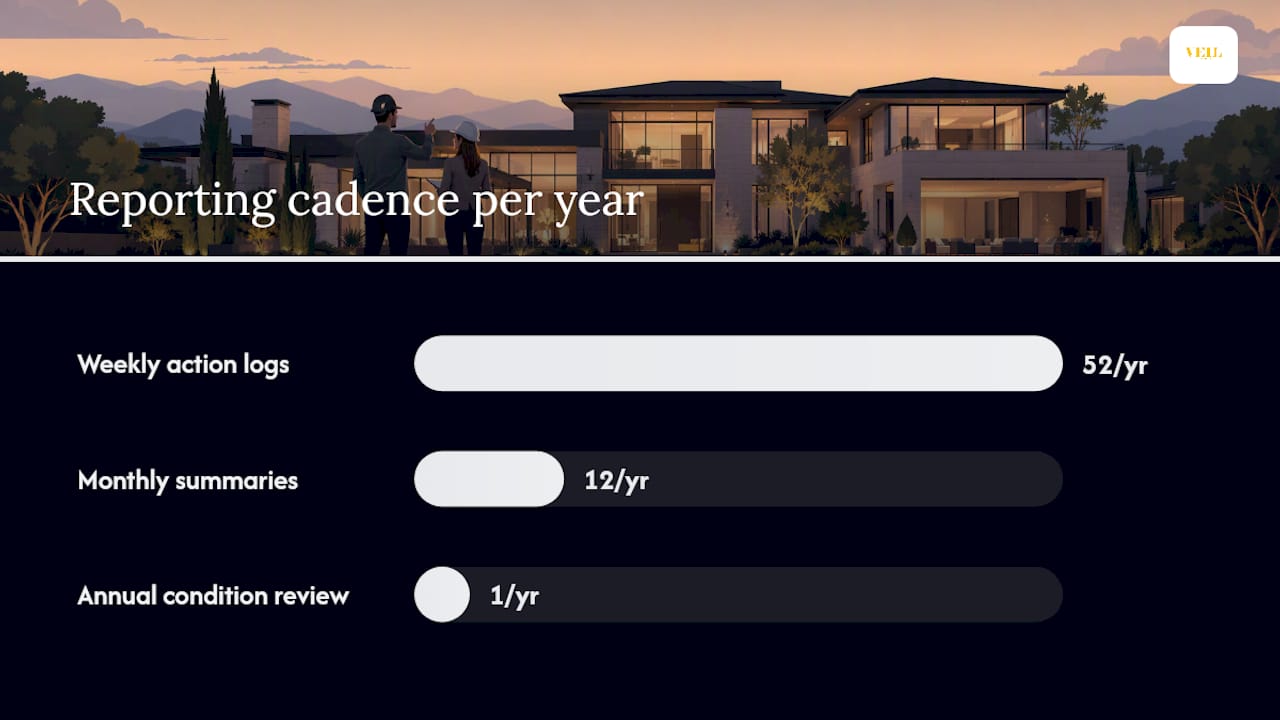
Reporting follows a three-tier rhythm that owners can actually audit: a weekly action log listing what was found and fixed, a monthly summary covering utility trends and system performance, and an annual condition review that assesses the home's overall state against the prior year. Practitioners in estate stewardship treat this cadence as standard, not optional, because it's the only structure that surfaces slow deterioration before it becomes a capital expense. An estate manager's typical deliverables include exactly this: a maintenance calendar, monthly financial reporting, and a documented project pipeline.
Vendor architecture and quality control for high-end finishes
The trades who work on a $50,000 kitchen appliance or a hand-plastered ceiling need to be different from the general handyman roster most property managers rely on. Vendor architecture means building a bench of preferred vendors and craft specialists whose capabilities are verified in advance, not discovered mid-repair.
Supervision is where most property managers cut corners, and where the difference actually shows. A detailed vendor management checklist should govern every trade relationship: written scopes of work before anyone starts, on-site stewardship for sensitive jobs, before-and-after photo documentation, and clear warranty accountability so a callback doesn't become a billing dispute.
Before hiring or renewing any vendor relationship, owners and estate managers should ask a few pointed questions:
- Has this vendor worked on comparable finishes or systems before, with references?
- Does the proposal specify materials, timeline, and a warranty period in writing?
- Who supervises the work while it's happening, and what documentation is delivered at close-out?
Pro Tip: Never accept a verbal scope of work for anything touching a custom finish. If a vendor won't put the scope, materials, and warranty terms in writing before starting, that's a signal to look elsewhere.
Quality control practices built around clear scopes and specialist tradespeople reduce the risk of contractor dependency, especially for owners who aren't in the market full-time to catch problems themselves.
Workflows and technology that make punch list management reliable
Smart-home sensors are useful, but they solve a different problem than physical inspection solves. Sensors catch sudden events, a pipe bursting, a door left open, but they miss the slow stuff: a hairline crack widening, a finish fading unevenly, a hinge wearing loose. That's why physical walk-throughs remain essential even in a fully automated home.
A reliable workflow looks like this:
- Capture the issue on-site with photos and notes, timestamped.
- Assign it to the right vendor immediately, not after a batch review.
- Set an approval threshold so minor repairs proceed without waiting on owner sign-off, while larger ones get flagged.
- Record the close-out with warranty metadata attached, so the next issue on that system starts with full history.
A single living home manual, paired with a warranty calendar, turns this workflow into long-term capital planning instead of a string of unrelated fixes.
Onboarding a property and a starter punch-list template
Bringing a new property under management starts with a full systems audit: collecting warranties and manuals, taking baseline photos of every major finish, vetting vendors, and establishing inspection windows and emergency authority in writing before anyone starts work.
A starter punch list for the first four weekly checks should cover:
- Entry points and security system function.
- Water shutoff valves and visible plumbing points.
- HVAC filter condition.
- Sump pump operation, where applicable.
- Pool water level and equipment status.
- Exterior drainage and gutter flow.
- Irrigation controller settings.
- Generator standby status.
- Major appliance function checks.
- Any custom finish flagged during the baseline audit.
Hand this list to an incoming steward alongside the home manual and set expectations immediately: what gets fixed on sight, what gets escalated, and what gets photographed regardless.
How Veilconcierge runs punch list management for high-net-worth clients
Veilconcierge builds oversight around a single point of contact, so an owner never has to chase five vendors to get one answer. That contact runs the inspection cadence, keeps the living home manual current, and delivers the weekly, monthly, and annual reporting rhythm owners need to audit the work. Membership tiers map directly to how much ongoing punch-list coverage a property requires, from periodic oversight to full-time stewardship.
Get your property on a real punch-list schedule
Everything covered here, the weekly and monthly cadence, the vendor architecture, the documentation an owner can actually audit, is what Veilconcierge runs day to day for residences across the region. Instead of assembling your own inspection schedule and vendor bench from scratch, you get a single point of contact who already has both in place.

Veilconcierge's comprehensive home management service starts with a full systems audit of your property, the same baseline survey covered above, so your punch list begins accurate instead of reactive. For owners who also host or travel frequently, bespoke event planning runs on the same supervision standards, one coordinator, documented vendors, no gaps. If you're ready to see what a properly run punch list looks like for your own residence, request a comprehensive home management review and get a baseline audit scheduled before the next season shift.
Why most punch lists fail before the first repair happens
The conventional advice on punch lists treats them as inspection checklists: walk the property, note what's broken, fix it. That framing misses the actual failure point. Most punch lists don't fail because nobody found the problem. They fail because nobody owned it after it was found.
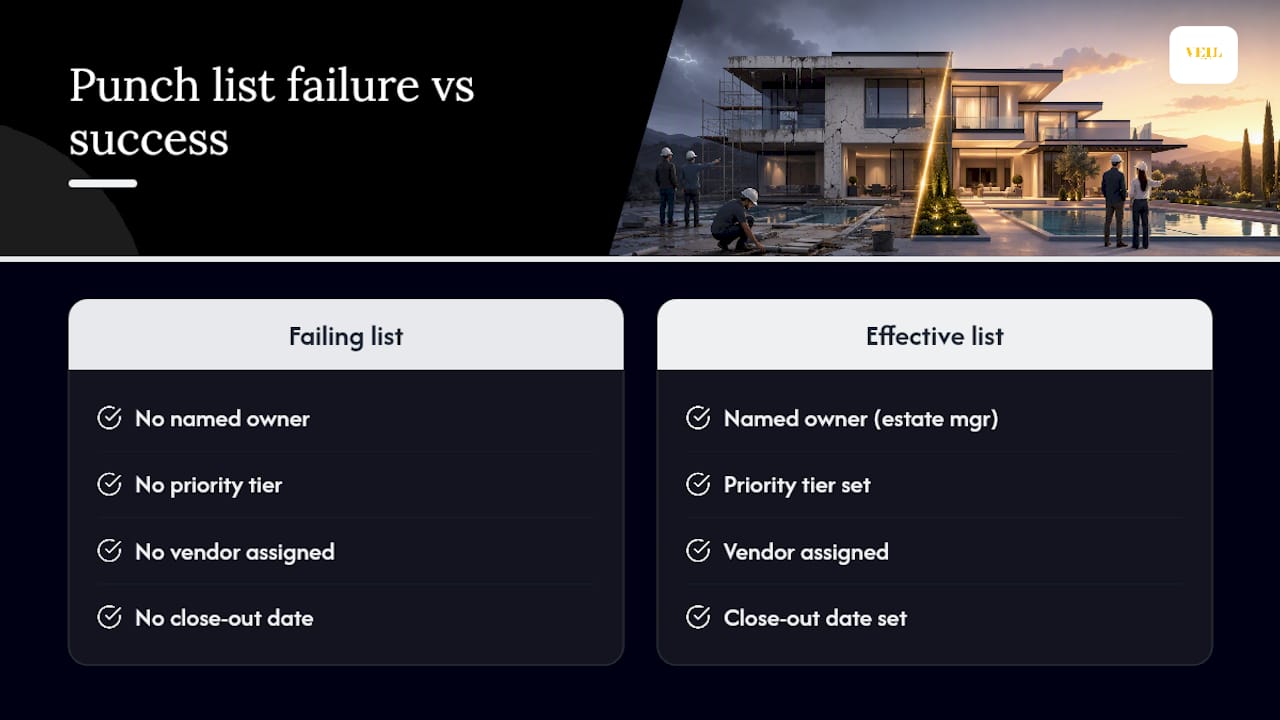
An item logged without a priority tier, a named vendor, and a close-out date isn't a punch list entry. It's a note that will get buried under next week's notes. The owners who get the best results aren't the ones with the fanciest tracking software; they're the ones whose estate manager treats every open item as a debt that accrues interest the longer it sits.
There's also a quieter mistake worth naming: over-trusting automation. Smart-home platforms are genuinely useful for catching sudden failures, but they create a false sense of coverage. An owner who assumes sensors mean fewer physical visits are needed is trading a real risk for a comfortable illusion. The properties that hold their value best are the ones where a trained person still walks the grounds every week, camera in hand, regardless of what the dashboard says.
— Veil
Sources
- Luxury Property Maintenance Preventive Insights - EstateSpace
- Luxury Property Management for International Owners: How to Run a Home You Are Rarely In - LuxuryEstate Journal
- Estate manager: role, salary benchmarks & hiring guide (2026) | Beverly