

Groups of four or more staying a week or longer almost always come out ahead in a villa, both on privacy and on cost per person. Couples, short breaks, and travellers who want a spa, restaurant, and front desk at arm's reach are usually better served by a hotel. Urban stays and wellness-focused trips tend to favour hotels regardless of group size. Read on for the checklist that turns this general rule into a decision for your actual trip.
TL;DR:
- Villas typically become more cost-effective than hotels once a group size reaches four to six guests, especially for stays longer than a week.
- Private villas offer exclusive outdoor spaces and flexible timings, making them ideal for milestone celebrations, multi-generational reunions, or privacy-focused trips.
- Staffed villas with on-call chefs and managers can match or surpass hotel services, but require careful confirmation of support availability and emergency contact details.
- Location plays a key role: urban villas may be less convenient than city hotels, while resort villas offer seclusion but often need a vehicle or transfer service for access.
- A professional concierge simplifies villa logistics and safety arrangements, ensuring seamless booking, transfers, provisioning, and emergency support for a stress-free stay.
Table of Contents
- Luxury villa vs hotel: space, privacy and daily rhythm
- Cost and value: running the per-person math
- Service, logistics and booking terms to check first
- Decision checklist: villa, hotel, or hybrid
- How a concierge closes the gap between villas and hotels
- Security and safety considerations for both stay types
- Who actually books villas versus hotels
- Location and accessibility: proximity vs privacy
- Ambiance: private retreat vs social atmosphere
- Editor perspective: where luxury stays are headed
- Veil Concierge: booking and managing the stay itself
- Sources
- FAQ
Luxury villa vs hotel: space, privacy and daily rhythm
The difference between a villa and a hotel suite isn't just square footage. It's who else is in the building.
A villa gives you a private pool, a full kitchen, gardens, and terraces that belong to your group alone for the length of the stay. Nobody else walks past your breakfast table. Nobody else is booked into the spa slot you wanted at 9 a.m. That exclusivity reshapes the entire rhythm of a trip: meals happen when your group is hungry, not when a restaurant seats you, and a celebration can run past midnight without a neighbour calling down to the front desk.
Hotels trade that private control for infrastructure. A five-star property gives you a restaurant, a spa, a concierge desk, and staff on shift around the clock, which functions as a built-in safety net if something goes wrong with your room or your plans change. As one industry comparison of hotel or villa options frames it, villas deliver exclusive access to outdoor space and uncrowded views, while hotels deliver integrated, predictable services.
The gap between these two experiences narrows considerably when a villa is staffed. A private chef, a housekeeping team, and an on-call concierge can replicate or exceed what a five-star hotel offers, while letting guests set their own timing for meals and cleaning.
Privacy stops being a preference and becomes the priority in a few specific scenarios:
- A milestone celebration where you want the property to yourselves, not shared common areas
- A multi-generational family reunion where different ages need different spaces at different hours
- Any trip where discretion matters more than amenities, such as a high-profile guest avoiding public dining rooms
Cost and value: running the per-person math
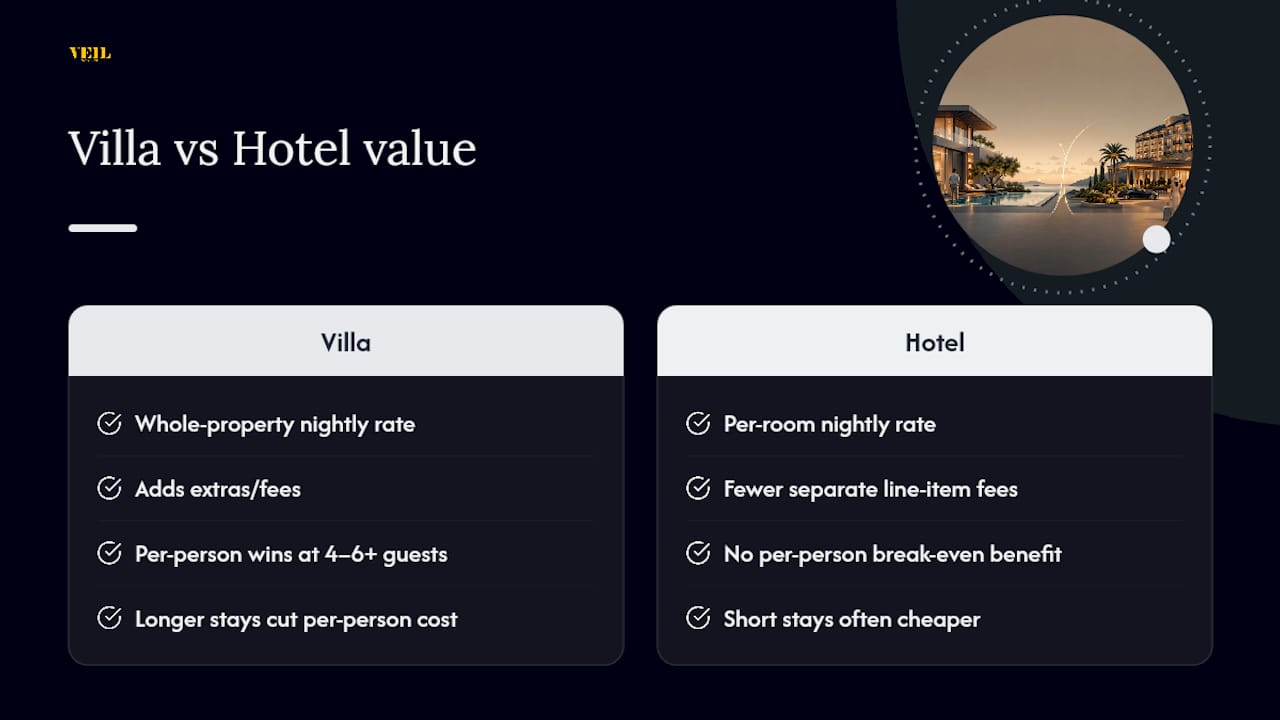
Villa pricing works by property, not by room, which changes the entire cost comparison for a group. A hotel quotes you a nightly rate per room; a villa quotes you a nightly rate for the whole house, plus extras like a management fee, cleaning, provisioning, and sometimes staff gratuities. Add those extras before you compare totals, or the comparison is meaningless.
The break-even signal: analysis of villa-versus-hotel value shows the per-person math typically favours villas once a group reaches roughly four to six guests, with the advantage growing stronger at six or more.
Here's the arithmetic in practice. A four-bedroom villa at a high nightly rate split across a larger group can be less costly per person than multiple hotel suites booked separately; adding fees narrows the margin but villas often remain cost-competitive for bigger groups. It still wins, but the margin shrinks once you count every line item.
That break-even point moves depending on where you're travelling and how you staff the property. Urban villas rarely beat a well-located city hotel on convenience, and hiring a full-time private chef for a short stay adds cost that only pays off across a longer trip or a larger group. Run the numbers for your own group size before assuming either side automatically wins.
Service, logistics and booking terms to check first
Villas vary enormously in what's included, so the fine print matters more than it does with a branded hotel chain. Before you commit, confirm these five items directly with the host or management company:
- Housekeeping frequency — daily, every other day, or only at turnover.
- Staff availability — whether a chef, butler, or property manager is on-site or on call.
- Provisioning policy — whether groceries are stocked before arrival or you're expected to shop.
- Transfers — whether airport pickup and local transport are arranged or left to you.
- Cancellation terms — villas often carry larger deposits and stricter cancellation policies than hotels, so confirm the lead time and refund window in writing.
A branded hotel has a general manager and a full staff on shift. A villa's version of that safety net is a concierge or property management company, and without one, a broken air conditioner or a missing key becomes your problem to solve at 11 p.m. in a country where you don't speak the language. A detailed villa booking checklist recommends confirming exactly who to call for maintenance issues before you sign anything.
Pro Tip: Ask for the property manager's direct emergency line and confirm response hours before you book, not after you arrive. A villa with no answer on a Sunday night is a very different experience from one with 24-hour local support.
Decision checklist: villa, hotel, or hybrid
Run through these questions before you book either option:
- Group size: Four or more travelling together points toward a villa. Two or three points toward a hotel.
- Length of stay: A week or longer strengthens the villa case. A weekend usually favours a hotel.
- Privacy vs built-in services: If you want the property to yourselves, book a villa. If you want a spa, restaurant, and front desk on demand, book a hotel.
- Date flexibility: Rigid, non-refundable dates suit a villa's deposit structure less well than a flexible hotel rate.
- Destination: A city break usually favours a hotel. A resort or coastal escape usually favours a villa.
If your answers split down the middle, look at hotel-branded villas or resort residences. These hybrid products combine a private house with the resort's spa, beach club, and on-call maintenance, and they're often the right call for a first-time villa traveller who wants privacy without losing the safety net. Once you've picked a lane, run the per-head math from the section above and confirm every inclusion before you pay a deposit.
How a concierge closes the gap between villas and hotels
The biggest reason travellers default to hotels isn't preference. It's coordination fatigue. A villa stay involves booking the property, arranging transfers, stocking the kitchen, and lining up staff, and doing all of that from another country is where good intentions fall apart.
Veilconcierge exists to remove that burden. Property oversight, chauffeur and transfer arrangements, private chef bookings, and pre-arrival provisioning are coordinated through one point of contact instead of five separate vendors.
A concierge earns its cost through the details most travellers forget until they're standing in an empty kitchen:
- Scheduling housekeeping and staff shifts around your actual itinerary
- Vetting local suppliers so a private chef or driver isn't a stranger you found online
- Handling arrival preparation so the villa is stocked and ready before you land
Security and safety considerations for both stay types
Hotels have built-in security infrastructure: staffed lobbies, key-card access, cameras, and a general manager accountable for the property around the clock. That structure gives solo travellers and first-time visitors to a destination a predictable baseline of safety without any extra planning.

Villas can match or exceed that baseline, but only when someone actively manages it. A gated, staffed estate with on-site security and a responsive property manager is often safer than a hotel corridor, because access is limited to people you've vetted rather than anyone with a room key on your floor. A standalone rental with no staff and an unfamiliar lock system is the opposite case, and it's where problems tend to surface.
The variable is oversight, not the building type itself. Ask who holds keys to the property, whether the listing includes a working alarm or camera system, and who responds if something goes wrong overnight. For families or executives travelling with dependents, a villa with round-the-clock local support closes most of the gap that makes hotels feel like the "safer" default.
Who actually books villas versus hotels
Villa guests skew toward multi-generational families, groups of friends splitting costs on a milestone trip, and repeat luxury travellers who've already done the five-star hotel circuit and want something more private for their next visit. Length of stay tends to run longer, often a week or more, because the value case for a villa strengthens with time.
Hotel guests skew toward couples, solo business travellers extending a trip for leisure, and anyone prioritizing a short stay where unpacking a full villa kitchen makes no sense. Wellness travellers booking spa-centric itineraries also lean hotel, since the entire point of the trip is an on-site program a villa can't replicate without significant extra staffing.
Neither group is locked into one format forever. A traveller who books a five-star hotel for a three-night city stopover might book a villa for the ten-day family portion of the same trip. Matching the format to the specific leg of a journey, rather than picking one style for an entire itinerary, is where the sharpest travellers land.
Location and accessibility: proximity vs privacy
Hotels win decisively on location convenience in cities. A five-star property in a downtown core puts you steps from restaurants, transit, and attractions, with a doorman who can hail transport in minutes. That proximity is a hotel's strongest structural advantage over a villa.
Villas flip that trade-off in resort and coastal settings. The best properties are often set back from crowds deliberately, on a private beach or hillside with a view a hotel room simply can't offer at any price. The cost of that seclusion is transport: you'll likely need a car, a driver, or a boat to reach restaurants and attractions, which is where arranging reliable chauffeur services or transfers becomes part of the actual budget, not an afterthought.
Neither location profile is universally better. It depends entirely on whether your trip is built around a destination's urban energy or its escape from that energy.
Ambiance: private retreat vs social atmosphere
A villa's atmosphere is shaped entirely by your own group, for better and occasionally for worse. There's no shared lobby, no other guests at breakfast, and no ambient hum of a hotel bar three floors down. For a family reunion or a discreet getaway, that quiet is the entire draw.
A hotel offers the opposite: a social current running through the property, from the lobby bar to the pool deck, where you're surrounded by other travellers even when you're not interacting with them. Some guests find that energizing. Others find it exactly what they're trying to escape on vacation.
This is less a question of quality than of temperament. Groups that get along well and want uninterrupted time together tend to thrive in a villa. Travellers who enjoy people-watching, hotel bars, and the low-stakes social texture of a busy property tend to prefer a hotel, even at the cost of some privacy.
Editor perspective: where luxury stays are headed
Demand keeps tilting toward privacy and longer stays, and hotel groups have noticed. Hybrid products, branded villas attached to resort infrastructure, are the clearest sign of that shift. If you're planning a trip now, book the format that matches this specific journey rather than defaulting to whatever you chose last time.
— Veil
Veil Concierge: booking and managing the stay itself
A concierge service provides an alternative to piecing together a villa trip on your own: one point of contact handles the booking, the transfers, the chef, and the property oversight that otherwise falls to you at 11 p.m. from another time zone.

Our travel booking team sources five-star hotels and private villas and residences through vetted local operators, so you're not gambling on a listing photo. For the villa side specifically, that means arranging chauffeurs and airport transfers, securing a private chef, and coordinating provisioning before you land, all through our concierge services. If the trip includes a milestone celebration, our event planning team can build the on-site experience around it.
If you're weighing a villa against a hotel for an upcoming trip, consult a concierge service to discuss your group size, dates, and destination. They can advise which format fits and handle the coordination so the only thing left for you to do is show up.
Sources
For readers who want to go deeper on the numbers and terms behind this comparison, these sources are worth a look: a value comparison of villa versus hotel stays, a booking guide to holiday homes, and a villa booking checklist covering staffing and cancellation terms in more detail.
- Luxury villa stays versus luxury hotels: a value comparison — A Luxury Travel Blog
- Villa vs hotel: which to book (2026) — Noon Travel
- Hotel or Villa: How to choose — Luxury Escapes
FAQ
Is a villa better than a hotel?
It depends on group size and trip length: villas typically deliver better value and more privacy for groups of four or more staying a week or longer, while hotels suit couples, short stays, and travellers who want spa or restaurant access built in.
What defines a luxury villa?
A luxury villa is a private, standalone property with exclusive amenities such as a private pool, full kitchen, and multiple living areas, sometimes with dedicated staff like a chef or property manager. The defining feature is exclusivity: no shared common areas with other guests, unlike a hotel.
Is it cheaper to get a villa or hotel?
For larger groups, a villa is usually cheaper per person once group size reaches roughly four to six guests or more, especially over a week or longer. For couples or short stays, a hotel room is often the cheaper and simpler option once villa extras like cleaning and management fees are added in.
What are the disadvantages of a villa?
Villas can require larger deposits, stricter cancellation terms, and more advance planning for staffing, provisioning, and transfers than a hotel. They also lack the built-in safety net of on-site staff around the clock unless the property is professionally managed or a concierge service like Veilconcierge coordinates that support.