

Every household employer should run layered checks before anyone steps into the home: identity verification, criminal record searches across every jurisdiction the candidate has lived in, a driving record if they'll drive, and employment references confirmed by phone. Written consent and a standalone disclosure come before you order any of it. The immediate next step is simple: either order the foundational checks yourself through a legitimate screening provider or engage someone who runs this process for a living.
TL;DR:
- Basic background checks should include identity verification, local criminal searches, sex offender registry, and employment verification, especially for roles with access to children or finances.
- Legally, employer must provide a standalone disclosure, obtain signed consent, and keep all documentation secure to comply with federal reporting laws.
- Layered vetting builds in stages from foundational identity and criminal checks to role-specific verifications and digital due diligence, based on access levels.
- Reference checks are more reliable when conducted via phone interviews with behavioral questions, rather than written letters, to better assess future performance.
- Ongoing monitoring and regular rechecks are crucial for high-trust roles, with systematic access control and documentation practices to maintain safety and compliance over time.
Table of Contents
- What household staff background checks actually cover
- How do you legally prepare to run a background check?
- What does layered vetting for household staff actually look like?
- How do you run reference checks that actually reveal something?
- Red flags in a household staff background check
- Ongoing monitoring after you've hired
- Veil's view: vetting scoped to access, not job title
- Verifying international backgrounds for foreign staff
- How to document the background check process securely
- A closing note on treating vetting as routine, not personal
- A managed alternative to running vetting yourself
- Primary sources for household staff vetting
- Sources
- FAQ
What household staff background checks actually cover
A single database pull tells you almost nothing on its own. Reliable household staff background checks stitch together several distinct searches, and each one answers a different question about the person you're about to hand your keys to.
Identity verification and address history confirm the person is who they claim to be and reveal every place they've lived, which matters because criminal records are filed locally, not centrally.
- National criminal database searches flag serious convictions but miss most local and county-level offences.
- County or provincial criminal searches in every jurisdiction the candidate has lived or worked cover what national databases routinely skip.
- Sex offender registry checks are a baseline for any role with access to children.
- Motor vehicle reports (MVR) matter for anyone driving your kids, your car, or you.
- Employment, education, and credential verification confirm the resume matches reality.
Credit or financial checks are appropriate only for roles handling money or valuables, and they carry their own consent rules under fair credit reporting law. "Instant" one-database packages are popular because they're fast, but instant checks are commonly incomplete precisely because they skip the county-level searches where most relevant records actually live.
How do you legally prepare to run a background check?
Before you request any consumer report, you need paperwork in order. Skipping this step doesn't just create legal exposure, it can make an otherwise clean result unusable.
- Provide a standalone written disclosure. This document must state, on its own, that you intend to obtain a background report. It cannot be buried inside an employment application.
- Get signed authorization. The candidate must sign separately, giving explicit consent to the specific checks you plan to run.
- Map the role's access first. Define exactly what the person will touch: your home, your vehicle, your children, your finances, your travel schedule. Vetting depth should follow that map, not the job title.
- Request candidate-provided fingerprint or federal-level summaries when the role warrants it, rather than trying to pull them yourself.
- Retain every signed form and report in a secure file. If a hiring decision is ever questioned, this paperwork is your record of compliance.
Federal consumer-reporting guidance explains why standalone consent exists: it protects the candidate's right to know and dispute what's being pulled, and it protects you from a report obtained improperly.
What does layered vetting for household staff actually look like?
Vetting is a process, not a single transaction. Security practitioners who work with private homes describe it as a layered model built in stages, each one adding depth as access increases.
- Layer 1, foundational: identity trace, national criminal search, sex offender registry. Every candidate gets this, regardless of role.
- Layer 2, local: county or provincial criminal searches for every address on the candidate's history. This is where most missed records actually surface, since local courts don't always feed national systems.
- Layer 3, role-specific: MVR for drivers, professional registry checks for chefs or trained caregivers, credential verification for anyone claiming certifications.
- Layer 4, digital due diligence: a review of public social media and open-source information, limited strictly to what's publicly visible.
An estate manager with keys, alarm codes, and financial visibility needs all four layers. An occasional weekend contractor with no unsupervised access might reasonably stop at Layer 1 and 2.
Pro Tip: Build your vetting checklist around the access list, not the job title. A "part-time nanny" who drives your kids and has a garage code needs the same depth as a full-time employee.
How do you run reference checks that actually reveal something?
Written letters are close to useless for judging future behaviour. Structured phone interviews outperform them because they let you ask follow-up questions a letter can't answer.
- Verify the referee independently. Confirm the person is a real former employer, not a friend using a personal email and a borrowed job title.
- Ask behavioural questions. How did they handle an unexpected emergency? What happened when something went wrong in the home? How did they respond when asked to keep something confidential?
- Triangulate dates and duties. Cross-check employment dates, specific responsibilities, and stated reasons for leaving against what the candidate told you.
- Probe gaps directly. A six-month unexplained gap in a resume isn't automatically disqualifying, but it deserves a direct question, not a shrug.
- Write down what you hear. Capture notes during the call, and flag anything evasive or inconsistent for a second conversation before you make an offer.
Field manuals for household hiring consistently recommend phone verification over written letters for exactly this reason: a letter can be written by anyone, but a live conversation is much harder to fake convincingly.
Red flags in a household staff background check
Not every flag is disqualifying, and treating them all the same way is its own kind of mistake.
- Recent convictions involving theft, violence, or fraud are serious regardless of the role.
- Inconsistent employment dates or unverifiable references suggest the resume doesn't match reality.
- A pattern of short tenures across multiple households can signal reliability problems, or simply a difficult run of employers. Context matters.
- Old, minor offences with no repeat pattern deserve less weight than something recent and relevant to the job.
If you see a serious flag, pause the hiring process before making any final decision. Give the candidate a chance to respond, since fair-treatment and dispute procedures matter here, and get legal advice if the finding is ambiguous. Document your reasoning either way. That written record protects you and treats the candidate fairly.
Ongoing monitoring after you've hired
A clean background check on day one says nothing about year three. Risk in a household context accumulates over time, which is why rechecks and access controls matter as much as the initial screen.
- Schedule annual rechecks for high-trust roles like estate managers, live-in nannies, or anyone with unsupervised financial access.
- Run event-driven checks after a serious incident, even outside the annual schedule.
- Rotate keys, alarm codes, and digital credentials on a regular cycle, and revoke access immediately on termination, not "sometime this week."
- Consider credential or dark-web breach alerts for staff who hold logins to your home systems or accounts.
Practical vetting programs treat annual rechecks and immediate credential revocation as standard operating procedure for high-trust household roles, not an extra precaution.
Pro Tip: Log every recheck date and access change in one file. A simple spreadsheet with dates and outcomes turns "we think we checked" into "here's proof we checked."
Veil's view: vetting scoped to access, not job title
A trusted coordinator can manage background checks matched to actual access, not assumptions. When Veil oversees a property, scheduled residence checks and vendor supervision follow the same layered logic, verified identity, confirmed credentials, monitored access, applied consistently rather than reviewed once and forgotten.
Delegating this work to a trusted coordinator preserves the employer's privacy during a process that otherwise requires collecting sensitive personal information directly. It also removes the administrative burden of tracking rechecks, consent forms, and access logs across multiple staff members and vendors over time.
Verifying international backgrounds for foreign staff
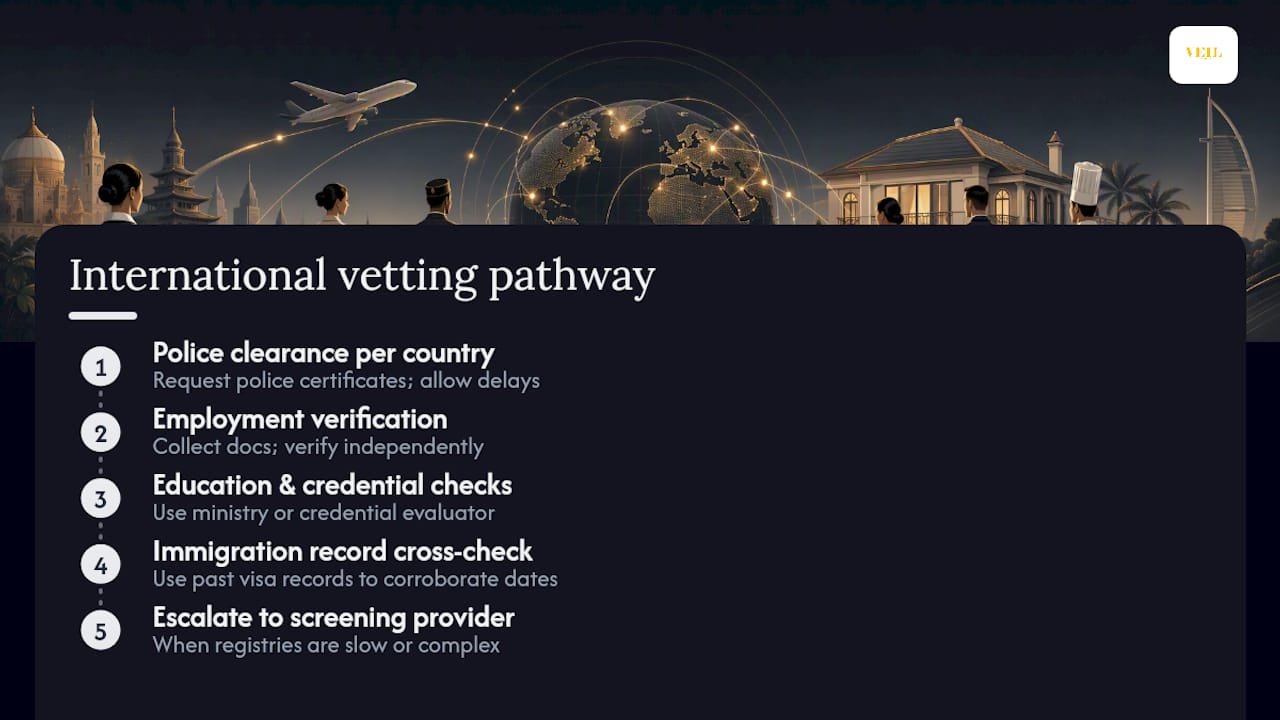
Candidates with work history outside your country need extra steps, since domestic criminal databases generally don't reach foreign jurisdictions. A clean domestic search on someone who spent five years working abroad tells you almost nothing about that period.
Start by requesting the equivalent of a police clearance certificate from every country where the candidate lived or worked for an extended period. Most countries have a national police agency that issues these on request, though processing times vary widely, from a few days to several months, so build that timeline into your hiring plan.
Employment verification gets harder across borders. Foreign employers may not respond to email requests the way domestic ones do, and language barriers complicate reference calls. Where possible, request documentation directly from the candidate, letters of reference, pay stubs, work permits, and verify them independently rather than taking them at face value.
Education and credential verification often requires going through a country's ministry of education or a recognized credential evaluation service, since diplomas and certifications from unfamiliar institutions are difficult to confirm without one.
If the candidate held a work visa in your country previously, immigration records can sometimes corroborate employment history and dates, giving you a domestic cross-check even for foreign-sourced experience. When the paperwork gets complex, a screening provider with international search capability is often worth the added cost. It saves weeks of back-and-forth with foreign registries that don't respond quickly to individual requests.
How to document the background check process securely
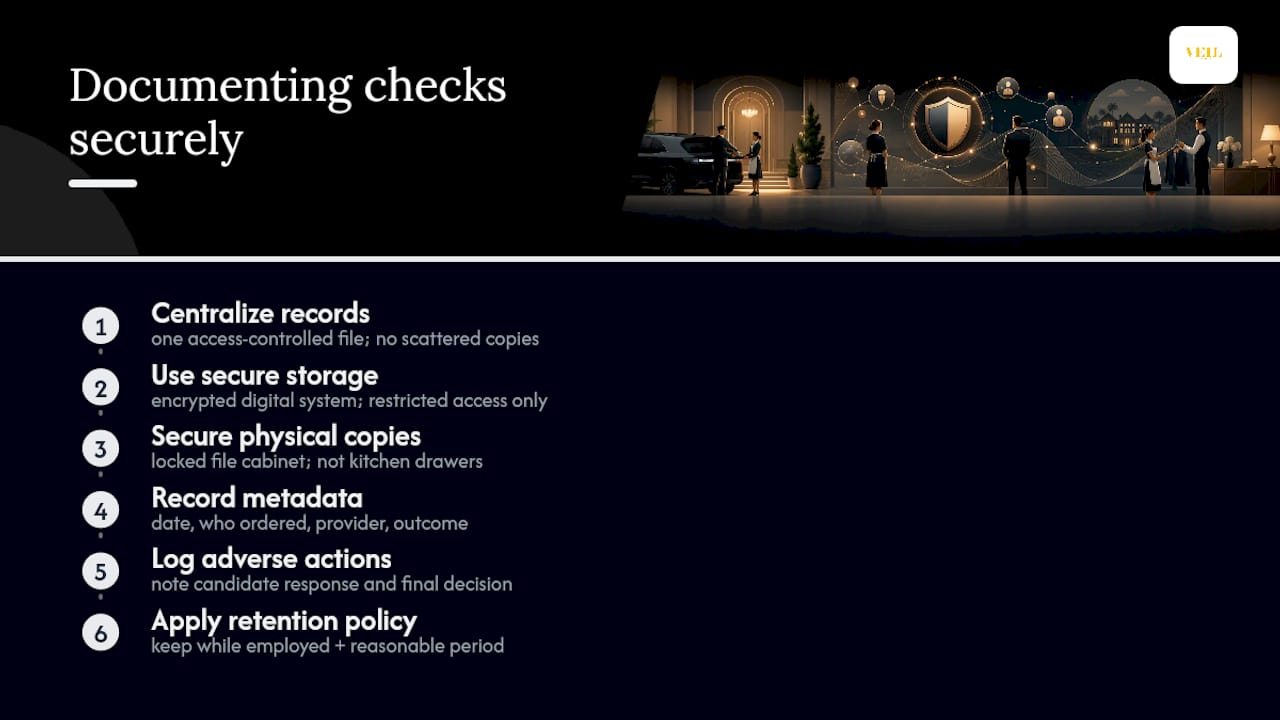
The paperwork trail matters as much as the checks themselves, particularly if a hiring decision is ever questioned later. Every signed disclosure, authorization form, and report result belongs in one secure, access-controlled file, not scattered across email threads and desktop folders.
Store documents in an encrypted digital system with restricted access, ideally limited to whoever in the household or family office actually makes hiring decisions. Physical copies, if you keep them, belong in a locked file, not a kitchen drawer.
Record the date each check was run, who ordered it, which provider conducted it, and the outcome, pass, flag, or pending review. If a report surfaces something adverse, document the steps you took afterward: whether you gave the candidate a chance to respond, what they said, and how you reached your final decision. This record is what protects you if a hiring decision is disputed down the line.
Set a retention period and stick to it. Consumer reporting rules generally expect you to keep authorization records for as long as the person is employed, plus a reasonable period afterward, but delete outdated reports once they're no longer needed rather than letting sensitive files accumulate indefinitely. Fewer files sitting around means less exposure if something is ever lost or accessed improperly.
A closing note on treating vetting as routine, not personal
Good vetting isn't about suspicion. It's about proportion. Match the depth of the check to the access being granted, document what you did and why, and follow the same fair process for everyone. For households juggling multiple staff, vendors, and properties, bringing in professional help to run this consistently is a reasonable choice, not an overreaction.
— Veil
A managed alternative to running vetting yourself
Running layered checks, chasing references, and tracking annual rechecks across several staff members is a real administrative load, and most households don't have the bandwidth to do it consistently. A coordinated concierge service can manage the vetting cadence, vendor supervision, and scheduled residence checks to ensure nothing slips between hiring cycles.

Coordinating contractor supervision and scheduled property oversight across properties can be naturally extended to staff vetting and access rotation, providing a unified approach rather than a bolt-on service. For households managing a primary residence and a second home, or families who simply want one trusted contact instead of five separate vendors, that continuity is the practical advantage over piecing it together internally.
If your household needs a single coordinated approach to staff oversight and property management, start with Veilconcierge's core services to see how vetting logistics fit into a broader oversight plan.
Primary sources for household staff vetting
For readers ready to act, these are the primary references behind the guidance above. Laws around consumer reports, disclosure, and consent vary by province and by country, so confirm local requirements before ordering any check.
- Federal Trade Commission: credit reporting guidance for consumer report obligations and consent standards.
- Hire Performance: background checks in the US vs Canada for jurisdictional differences in available checks.
- Biscayne Strategic Solutions: vetting household staff and vendors for the layered vetting framework.
- Publicrecordcenter for a practical breakdown of what a complete check includes.
Sources
- Background checks in the US vs Canada | Hire Performance
- Vetting household staff & vendors | Biscayne Strategic Solutions
- Publicrecordcenter
- Background checks for household employees: what families should really check | Verify Vetting Solutions
FAQ
What is the most common reason for failing a background check?
Undisclosed or unverifiable criminal history is the most common disqualifying issue, followed closely by employment history that doesn't match what the candidate claimed on their resume.
What disqualifies someone from being a caregiver?
Recent convictions involving violence, theft, fraud, or offences against children are typically disqualifying, along with a documented pattern of dishonesty across multiple references.
What are red flags in a background check?
Inconsistent employment dates, unverifiable references, recent convictions relevant to the role, and a pattern of short tenures across several households are the clearest warning signs.
What things will show up on a household staff background check?
A layered check can surface criminal records across every jurisdiction lived in, sex offender registry matches, driving violations, and discrepancies between claimed and verified employment or education history.
Can Veilconcierge help coordinate household staff vetting?
Veilconcierge coordinates background check logistics and ongoing property and vendor oversight as part of its broader concierge services, giving households one point of contact instead of managing multiple providers directly.