

A professional home provisioning checklist turns a dormant residence into a lived-in home before the owner ever crosses the threshold. Done properly, it delivers fresh linens, a stocked pantry, commissioned HVAC and pool systems, and photo-verified proof that everything works. A luxury concierge company builds this on a 30-day runway, because the alternative is discovering a broken system on the day it matters most.
TL;DR:
- Booking core vendors such as HVAC, pool, pest control, and deep cleaning at least 30 days before arrival ensures preferred providers are available and prevents last-minute rush costs.
- System commissioning and staging should be completed two to four weeks prior, with a 48-hour buffer before the owner's arrival to accommodate any delays or unexpected issues.
- Perishable groceries should be delivered within 24 to 48 hours of arrival, while nonperishable staples are stockpiled during the earlier provisioning phase.
- Verification of readiness relies on timestamped photos, detailed handover notes, and remote walkthroughs to confirm all systems, staging, and safety checks are complete.
- Coordinating all vendors and documentation through a single project lead reduces scheduling conflicts and ensures seamless, repeatable provisioning aligned with the owner’s preferences.
Table of Contents
- What does a home provisioning checklist actually cover?
- What's the ideal timeline for pre-arrival provisioning?
- Room-by-room provisioning: what goes where
- Systems and safety checks that prevent day-one failures
- Why a residence manual makes provisioning repeatable
- Coordinating vendors, COIs, and community clearance
- How is a finished setup verified before the owner arrives?
- How do you manage inventory and restocking between visits?
- What should the emergency contact protocol include?
- Are there eco-friendly options for home provisioning?
- What should you budget for provisioning services?
- Why single-point coordination changes the outcome
- Ready to hand off your next arrival to a professional team?
- Sources
- FAQ
What does a home provisioning checklist actually cover?
A concierge-grade checklist has four moving parts: vendor coordination, provisioning, staging, and verification. Vendor coordination means booking HVAC technicians, pool companies, pest control, and deep cleaners far enough ahead that you get your preferred provider rather than whoever answers the phone that week. Provisioning covers everything that goes into cupboards, closets, and the garage. Staging is the difference between a house that looks stocked and one that feels occupied. Verification is the proof layer, documented and timestamped, that confirms the work happened.
The 30-day window exists because peak-season booking pressure is real. Homes with tight windows before arrival often force owners to accept whichever technician is available rather than a preferred vendor, according to one pre-arrival commissioning protocol used by seasonal concierge teams. The core vendors that need this lead time include:
- HVAC servicing and filter replacement
- Pool or spa chemistry restoration
- Pest control and seasonal treatment
- Deep cleaning crews
- Generator and backup power testing
Wait until the two-week mark to start calling, and you have already lost the negotiating position that makes a smooth arrival possible.
What's the ideal timeline for pre-arrival provisioning?
A structured sequence beats a scramble. An estate opening checklist built around vendor sequencing, systems commissioning, and staging is standard across professional property oversight, and it should start two to four weeks before the owner's expected arrival, at minimum. A luxury concierge service runs a four-stage version of it:
- Day 30 to 14: Book and confirm HVAC, pool, pest control, and deep cleaning appointments in writing. Collect vendor certificates of insurance now, not later.
- Day 14 to 7: Commission mechanical systems, complete the deep clean, launder or replace linens, and order nonperishable pantry staples.
- Day 7 to 1: Schedule perishable grocery delivery, complete staging touches, refresh smart-home settings, and run photo checks on every room.
- Day 1 and arrival: Final walkthrough, scene-setting (lighting, temperature, music if applicable), a printed handover note, and client sign-off.
High-net-worth seasonal installs typically run on a four to eight week booking window, with full-service jobs, linens, pantry, wine cellar audits, art rehanging, often needing two to three dedicated on-site days under a single coordinating project lead.
Pro Tip: Build in a 48-hour buffer between your final vendor visit and arrival day. It absorbs the one delay that always happens, without pushing into the owner's actual arrival window.
Room-by-room provisioning: what goes where
Systems and paperwork matter, but the felt experience of arrival comes down to what's on the counter and in the closet.
Kitchen and pantry. Deep clean every surface and appliance interior, then stock nonperishable staples (oils, coffee, tea, spices) during the 14-to-7-day window. Perishables, milk, eggs, produce, fresh bread, should land within 24 to 48 hours of arrival, timed so nothing wilts before the first meal. If the owner has a signature coffee order or a specific tea brand, that detail belongs in the pantry, not guessed at.
Bedrooms and linens. Every bed gets fresh or freshly laundered linens matched to the owner's pillow firmness and duvet weight preferences. Closets should have basics ready: hangers, a spare robe, extra blankets in the top shelf.

Bathrooms and toiletries. Stock preferred toiletry brands at the levels the owner actually uses, not a generic hotel amenity set. Prescription pickups, when requested, get handled with the same discretion as everything else on the property.
Entry and arrival touches. Fresh flowers on the console table, bottled water in the fridge, a short welcome note. Small, but it's the first thing a tired traveller notices.
Vehicles. If a car is part of the property, confirm it's fuelled or charged, cleaned, and ready, with valet or chauffeur logistics confirmed a day ahead.
Systems and safety checks that prevent day-one failures
Provisioning is only half the job. The mechanical layer has to work, and it has to work quietly, without the owner ever knowing there was a problem to fix.
- HVAC: Replace filters and run the system for 48 to 72 hours before arrival rather than flipping it on cold, since staggering the temperature change over that window helps manage humidity and avoids coil sweating.
- Pool or spa: Test and rebalance chemistry early. If algae or imbalance has set in, recovery can take several days, which is exactly why this sits in the 30-day window, not the 7-day one.
- Water systems: Run hot water lines, check for leaks, and load-test the generator along with battery and charging systems.
- Safety: Test smoke and carbon monoxide detectors, run a pest sweep, and check for moisture or mould in crawl spaces and bathrooms.
- Smart-home: Verify lock codes, confirm cameras are online, and run through every lighting or climate "scene" before the owner arrives.
Real-time, date-stamped photo documentation of these checks is now treated as a baseline expectation in professional property oversight, not an add-on.
Why a residence manual makes provisioning repeatable
A one-time stock-up is useful. A documented system that repeats itself every season is what actually protects the owner's time. A residence manual acting as a single source of truth, appliance manuals, warranty records, shutoff valve locations, smart-home scene settings, materially reduces errors and lets any concierge or estate manager replicate exact preferences without re-asking the owner every time, according to one luxury condo house manager's checklist.
Pair that with a living profile covering food and wine preferences, floral choices, pillow firmness, preferred scents, and any medical or dietary notes. Provisioned homes should feel personally lived-in rather than staged like a showroom, which is exactly what a good living profile makes possible. Inventory photography rounds this out: it protects high-value items with a documented pre-service condition record and speeds up every future provisioning cycle. Storing this digitally, in a format similar to a secure digital estate vault, keeps warranty and appliance records accessible without a filing cabinet.
Coordinating vendors, COIs, and community clearance
Booking early only works if the paperwork keeps pace. Core vendors, HVAC, pool, pest control, deep cleaning, need written confirmation, not a verbal agreement that evaporates during peak season.
- Collect certificates of insurance from every vendor before they set foot on the property.
- In gated communities or HOAs, guardhouse clearance and COI submission are often required 72 hours before vendor access, and missing that window can delay work on install day, per white-glove seasonal install practices.
- Confirm exact vendor arrival windows in writing so nobody shows up to a locked gate.
Pro Tip: Assign one project lead to the entire vendor stack. A single point of contact for scheduling, billing, and liability eliminates the double-booking and miscommunication that tends to happen when four vendors are each coordinating separately.
How is a finished setup verified before the owner arrives?
Verification is what separates "we think it's ready" from "we know it's ready."
- Date-stamped photos or short video captures of key systems (thermostat readings, pool chemistry strips, pantry shelves) delivered through a secure portal.
- A printed handover note left in a visible spot summarizing exactly what was completed and flagging anything still outstanding.
- A live remote video walkthrough for owners still travelling, giving them real-time sign-off before they've even landed.
A staged day-before routine, HVAC switched to the occupied schedule, fresh flowers placed, refrigerator stocked, and a written report left on the counter is standard for professional pre-arrival preparation, and it's the step that makes the arrival feel effortless instead of assembled at the last minute.
How do you manage inventory and restocking between visits?
Provisioning doesn't end when the owner walks in. Consumables, coffee, toiletries, cleaning supplies, pantry staples, deplete on a schedule, and the smart approach treats that schedule as data rather than guesswork.
A basic inventory list tracks quantity on hand, typical consumption rate, and reorder point for each category. Concierges often treat the first 48 hours of occupancy as a "starter kit" window: the essentials arrive first (coffee, breakfast basics, toiletries), and a full-house inventory audit follows once the owner has settled in, rather than trying to stock everything at once and risk overload on arrival day.
For a seasonal or secondary residence, restocking protocols matter even more, because nobody is there day-to-day to notice the coffee is running low. Set a reorder threshold (say, when a category drops to a two-week supply) and have the concierge or property manager place the order automatically rather than waiting for a request. Perishables need their own rule: order close to arrival, never weeks ahead, and confirm delivery windows against the actual arrival date so nothing spoils in an empty fridge.
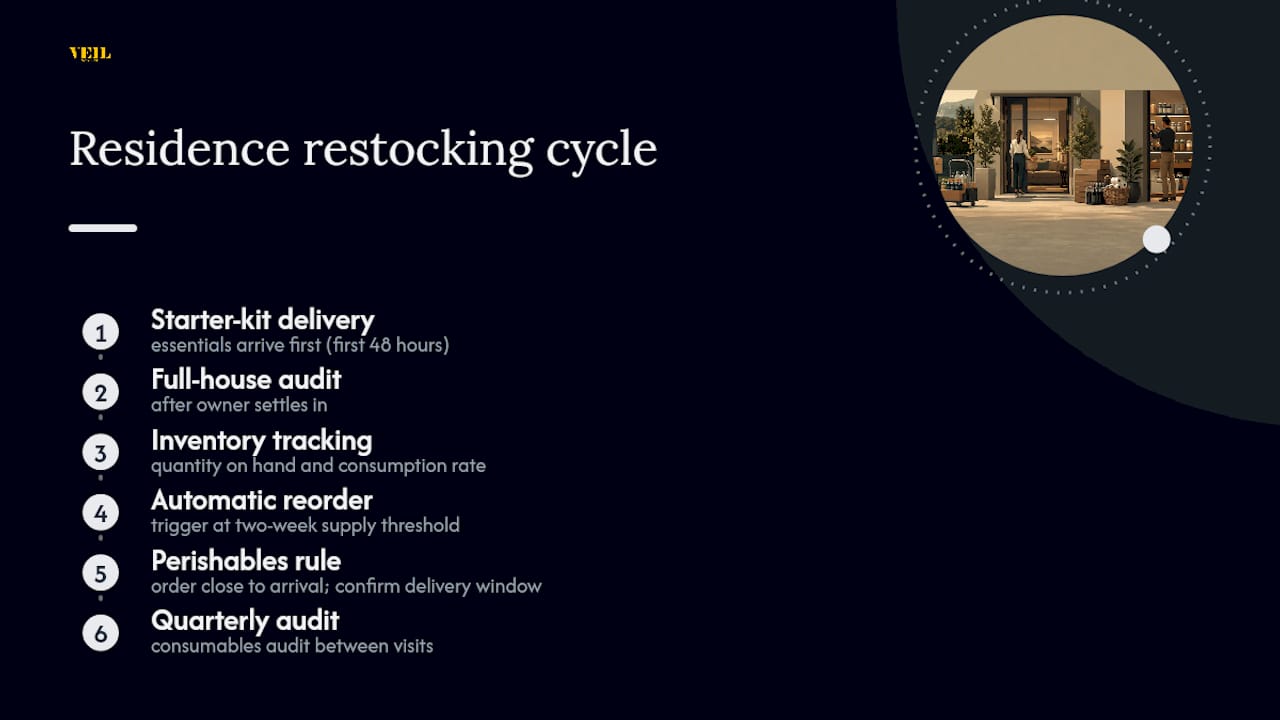
Between visits, a quarterly consumables audit, cross-checked against the residence manual, catches slow leaks: the sunscreen nobody replaced, the light bulbs that burned out unnoticed, the cleaning supplies that ran dry in March and stayed that way until June.
What should the emergency contact protocol include?
A residence sitting empty for weeks between visits needs a documented emergency chain, not a scramble through old text messages when a pipe bursts.
The list should include, at minimum: the property manager or concierge lead, the HVAC and plumbing vendors already on file, a licensed electrician, local emergency services, the property's insurance provider and policy number, and a neighbour or trusted local contact who can grant physical access if needed. Every contact should be reachable by phone, not just email, and the list itself should live in more than one place, taped inside a utility closet and stored digitally with the residence manual.
Protocols matter as much as the list itself. Who has authority to approve emergency repair spending without waiting for owner sign-off? What's the threshold, a burst pipe versus a flickering light, that triggers an immediate call versus a routine note in the next update? A clear answer to both questions, documented in advance, is what keeps a minor issue from becoming a five-figure repair bill discovered three weeks later.
For homes with alarm or smart-home monitoring, confirm the monitoring company has current contact information and knows who is authorized to respond. An alert that goes to a disconnected number defeats the entire point of the system.
Are there eco-friendly options for home provisioning?
Sustainable provisioning isn't a separate checklist bolted onto the main one. It's a series of substitutions inside the existing process.
On the cleaning side, requesting non-toxic, biodegradable products from the deep-cleaning vendor costs little and matters for homes with children, pets, or chemical sensitivities. Pantry stocking can favour local and seasonal suppliers over imported staples where the owner has no strong brand preference, which also tends to mean fresher perishables with a shorter supply chain.
Systems commissioning offers real sustainability leverage. A properly serviced HVAC system, filters changed, coils clean, runs more efficiently than a neglected one, which matters more for a property occupied only part of the year, where inefficiency compounds during long vacant stretches. Smart-home scenes that schedule lighting and climate to actual occupancy, rather than running full systems on an empty house, cut both cost and waste.
Water-conscious pool chemistry management reduces the volume of chemicals discharged during backwashing, and low-flow fixtures installed during a routine plumbing check reduce consumption without the owner noticing any difference in performance. None of this requires trading comfort for conscience. It requires building the preference into the residence manual once, so every future provisioning cycle defaults to it automatically.
What should you budget for provisioning services?
Cost expectations vary with property size, service scope, and how much of the 30-day sequence is outsourced versus handled by an existing housekeeper or property manager. Full-scope seasonal installs, vendor coordination, systems commissioning, provisioning, and staging together, commonly involve several days of dedicated on-site work under a single project lead, which is where most of the labour cost sits.
Three categories drive the budget: vendor services (HVAC, pool, pest, deep cleaning), consumables (pantry, toiletries, linens if replacement is needed rather than laundering), and coordination or management fees for the concierge or property manager running the sequence. Vendor cost examples and commissioning budgets are often published directly by concierge operators and service providers, which is a useful place to check current ranges before committing to a scope.
The variable that swings a budget most is lead time. Booking inside the two-week mark, rather than the recommended 30 days, often means paying rush rates or accepting a less-preferred vendor at standard rates, neither of which is a good trade for the owner. Building the budget around the full 30-day sequence, with contingency for one unexpected repair, tends to be more predictable than trying to compress the same scope into a shorter window and hoping nothing goes wrong.
Why single-point coordination changes the outcome
Professional concierge services typically run provisioning through one coordinating lead rather than a patchwork of separately managed vendors, because that structure is what actually prevents the scheduling conflicts that derail arrival dates. Vendor stacks, COI collection, and community clearance all move through a single accountable contact, which keeps the entire 30-day sequence moving without the owner having to manage five different phone calls.
The living profile is where the difference becomes visible. Documented preferences, pillow firmness, floral choices, pantry staples, paired with timestamped photo verification, let a concierge recreate the exact feel of a residence on arrival day, every season, without re-asking. That combination of documentation and discreet execution is what separates a stocked house from one that genuinely feels lived-in.
Ready to hand off your next arrival to a professional team?
Veil Concierge is the alternative to piecing together HVAC technicians, cleaners, and grocery deliveries yourself from another province, or worse, hoping a part-time caretaker catches every detail. Our home setups service runs the full 30-day sequence: vendor booking and COI collection, systems commissioning, room-by-room provisioning, and photo-verified handover, all coordinated through one point of contact instead of five separate ones.

Engagement starts with a short consultation to scope your residence, your preferences, and your arrival date, followed by an estimate and a locked vendor calendar. If your home also needs ongoing oversight between visits, our property oversight services extend the same living-profile approach year-round. Submit your residence brief or book a walkthrough now through our main services page to lock in vendor slots before your next arrival window closes.
Sources
Estate opening protocols, seasonal commissioning sequences, HNW install standards, and luxury property management research informed this guide.
- Estate opening checklist
- The Snowbird October Arrival Protocol for Scottsdale Luxury Homes (2026)
- HNW white-glove seasonal install
- Luxury property management: the secret ingredient to effortless second-home
FAQ
How far in advance should home provisioning start?
Begin at least 30 days before arrival, since core vendors like HVAC, pool, and pest control often need that lead time to secure preferred providers rather than whoever is available on short notice.
What's included in a residence manual?
A residence manual documents appliance manuals, warranty records, shutoff valve locations, and smart-home scene settings, acting as a single reference an estate manager or concierge like Veil Concierge can use to replicate owner preferences every season.
Do provisioning services include grocery shopping?
Yes. Pantry staples are typically ordered during the 14-to-7-day window, while perishables like produce and dairy are timed to arrive within 24 to 48 hours of the owner's arrival.
How is provisioning verified before the owner arrives?
Through date-stamped photos or short videos of completed work sent via a secure portal, plus a printed handover note and, for travelling owners, an optional live remote walkthrough.
What happens if a vendor is booked too close to arrival?
Booking inside two weeks often means accepting whichever technician is available rather than a preferred vendor, and can push costs toward rush rates, which is why the 30-day window matters.