

A home emergency plan for a luxury residence is a documented Disaster Recovery Plan (DRP) combined with delegated authority that lets your concierge act the moment something goes wrong. A luxury concierge can build and operate this plan for you, coordinating vendors, insurance, and recovery around the clock. Services like home setup and maintenance keep the property continuously ready to execute the plan.
TL;DR:
- The emergency plan should include pre-authorized spending limits high enough for mitigation but not full restoration costs, to enable quick responses.
- Response protocols must be clear, with a hotline that logs, validates, and dispatches vendors instantly, backed by documented response times for insurance claims.
- Regular drills, vendor credential checks, and property inspections are essential to keep the plan effective and up-to-date over time.
- Most failures stem from lack of authority, not missing details, so owners must explicitly define the concierge's spending and vendor approval powers.
- A comprehensive plan combines digital and physical copies, with a vetting process managed by a concierge service to ensure swift, authoritative action during emergencies.
Table of Contents
- What goes into a concierge-managed home emergency plan?
- Negotiating authority and spending controls with your concierge
- How a 24/7 activation and communication protocol should work
- Keeping the plan current through drills and reviews
- How a luxury concierge service builds and runs your emergency plan
- What actually separates a working plan from a paper one
- Getting Veilconcierge to design your plan
- Sources
What goes into a concierge-managed home emergency plan?
A proper DRP is not a laminated card in a kitchen drawer. It is a working document your concierge maintains, updates, and executes on your behalf, built around the same principles restoration professionals recommend for high-value properties: named contacts, mapped shut-off points, and a sequence of actions that anyone on the team can follow under pressure.
The strongest plans share a consistent structure. Yours should include:
- A stakeholder contact roster covering you, your insurer, key trades, and household staff, with roles clearly assigned.
- Site diagrams showing water, gas, and electrical shut-off locations, alarm panel access, and safe zones within the property.
- A prioritized sequence for protecting valuable contents before, during, and after an event.
- A pre-vetted vendor roster with response time commitments and transparent pricing agreed upon in advance.
- Insurance contact details and documentation standards, including photographic and digital records taken before any incident.
- Continuity provisions covering alternate accommodation and uninterrupted household services if the residence becomes uninhabitable.
Each element earns its place because it removes a decision that would otherwise have to be made from scratch, mid-crisis. A concierge who already knows where the main water shut-off sits doesn't waste twenty minutes searching for it during a burst pipe at 2 a.m.
Negotiating authority and spending controls with your concierge
A plan only works if someone can act on it without waiting for your signature from another continent. That means putting real authority into the management agreement, not just good intentions.
Three contractual elements make the difference between a plan that responds and one that stalls:
- Pre-authorized emergency spending thresholds. Your agreement should specify a dollar figure your concierge can commit without contacting you first, covering emergency mitigation like water extraction, board-up services, or temporary power.
- Pre-event response agreements with vendors. These lock in priority response and clear pricing before an emergency happens, so no one negotiates rates while your basement floods.
- Financial reporting and reconciliation rules. Every dollar spent under delegated authority should generate a receipt, a brief note on the decision made, and prompt notification to you.
Luxury property management guidance recommends that the management agreement explicitly define emergency repair authority alongside routine maintenance budgets and vendor approval processes, rather than leaving these questions implied.
Pro Tip: Set your spending threshold high enough to cover mitigation, not full restoration. That keeps fast decisions while major repair costs still come back to you for approval.
The threshold itself deserves scrutiny. Set it too low, and your concierge waits on you during a burst pipe; set it too high without reporting requirements, and you lose visibility into how money moves.
How a 24/7 activation and communication protocol should work
Time lost in the first hour of a water leak or electrical fault often decides whether you're looking at a repair or a renovation. A concierge-managed plan needs a hotline that answers every time, backed by a structure that tells the person on the other end exactly what to do next.
The protocol should move through clear tiers:
- Intake: the hotline logs the call, confirms the property and the nature of the emergency, and issues an immediate acknowledgement.
- Validation: a concierge team member confirms severity and selects the appropriate pre-vetted vendor from the roster.
- Dispatch: the vendor is activated under the existing pre-event agreement, with response time already contractually set.
Restoration best practice calls for exactly this kind of tiered dispatch with scheduled owner updates, so you are never left wondering whether anyone has responded.
One detail insurers weigh heavily is timing. A documented, timestamped response record, from first call to vendor arrival, becomes evidence supporting your claim rather than a gap your insurer questions.
Every update should be logged: who was contacted, when the vendor arrived, and what mitigation steps were taken before restoration specialists or first responders were engaged. That log becomes your documentation trail for insurance and your proof that the plan actually worked.
Keeping the plan current through drills and reviews
A DRP that sits untouched for three years is a liability disguised as a safety net. Vendors change ownership, contact numbers go stale, and property renovations move a shut-off valve nobody updated the diagram for.
A disciplined maintenance cycle should include:
- A tabletop exercise at least annually, walking through a plausible scenario with your concierge team and key vendors present.
- A full annual review of vendor credentials, insurance coverage changes, property alterations, and contact accuracy.
- A written after-action report following any real activation, tracking warranty claims through to closure.
- Scheduled property inspections that feed observations, like a failing sump pump or an aging water heater, back into the plan itself.
Property manager guidance is consistent on this point: having a plan matters less than proving, through regular exercises, that the people who'd execute it actually can.
How a luxury concierge service builds and runs your emergency plan
Such a service typically starts with a property audit, walking the residence to map shut-off locations, entry points, and existing vulnerabilities before drafting a single line of the DRP. From there, the team onboards a vetted vendor roster, drafts the emergency authority language for your management agreement, and builds communication templates household staff can follow without confusion.
Home setup services may also play a direct role, handling seasonal opening and closing so the property is never caught unprepared between visits. Deliverables often include:
- A signed DRP document, in both digital and physical copy.
- An emergency contact card kept on-site and with key household staff.
- A single concierge point of contact for every activation, day or night.
A documented plan stored only online is a plan that fails the moment the internet goes down during a storm. Physical and digital copies together are what keep a DRP usable when it matters most.
What actually separates a working plan from a paper one
Most home emergency plans fail not from missing detail but from missing authority. Owners assume "the concierge will handle it" without ever signing off on spending thresholds or vendor agreements. The plans that work have one legible chain of command and vendors who've already agreed to show up.
— Veil
Getting Veilconcierge to design your plan
Veilconcierge builds and operates your home emergency plan as a standing service, not a one-time document handed over and forgotten. Where a homeowner managing this alone would spend weeks vetting restoration vendors, drafting shut-off diagrams, and negotiating response guarantees, Veilconcierge already has the vendor relationships and the process in place.

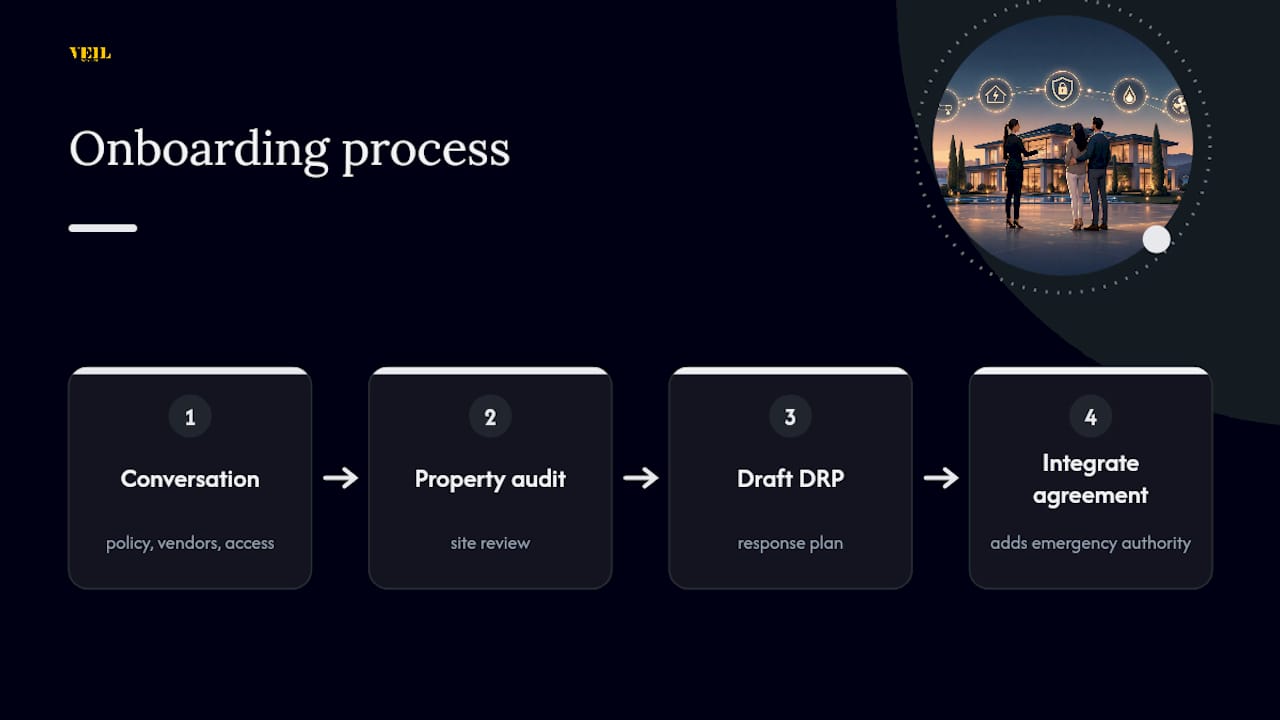
Onboarding starts with a short conversation about your property: insurance policy details, current vendor relationships if you have any, and access arrangements like keys or smart lock codes. From there, Veilconcierge conducts the property audit, drafts your DRP, and folds emergency authority language directly into your comprehensive home management agreement. Owners who want continuous property attention alongside emergency readiness often pair this with Veil Home Setups for seasonal preparation between visits.
If you're also reviewing how your insurance responds to fast-moving events like flooding, it's worth understanding parametric insurance products built for rapid payouts, which pair well with a concierge-managed response.
Ready to see what a managed plan looks like for your property? Visit Veilconcierge to request a DRP audit and start a planning consultation.
Sources
For vendor vetting standards and DRP structure, consult Sparkle Restoration's disaster recovery guidance and a sample property emergency response plan. Keep both digital and physical copies of your finished plan.
- Top 10 Disaster Recovery Tips for Luxury Properties | Sparkle Restoration Services
- 3 steps for building managers to prepare for emergency events — NAR
- Luxury property management guide (Own Luxury Homes)