
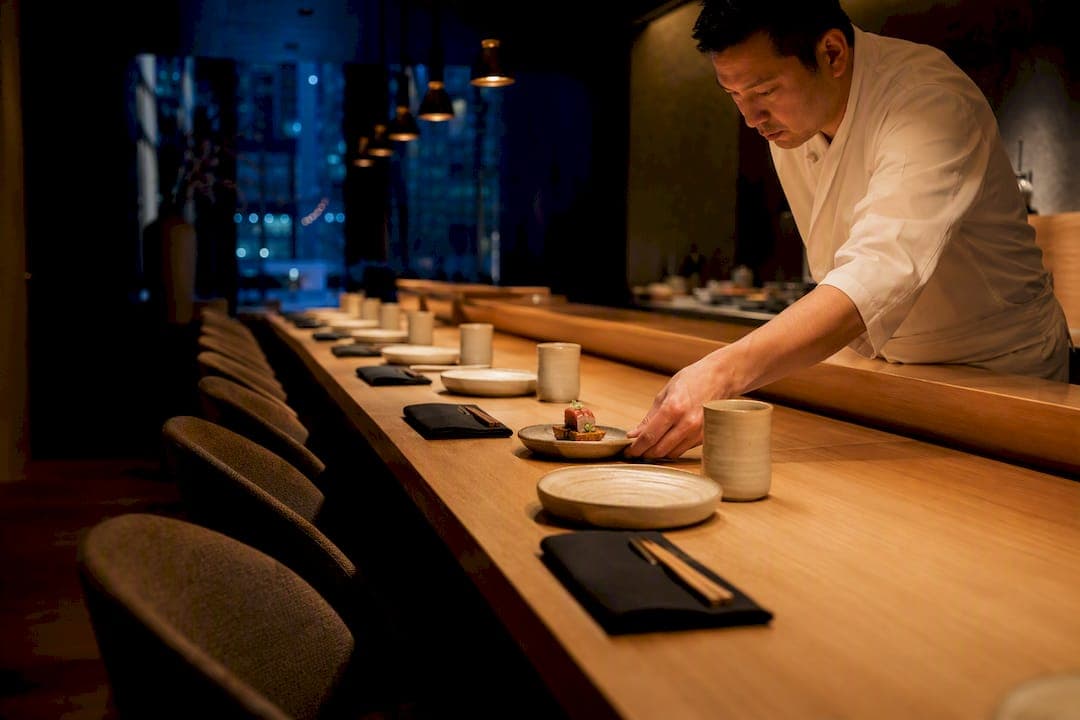
The fastest route to a hard-to-get reservation combines platform timing with a fallback plan: set Resy or Tock Notify across a date range, hit the 28 to 30 day drop at the exact release hour, and check again at the 7 day and 24 hour marks when hidden inventory tends to surface. If the date is fixed and non-negotiable, a concierge or credit-card concierge channel gets you there faster, at a cost. If your schedule has any flexibility, off-peak timing and cancellation chasing usually work without costing a dime.
TL;DR:
- Algorithmic drops favor speed and account readiness, making timing and account setup crucial for securing reservations at fixed-release restaurants.
- Tiny-counter and tasting-menu venues require persistence, Notify alerts, and prepaid models rather than raw speed to maximize chances.
- Checking for hidden releases at 7 and 24 hours before the reservation date can reveal unreleased inventory due to cancellations or private holds.
- Using bar seating and walk-in strategies can be effective alternatives, especially for smaller parties and during off-peak hours or days.
- Engaging concierge or credit-card services can improve odds for fixed dates, but success depends on relationships, flexibility, and clear communication of priorities.
Table of Contents
- What makes a reservation hard to get in the first place?
- Which reservation platform should you use, and how do you exploit it?
- When do the drops and hidden releases actually happen?
- Can a concierge or credit-card program actually get you in?
- How do you actually catch a last-minute cancellation?
- What can you do with no reservation at all?
- What builds long-term access at the restaurants that matter most?
- Should you ever pay for a reservation, and what's the trade-off?
- What does a 30-day campaign actually look like?
- Veil Concierge's perspective on time-sensitive dining requests
- How Veil Concierge handles bookings, travel, and the rest of your evening
- Sources
What makes a reservation hard to get in the first place?
Not every difficult table is difficult for the same reason, and that distinction changes which tactic actually works. A restaurant with a strict 30-day release and a hundred seats behaves nothing like a nine-seat counter with two nightly sittings, even though both show "fully booked" on the app.
Algorithmic drops are the most common category in New York City. These are rooms that release their full inventory at a fixed date and time, typically through Resy or Tock, and the entire game is speed and account readiness. Think of restaurants that open bookings exactly 30 days out at 10:00 AM. There's no relationship to build, no phone call that helps. It's pure timing and a fast connection.
Tiny-counter and tasting-menu rooms are a different animal entirely. These venues might only have eight or twelve seats total, running two or three seatings a night. Because the room is so small, a single cancellation represents a meaningful percentage of the night's capacity, and demand vastly outstrips what any release schedule can satisfy. Persistence and Notify alerts matter more here than raw speed, since these restaurants often use Tock's prepaid model, which sharply reduces the number of no-shows and cancellations in the first place.
Bar seats versus dining-room seats operate on entirely separate inventory in most cases. A restaurant can show zero availability in its dining room for six weeks while still seating walk-ins at the bar every single night. This is one of the most underused workarounds in the entire hard-to-book category, and it's covered in more detail further down.
Event- and season-driven scarcity is temporary and predictable once you know what to look for. Restaurant Week, major sporting events, graduation weekends, and the entire month of December all compress supply against a spike in demand. A restaurant that's a moderate three-week wait in March can become effectively impossible during the same week as a UN General Assembly session or a major fashion week.
Here's why the category matters before you pick a tactic:
- Algorithmic-drop restaurants reward speed, a saved payment method, and a strong booking history.
- Tiny-counter rooms reward patience, Notify alerts, and prepayment through Tock.
- Bar and walk-in supply rewards flexibility on timing and party size.
- Event-driven scarcity rewards planning around the calendar rather than fighting the algorithm.
Knowing which bucket your target restaurant falls into before you spend an hour refreshing a page saves you the frustration of using the wrong strategy on the wrong kind of room.
Which reservation platform should you use, and how do you exploit it?
Resy, Tock, and OpenTable are not interchangeable, and using the wrong one for a given restaurant wastes your best shot at a table. Each platform has a different relationship with restaurant type, release mechanics, and the tools it gives diners to fight for scarce inventory.
Resy dominates the independent fine-dining scene across most major cities, and it's the platform behind a large share of New York's hardest bookings. Resy publishes city guides and timed-drop schedules for high-demand rooms, and its core weapon for diners is the Notify feature paired with account history. Timed drops on Resy favour whoever is logged in, has a saved card, and hits refresh at the exact second the clock turns over. Investigative reporting on the hardest reservations in the city confirms that combining Notify, off-peak timing, a strong account history, and concierge access materially raises your odds on Category 1 Resy tables, the platform's internal label for its most contested rooms.
Tock is the platform of choice for prepaid tasting menus and chef-driven counters. Because guests pay upfront when booking, Tock restaurants see far fewer last-minute cancellations than a standard reservation system, which means the open slots that do appear move within seconds. Guides on booking hard-to-book restaurants consistently point diners toward Tock and direct contact for these rooms rather than treating them like a standard Resy drop.
OpenTable covers the broadest swath of restaurant inventory anywhere, with 65,000 restaurants worldwide using its search, filtering, and Notify tools. Where OpenTable falls short is the tiny-counter drop scene. Very few of the city's genuinely hardest tables run primarily through OpenTable, so treat it as your primary tool only when the restaurant itself lists OpenTable as its main booking channel, which a quick check of the restaurant's own website will confirm in seconds.
A few mechanics apply across all three platforms:
- Keep a saved payment method on file before a drop; entering card details during a timed release costs you the seat.
- Stay logged in and test your login the night before a known release, since expired sessions are a common reason people miss a drop.
- Expect a CAPTCHA or "are you human" check during high-traffic drops, and don't panic when it appears. It's slower, not fatal.
- Set Notify across a range of dates and times rather than a single night, since a single-date alert misses the flexibility that actually produces a hit.
Pro Tip: Set your Notify window to cover at least five or six candidate dates rather than one. A single-date alert might never fire, while a five-day window gives cancellations far more chances to match your search.
When do the drops and hidden releases actually happen?
Most of New York's hardest restaurants release their primary inventory 28 to 30 days out, at a fixed hour that rarely changes week to week. That standard window is confirmed across multiple guides covering the city's toughest restaurant reservations, and it's the single most important number to memorize if you're chasing a specific room.
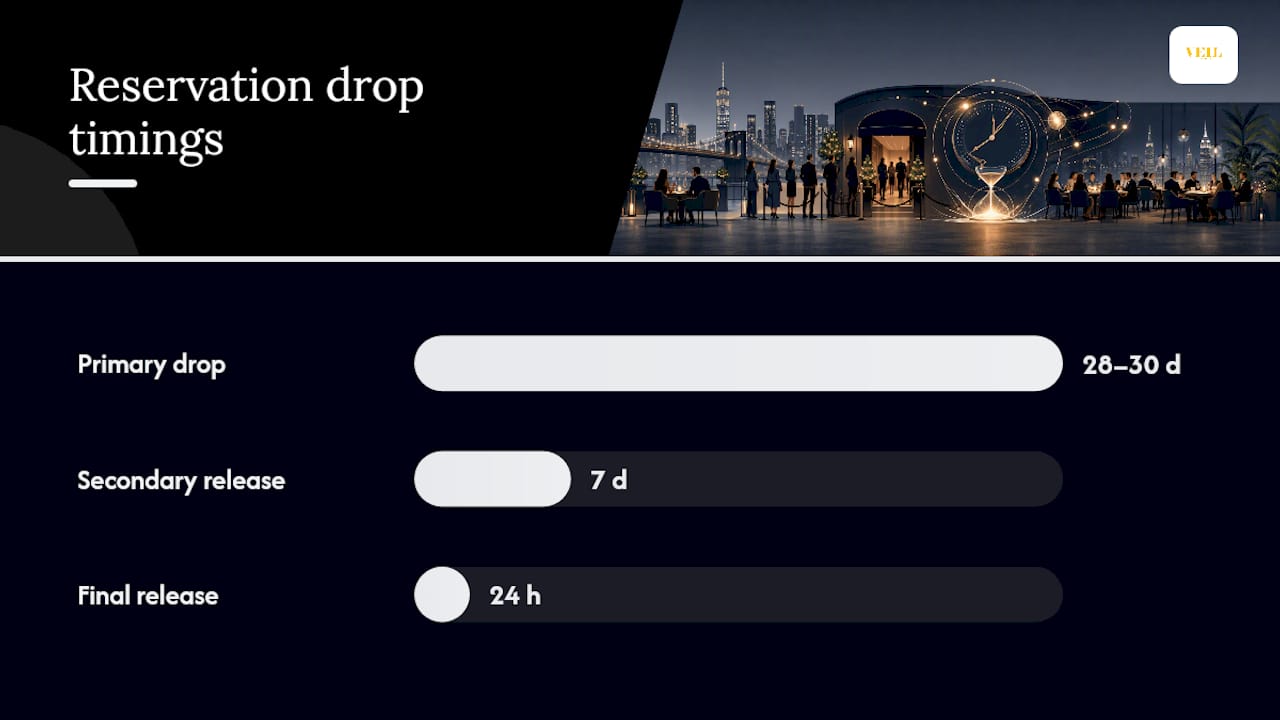
What most diners miss is the second and third wave. Many restaurants hold back a small amount of inventory that surfaces again at the 7 day mark, and a final sliver often appears 24 hours before service. These hidden drops exist because restaurants build in a buffer for VIPs, staff tables, and private events that sometimes gets released back into public inventory once those holds are confirmed or cancelled. Checking only the 30-day mark and giving up afterward means missing two more legitimate windows to get in.
Here's a simple sequence for timing your attempts:
- Mark the exact release date and hour for your target restaurant (30 days out is the default; confirm by calling if the schedule isn't published).
- Set Notify immediately after the initial drop, covering a wide date range rather than one night.
- Check the platform again at the 7-day mark, specifically looking for small newly released tables.
- Check one final time at the 24-hour mark, when leftover holds are most likely to be released.
- If nothing has opened by the morning of, shift focus to walk-in and bar strategies for that same evening.
Off-peak timing multiplies your odds at every stage of that sequence. A Tuesday at 5:45 PM, a weekday lunch service, or a 9:45 PM late seating all carry dramatically better availability than a Saturday at 7:30 PM, even at the same restaurant during the same week.
Season matters just as much as day of week. January and early February are consistently the easiest months to book almost anywhere in the city, since post-holiday spending slows and resolution-driven diners haven't yet crowded back in. On the other end, anything touching a major holiday, a UN session week, or fashion week compresses availability across the board, and no amount of Notify diligence changes that math. Plan around the calendar rather than fighting it.
Some restaurants simply don't publish their release schedule anywhere online, which is more common than most first-time diners expect. In that case, a direct phone call to the restaurant is often the only reliable way to confirm the actual booking cadence, since online guides can go stale the moment a restaurant quietly shifts its release hour.
Can a concierge or credit-card program actually get you in?
Concierges genuinely help, but the honest answer involves a fair amount of nuance most articles skip past; for discreet, high-net-worth legal clients needing premium support, services specializing in high asset divorce in Scottsdale and Paradise Valley illustrate how dedicated expertise enhances client outcomes. What a good concierge realistically accesses is a small pool of held inventory that some restaurants set aside specifically for repeat, high-value relationships, plus the ability to make phone calls and follow up in ways a solo diner refreshing an app cannot replicate. That's valuable, but it isn't a guarantee, and success rates vary widely by restaurant, by season, and by how firm your requested date is.
Credit-card concierge programs, most notably Amex Platinum and Centurion, often maintain their own relationships with a subset of high-demand restaurants and can occasionally surface tables that never appear on public platforms. The right way to use this channel is to request early, state your date flexibility clearly, and treat the first response as a starting point for negotiation rather than a yes-or-no answer. Concierge teams that get a vague request with a rigid single date have far less room to work than one given a window and a clear priority order of restaurants.
Hotel concierges follow a similar logic, with one key difference: their leverage depends heavily on whether you're an actual guest of that hotel. A concierge at a luxury property with an established relationship to a restaurant's management can sometimes make a call that gets results, particularly for guests staying multiple nights. If you're not staying at the hotel, that leverage mostly disappears, and you're better served contacting a dedicated concierge service directly.
This is where a managed option like Veil Concierge fits into the picture for travellers who'd rather hand the entire coordination problem to someone else. A concierge team working on your behalf can run the platform monitoring, the direct restaurant calls, and the timing across multiple channels simultaneously, which is difficult to replicate solo while also planning the rest of a trip.
A few practical notes on getting the most from any concierge relationship:
- Give a date range, not a single fixed night, whenever your schedule allows it.
- Rank your restaurant list by priority so the concierge knows where to focus first.
- Confirm what happens if the reservation falls through close to your travel date.
- Ask what documentation or membership is required before requests are submitted.
How do you actually catch a last-minute cancellation?
Cancellations happen constantly, even at the city's most impossible restaurants, and catching one comes down to workflow discipline more than luck. The single biggest mistake diners make is setting a Notify alert for one specific date and then forgetting about the app entirely. Set your alert across a range of dates instead, and turn on push notifications rather than relying on email, since email alerts routinely arrive minutes after the seat is already gone.
Before you're actually racing for a cancellation, get your account ready so there's zero friction at the moment a table appears. Pre-fill your payment information, confirm your profile details are current, and log out and back in the night before to make sure your session hasn't expired. A ten-second login delay at the exact moment a table opens is often the entire difference between success and a "fully booked" screen refreshing back at you.
Reduce the technical friction, too. A cluttered browser with a dozen tabs open, a slow connection, or an outdated app version all cost you precious seconds during a cancellation race. Keep the target restaurant's booking page open and ready rather than searching for it fresh when an alert fires.
AI-assisted tools have started to change part of this workflow, though not the whole thing. Integrations through tools like Claude and ChatGPT can now surface available seats faster than manually refreshing a page, but the reporting on these tools is consistent: they typically redirect to the booking platform itself to complete the reservation rather than finalizing it inside the chat. Treat AI as a faster discovery layer, not a replacement for having your login and payment method ready on Resy or Tock the moment it points you there.
Pro Tip: Keep a dedicated browser profile logged into Resy and Tock with saved payment details, separate from your everyday browsing. It shaves off the seconds that decide a cancellation race.
Set realistic expectations here. You are competing against other diners doing exactly the same thing, sometimes using automated tools, and success rates genuinely vary by restaurant and by channel. A quiet Tuesday cancellation at a mid-tier hot spot is a very different race than a Saturday cancellation at the city's single most talked-about table.
What can you do with no reservation at all?
Walking in without a booking isn't a last resort. At many of the city's hardest restaurants, it's a legitimate and reasonably reliable strategy on its own, provided you understand how that specific restaurant handles walk-ins. Some hold a fixed number of bar seats for walk-ins every single night. Others only seat walk-ins after the first dining-room turn clears, usually around 9:00 PM or later.
A workable approach:
- Call ahead or check the restaurant's website to learn its specific walk-in policy before showing up.
- Arrive right at opening, when the first wave of reservations hasn't yet created a wait, or arrive after the first seating has turned over.
- If you're solo or a party of two, ask directly about bar seating, since bar inventory frequently runs on a completely separate list from the dining room.
- Be genuinely willing to eat at the bar rather than treating it as a lesser consolation, since bar service at most high-end restaurants includes the full menu.
- If a short wait is required, ask the host for an honest estimate and have a backup restaurant nearby in case the wait stretches longer than expected.
Solo diners and pairs have a structural advantage here that larger groups simply don't get. A restaurant can slot a party of two into gaps a party of six never fits into, and many hosts will actively look for ways to seat a flexible smaller party during a busy night.
Politeness with the host staff matters more than most diners assume. A calm, specific request, "we're happy to sit at the bar, or wait twenty minutes if a two-top opens", gives the host something concrete to work with, rather than a vague "do you have anything?" that's easy to answer with a flat no.
What builds long-term access at the restaurants that matter most?
The single most durable way to secure repeat access at a hard-to-book restaurant is consistency over time, not a clever one-off trick. Restaurants remember reliable guests, and staff at busy rooms notice who shows up on time, treats the team well, and doesn't cause problems. That reputation, built across months rather than days, is what eventually earns access to off-platform allocations that never appear on Resy or Tock at all.
The inverse is just as true. No-shows and last-minute cancellations damage your standing at a restaurant faster than almost anything else, and some rooms actively track this behaviour against a guest's booking history. A single no-show at a tiny-counter restaurant can meaningfully affect that night's revenue, and staff notice.
Early visits should be low-demand and easy to accommodate. Take the seating you're offered rather than pushing for a specific table, tip appropriately, and treat the visit as a first impression rather than an opportunity to negotiate for better access next time. A short thank-you note or a message through the restaurant's booking platform after a great visit is a small gesture that genuinely registers with staff who rarely receive that kind of follow-up.
Set your timeline expectations honestly. Building genuine off-platform, relationship-based access at the city's top-tier rooms realistically takes months, sometimes closer to a year of consistent patronage. A neighbourhood spot with a devoted following moves faster, often within just a handful of visits.
Pro Tip: Book smaller, quieter tables at your target restaurant first. A relaxed Tuesday dinner does more for your standing than showing up once during a chaotic Saturday rush.
- Show up on time, every time, and cancel with genuine notice if plans change.
- Take the table you're offered on early visits rather than requesting upgrades.
- Tip fairly and treat every staff interaction with the same respect.
- Keep gestures like a thank-you note occasional, not transactional or expected.
Should you ever pay for a reservation, and what's the trade-off?
Paid marketplaces and membership services exist specifically because algorithmic drops and Notify alerts don't work for everyone's schedule, and they're effective for exactly that reason. These services hold or resell inventory at a premium, and coverage of the space confirms they can secure a table quickly, at a real financial cost that free tactics avoid.
Paying makes rational sense in one specific scenario: a fixed date tied to an occasion you can't move, like an anniversary, a proposal, or a client dinner where the restaurant itself is part of the deal. In that situation, time is worth more than money, and a guaranteed table beats a week of refreshing an app with no certainty of success. If your date has any flexibility at all, free tactics, Notify, off-peak timing, and cancellation chasing, usually get there without the added cost.
There's a real ethical dimension worth thinking through honestly. Reservation reselling pulls inventory away from diners who'd book it directly at the standard price, and it can distort a restaurant's relationship with its own regular guests. Some restaurants have pushed back hard against resale markets for exactly this reason, since it undermines the fairness of a release system they built for everyone.
Before paying for access anywhere, check the practical risk side too:
- Confirm the service's refund policy if the restaurant cancels or the booking falls through.
- Read the platform's terms of service around resale, since some violate the restaurant's own booking rules.
- Ask what happens if you need to change the date after paying.
- Weigh the premium against simply calling the restaurant directly first, since some will occasionally hold a table for a genuine, polite request.
What does a 30-day campaign actually look like?
A hard-to-get table rarely comes down to one lucky refresh. It comes down to a sequence executed correctly over about four weeks, with clear points where you decide whether to keep grinding for free or escalate to a paid channel.
- Week 1: Identify the correct platform for your target restaurant, confirm its release schedule by phone if it's not published, create or update your account, and set Notify across a wide date range.
- Week 2: Hit the primary 28 to 30 day drop at the exact release hour, then call the restaurant directly afterward to verify you didn't miss a separate walk-in or bar policy worth pursuing in parallel.
- Week 3: If your date is fixed and the drop didn't produce a table, escalate to a concierge or credit-card concierge request now, while there's still enough runway for follow-up. Keep Notify running throughout.
- Week 4 (final 72 hours): Chase cancellations aggressively at the 7-day and 24-hour marks, and build a same-night walk-in or bar-seat backup plan in case nothing surfaces in time.
| Week | Primary action | Backup if it fails |
|---|---|---|
| 1 | Confirm platform and release schedule; set Notify | Call restaurant directly to verify cadence |
| 2 | Execute the 28 to 30 day drop attempt | Check bar and walk-in policy same day |
| 3 | Escalate to concierge or card concierge if date is fixed | Keep monitoring Notify alerts |
| 4 | Chase 7-day and 24-hour cancellations | Walk-in plan with a backup restaurant ready |
Veil Concierge's perspective on time-sensitive dining requests
Most advice on hard-to-book restaurants treats the problem as a solo diner's puzzle to solve with better timing. In practice, the requests that matter most, a fixed anniversary date, a client dinner with no room for error, tend to arrive with almost no runway, and the diner has already exhausted the app-based tactics before calling for help.
Veil approaches those requests by working several channels at once rather than betting everything on one. That typically means running platform monitoring across Resy and Tock in parallel, placing direct calls to the restaurant to confirm real availability rather than relying on what an app displays, and drawing on established vendor relationships where they genuinely exist. None of that guarantees a specific table on a specific night, and any service that promises otherwise is overselling what's actually possible in a market this competitive.
What a coordinated approach does change is the odds and the effort on the client's side. A request that comes in with a firm date and a short list of acceptable alternatives gives a concierge team far more room to work than a single rigid demand, and that's true whether the ask is a restaurant table, a chauffeured car, or an entire evening built around both.
— Veil
How Veil Concierge handles bookings, travel, and the rest of your evening
Chasing Resy drops and cancellation alerts works, but it takes real time, and not every traveller or busy professional has an extra hour to spend refreshing an app on the exact morning a release goes live. Concierge services exist as an alternative to doing that chase yourself: providing a single point of contact who runs platform monitoring, direct restaurant calls, and follow-up, while you focus on the rest of your trip or your evening.

Requesting help is straightforward. You share your target restaurants, your acceptable date range, and any occasion details worth passing along, and Veil coordinates from there, whether that means a one-off dining request or a broader evening that includes chauffeured transportation to and from the table. Members with an active Veil membership get priority handling on time-sensitive requests like this, since ongoing access to a trusted concierge relationship is exactly what makes fast escalation possible when a date can't move. If you're travelling and need support beyond dining, Veil's worldwide concierge services extend the same coordinated approach to cities outside British Columbia.
If you have a specific date, a specific restaurant, or an evening that needs to come together without a hitch, reach out to Veil Concierge and start the request today.
Sources
- OpenTable
- Resy
- How to Get the Hardest Restaurant Reservations in 2026 — Trillionaire Daily
- How to Book Hard-to-Book Restaurants in 2026 | Pearl
- How to Make AI Restaurant Reservations — Food & Wine