
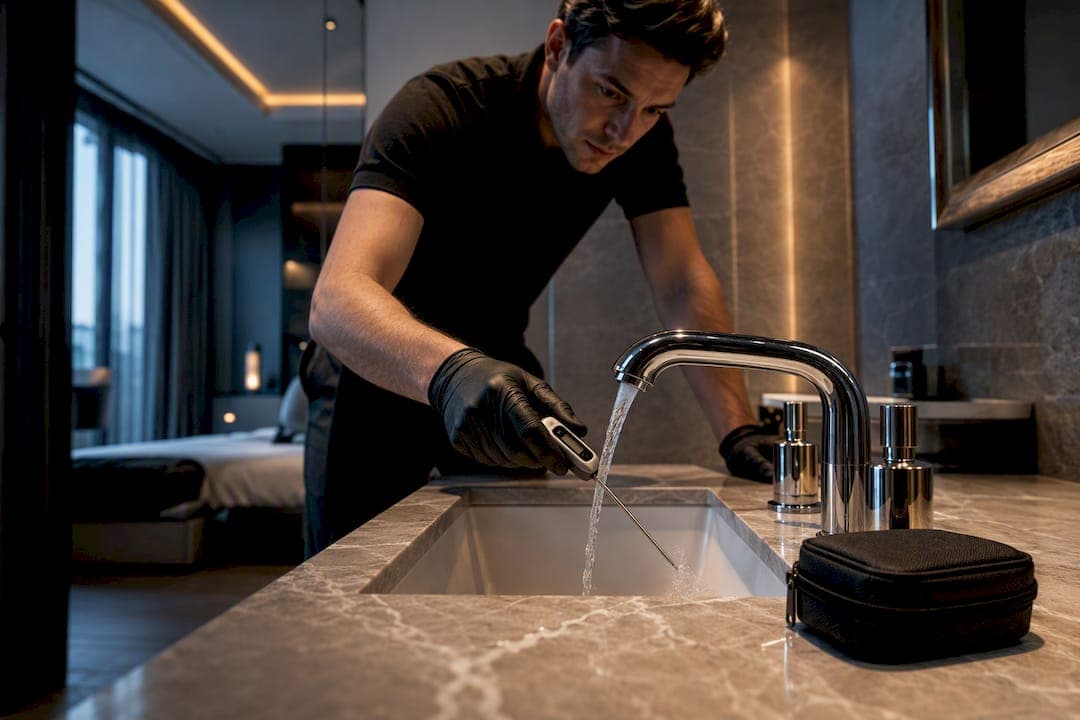
Professional guest house preparation covers four disciplines: a full systems and safety inspection, hotel‑grade housekeeping and provisioning, coordinated maintenance and contractor supervision, and a documented final verification before anyone arrives. Firms operating at the top of this market target response times under 60 seconds with 24/7 bilingual coverage, because the goal is anticipation, not damage control. A luxury concierge service can apply this model to guest houses and secondary residences acting as the single point of contact behind every vetted trade, housekeeper, and inspection.
TL;DR:
- Preparation should mostly be completed 8 to 4 weeks before arrival to secure trade bookings for structural work, especially during peak seasons.
- A thorough safety and systems check, and final inspection, must be performed and documented with photos before a guest arrives.
- Providers should respond within minutes, offer 24/7 bilingual support, and maintain vetted local teams with clear reporting and confidentiality protocols.
- Contractors must be supervised on-site with documented work logs, and any safety issues identified must be addressed immediately before guest access.
- Owners should receive a digital acceptance record with photos and a detailed report confirming the property’s readiness prior to arrival.
Table of Contents
- The core checklist for guest house preparation
- When should you start preparing a guest house?
- What operational standards should a provider meet?
- How does inspection and contractor oversight actually work?
- What happens on arrival day?
- What approvals and privacy controls should owners set?
- How is readiness verified before a guest arrives?
- How should guest belongings be stored and secured?
- What sustainability practices belong in guest house preparation?
- What hygiene and sanitation standards should apply?
- Veil's perspective: why anticipation beats reaction
- How Veil Concierge handles full‑service guest house preparation
- Sources
- FAQ
The core checklist for guest house preparation
Preparing a guest house properly means working through five categories before a single guest arrives. Skip one and it usually shows up as a complaint, a service call, or worse, a damaged relationship with a visiting family member or tenant.
A thorough guest room checklist and property walkthrough should include:
- Systems check — HVAC function, hot water recovery, breaker panel and power draw, exterior security devices, and a pest or odour inspection in closets, crawlspaces, and under sinks.
- Housekeeping — a documented linen protocol, hotel‑style turn‑down, laundering of all soft goods, and cleaning standards consistent with a managed rental, not a once‑over.
- Stocking — toiletries, bathroom and kitchen consumables, welcome amenities, and fridge or pantry provisioning suited to the length and nature of the stay.
- Maintenance — any scheduled repairs completed, vendors supervised on site, and cosmetic touch‑ups (paint chips, loose hardware, worn caulking) resolved before arrival.
- Arrival logistics — access codes or keys confirmed, parking arranged, and welcome materials placed where a guest will actually see them.
Managed guest homes typically bundle these categories together as a standard service scope precisely because owners rarely have time to chase five separate vendors before a weekend arrival.
When should you start preparing a guest house?
Timing determines whether preparation feels calm or frantic. The lead time you need depends on what needs booking, not on how far away arrival feels.
- 8 to 4 weeks out — book trades and vendors for anything structural: HVAC servicing, plumbing repairs, painting, or landscaping. This window disappears fast during peak Whistler ski season or Vancouver summer weekends.
- 7 to 3 days out — deliver fresh linens, place supply orders, and complete deeper maintenance items that don't require a full trade booking.
- 24 to 72 hours out — run the final turnover, test every system once more, and complete the inspection walkthrough.
Short-notice arrivals compress this into a single accelerated pass, usually by running the systems check and turnover simultaneously rather than in sequence.
Pro Tip: If a guest house has sat empty for more than two weeks, run the hot water and HVAC systems for a full cycle at least 48 hours before arrival. Dormant systems often reveal a leak or a failed component only after they've been running for a while, and you want that discovered by a technician, not a guest.
What operational standards should a provider meet?
Luxury guest house preparation is a service level, not a chore list. The right benchmark is hotel discipline applied to a private residence.
Expect a provider to commit to:
- Personal response times measured in minutes, not hours, with a clear escalation path when an issue can't be resolved on the spot.
- 24/7 availability, including a bilingual or multilingual contact where the client base requires it.
- Local, vetted teams rather than a rotating cast of unknown subcontractors.
- Documented turnover standards, including checklists and photo proof rather than a verbal "all good."
- Owner reporting that confirms exactly what was done, when, and by whom.
Some luxury portfolios report a median first reply in a couple of minutes, which sets the realistic bar for what "responsive" means at this service level.
Confidentiality matters just as much as speed. Staff rosters with limited, need‑to‑know access, combined with confidentiality clauses in service agreements, keep a guest house's comings and goings private. Veil Concierge's terms and privacy protections reflect this same principle: operational rigour and discretion aren't competing goals, they're the same job.
How does inspection and contractor oversight actually work?
A proper pre‑arrival inspection isn't a walk‑through with a phone camera. It follows a checklist covering safety systems (smoke and CO detectors, exterior lighting, lock function), water pressure and temperature, electrical load, HVAC response time, and every major appliance.
Contractors brought in for repairs should be briefed on scope before arrival, vetted against the same standard as recurring vendors, and supervised on site rather than left with a key and a task list. Villa managers typically split their time between walkthroughs, vendor supervision, and reporting, which is a different function from guest‑facing staff like a housekeeper or a butler.
Work should be logged with:
- Timestamped photos before and after the repair
- Warranty documentation for parts or labour
- A written note of who approved the work and at what cost
Pro Tip: If a contractor flags a critical issue (a failed breaker, a gas smell, a security system fault) that can't be resolved same‑day, insist on a pause and rebook rather than proceeding around it. A cosmetic fix can wait. A safety fault cannot.
What happens on arrival day?
The final hours before a guest arrives are where preparation either holds or falls apart. This is the stage where small details, an unset thermostat, a stale room, a fridge with nothing in it, become the guest's first impression of the entire property.
Arrival day tasks typically include:
- A final deep clean pass and light scenting, avoiding anything overpowering
- HVAC setpoints adjusted to a comfortable temperature ahead of arrival, not on arrival
- Hot water and lighting tested one last time, room by room
- Fridge and pantry stocked to match any dietary notes or special requests
- A welcome package with a personal touch, plus timed services like a private chef or driver arranged for the arrival window
- Keys, access codes, and written instructions handed off cleanly, with a direct contact number for anything that comes up
This same discipline shows up in hotel arrival operations, where structured check‑in workflows exist specifically to remove friction at the exact moment a guest forms their first impression.
What approvals and privacy controls should owners set?
Before any preparation begins, owners should set clear boundaries on spend, access, and communication. This isn't bureaucracy for its own sake. It's how you stay in control of a property you may not be standing in.
- Set a monetary threshold that triggers owner approval versus operator discretion, so a $50 repair doesn't require a phone call but a $2,000 one does.
- Confirm how any chargebacks or disputed costs get handled and documented.
- Require damage protection and insurance coordination in writing, not verbally.
- Limit staff access to only those working that day, and require a confidentiality clause covering the property and anyone who uses it.
Comprehensive home management agreements typically spell out exactly these terms, which is worth requesting in writing before work starts, not after a dispute.
How is readiness verified before a guest arrives?
Verification is the step most owners skip, and it's the one that catches problems before a guest does. A completed walkthrough checklist, backed by a photo log, should be sent to the owner as a digital acceptance record, not just a text saying everything's fine.
- Walkthrough checklist and photo log completed room by room
- Digital acceptance sent to the owner before the guest's arrival window opens
- Guest check‑in confirmed with a rapid remedy window for anything reported in the first hours of the stay
- A short owner debrief afterward, including recommendations for the next preparation cycle
A quiet ten‑minute room check after housekeeping, done by someone other than the cleaner, catches errors a guest would otherwise be the one to spot. Building that micro‑audit into every turnover is one of the cheapest insurance policies in property management.
How should guest belongings be stored and secured?
Guest houses that serve visiting family, staff, or short‑term tenants need a clear answer for where personal items go when they're not in use, and who can access them. This is separate from home security generally. It's specifically about protecting what a guest brings with them.
Lockable storage, whether a dedicated closet, a small safe, or a lockbox for valuables and travel documents, should be part of the room setup before arrival, not something arranged after a guest asks. Access to any master key or code should be logged, with a record of who held it and when it was returned.
For longer stays, luggage storage during transitions (a guest arriving before the room is ready, or checking out before their flight) needs a secure, staffed location rather than an unlocked hallway or garage. Security camera coverage of common areas is standard in most managed properties, but cameras should never cover private guest spaces like bedrooms or bathrooms; that boundary is both a legal and a trust issue.
Digital security matters too. If the guest house has smart locks or a shared Wi‑Fi network, guest access codes and passwords should reset automatically between stays. A code that still works for last month's guest is a real vulnerability, not a minor oversight. Documented access logs, tied to the same photo and reporting discipline used for maintenance, give owners a clear record of who came and went, and when.
What sustainability practices belong in guest house preparation?
Environmental practice in guest house preparation isn't about installing solar panels before a weekend guest arrives. It's about the operational choices made during every turnover, which add up across a full season of use.
Linen and towel programs that default to full replacement on every visit waste water and energy at scale. A better standard: fresh linens always provided, but laundering scheduled efficiently rather than run as single small loads after every short stay. Cleaning products matter too. Non‑toxic, low‑VOC cleaning supplies protect guest health and reduce the property's chemical load over time, particularly relevant in a guest house used frequently by children or family with sensitivities.
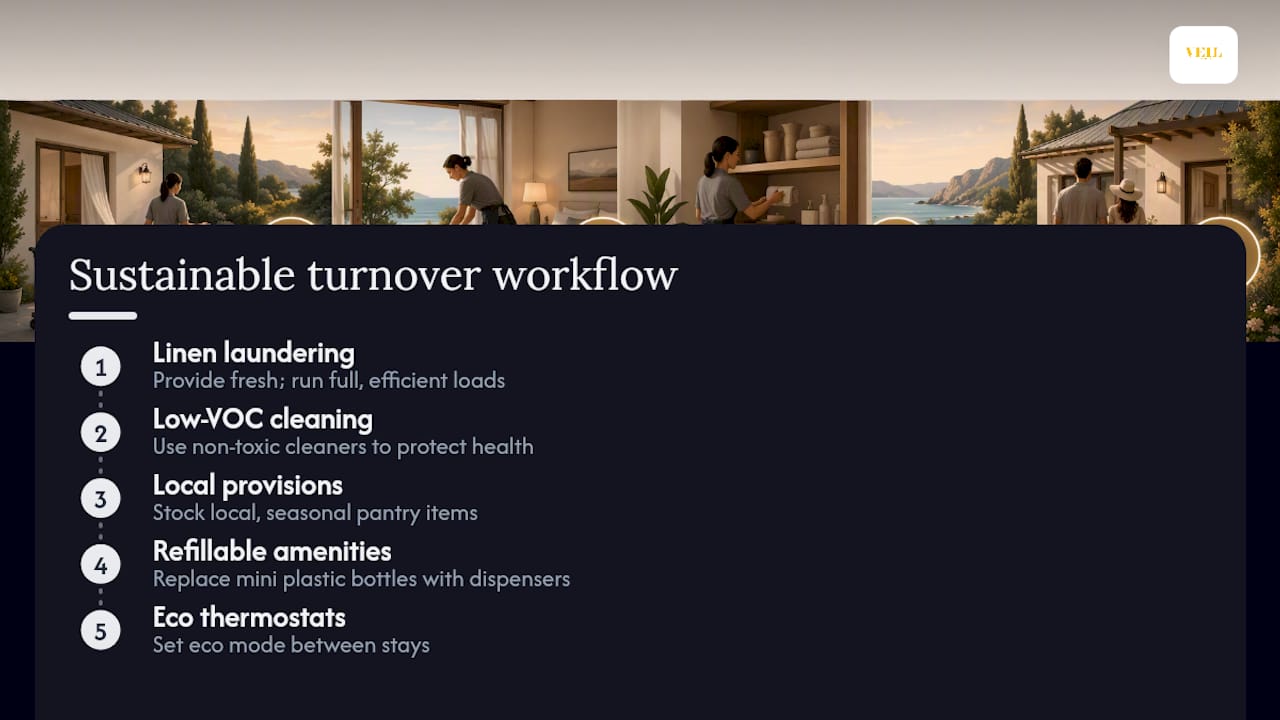
On the provisioning side, stocking local and seasonal pantry items reduces transport emissions and often costs less than importing specialty goods for a single stay. Amenity waste is another quiet cost: mini toiletries in individual plastic packaging generate far more waste than refillable dispensers, and most guests don't notice or mind the switch.
Smart thermostats set to eco mode between stays, rather than left running at full comfort settings in an empty house, cut energy use meaningfully across a season without affecting the guest experience at all. None of this requires a sacrifice in luxury. It requires a provider who treats sustainability as part of the operational checklist, not an afterthought bolted on for marketing purposes.
What hygiene and sanitation standards should apply?
Sanitation standards that became routine during the pandemic haven't disappeared. They've simply become the baseline expectation for any professionally prepared guest house, luxury or otherwise.
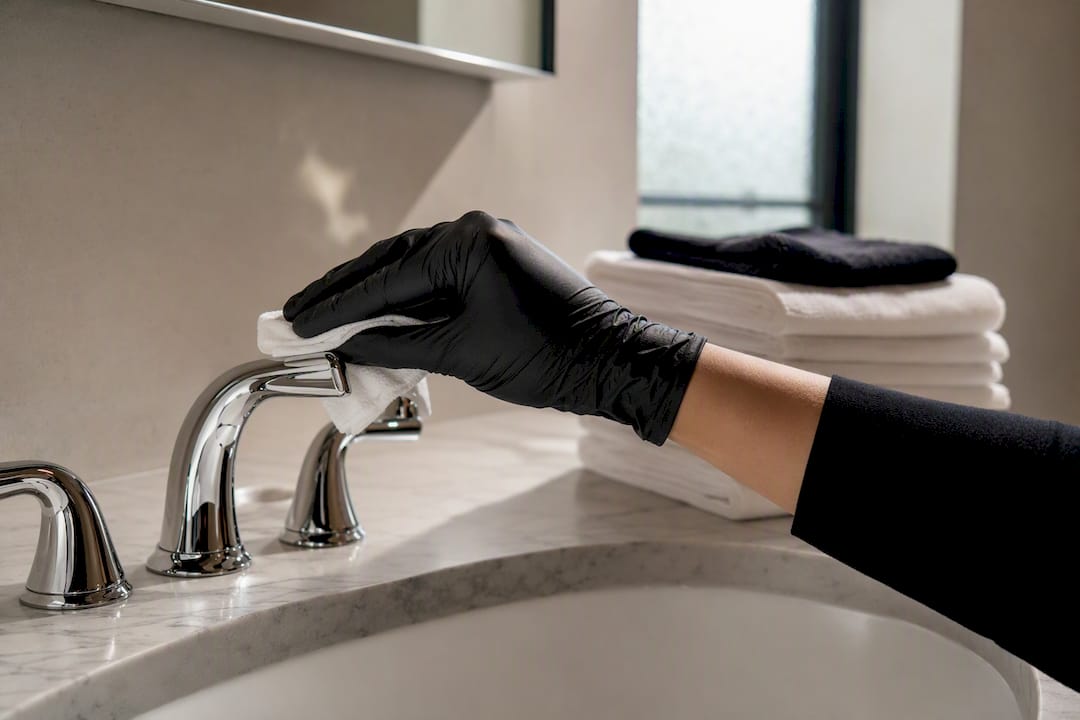
High‑touch surfaces (door handles, light switches, remote controls, faucet handles) should be disinfected as a distinct step from general cleaning, not assumed to be covered by a standard wipe‑down. Linens and towels should be laundered at a temperature proven to eliminate common pathogens, and stored in a sealed, sanitized area until the room is occupied.
Air quality deserves attention too. A guest house that's been closed up between stays benefits from a full air exchange, opening windows or running HVAC on a ventilation cycle, before a deep clean even starts. This matters more in humid climates or properties near the coast, where trapped moisture affects both air quality and long‑term maintenance.
Cleaning teams should follow a written sanitation protocol, not an informal routine that varies by who's on shift that day. That protocol should specify which products are used where, particularly in kitchens and bathrooms, and should be available to the owner on request. A visible sanitation standard, even something as simple as a sealed strip across a freshly cleaned bathroom, reassures a guest without requiring a single word of explanation.
Veil's perspective: why anticipation beats reaction
Most guest house problems never reach the owner because they're resolved before a guest notices. That's the real standard, not a spotless photo after the fact. A luxury concierge service coordinates that anticipation across vetted local teams for property oversight, from a failed water heater caught during a routine check to a same‑day linen delivery ahead of an unexpected weekend guest. Reacting well is good. Never having to react is better.
— Veil
How Veil Concierge handles full‑service guest house preparation
Coordinating five separate categories of work, systems checks, housekeeping, stocking, maintenance, and arrival logistics, across multiple vendors is exactly where most preparation plans fall apart. A concierge service removes that friction by acting as the single point of contact for every vetted local team involved, so clients are never chasing multiple phone numbers before a guest arrives.

Everything covered in this guide maps directly to Veil's home setup service: inspection, professional housekeeping, provisioning, contractor supervision, and a documented walkthrough before handoff. Whether it's a guest house sitting empty in a resort area or a second residence expecting family, the process runs the same way every time, with consistent standards and reporting.
If you want a guest house ready without personally coordinating five vendors, reach out through Veil Concierge for a bespoke quote or to book a home setup ahead of your next arrival.
Sources
The operational standards referenced throughout this guide come from established voices in luxury property management. The Forbes Business Council piece on hotel‑grade operations sets out the response‑time and anticipation standards used across this article. Guestly Homes' 2026 guide to managed guest homes outlines typical service scope for owners considering a managed model. OmniVillas' guide to luxury vacation rental management covers manager selection and common operational failure points. Finally, Villas for Kings' description of the villa manager role explains the day‑to‑day mechanics of walkthroughs, vendor supervision, and reporting.
- Why the world's most luxurious vacation properties need hotel‑grade operations
- What are managed guest homes? A 2026 guide for owners and HR leads
- Luxury vacation rental management: what it is and how to choose a manager
- The villa manager job: 14 properties, one P&L, described
FAQ
How far ahead should guest house preparation start?
Book trades and vendors 8 to 4 weeks ahead for structural or scheduled work, then handle linens, supplies, and deeper maintenance in the 7‑to‑3‑day window before arrival.
What does professional guest house preparation include?
It covers a full systems and safety inspection, hotel‑grade housekeeping and provisioning, maintenance and contractor coordination, and a documented final verification before arrival.
Who is liable if something breaks during preparation?
Liability should be defined in writing before work starts, including approval thresholds for repair spend and confirmed insurance or damage protection coverage.
How does Veil Concierge verify a guest house is ready?
Veil Concierge completes a checklisted walkthrough with a photo log and sends a digital acceptance record to the owner before the guest's arrival window opens.
What proof should an owner expect after a turnover?
Expect timestamped photos, a completed inspection checklist, and a written report confirming what was done, by whom, and when, rather than a verbal confirmation.