
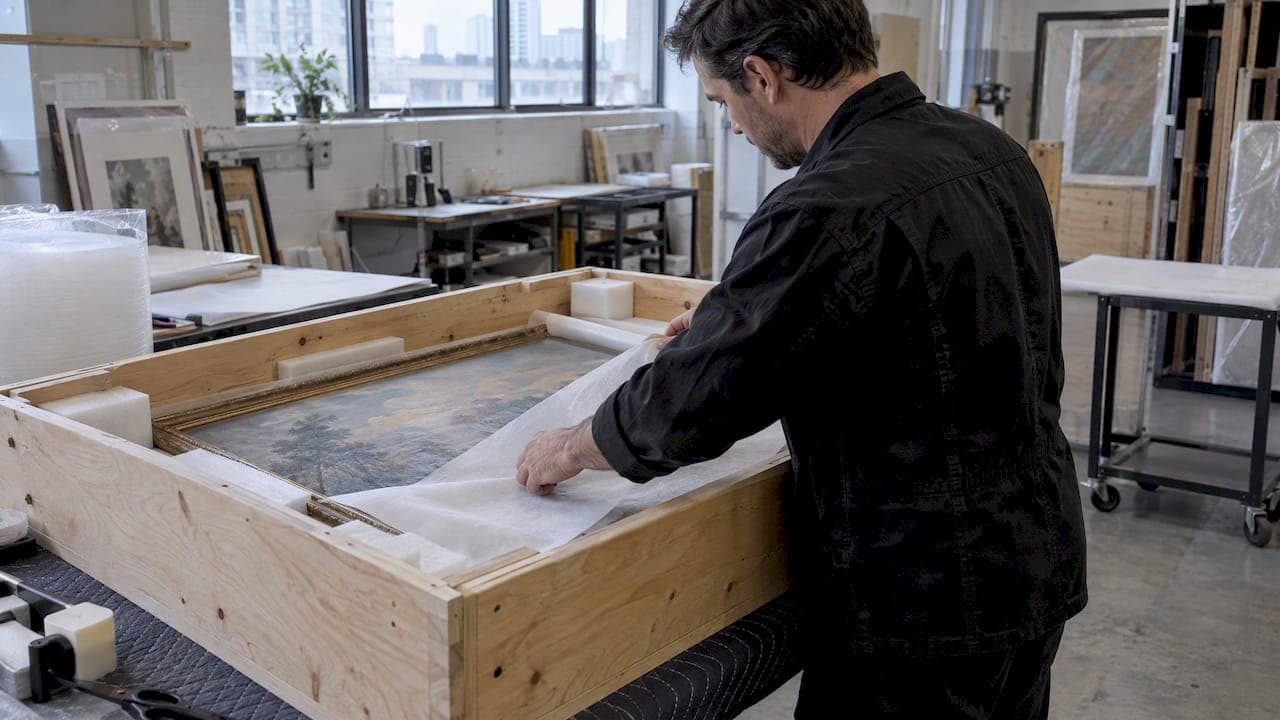
Specialist fine-art movers or conservator-supervised services are usually the right call for high-value or fragile pieces in Vancouver, not general movers with furniture blankets. Before you sign anything, insist on three things: a documented condition assessment, museum-grade packing or a travel frame built for the piece, and insurance terms that name the declared value and spell out exclusions in writing.
TL;DR:
- Each move should include a documented condition assessment, museum-grade packing or frames, and clear insurance terms that specify declared value and exclusions.
- Crates must have details like skids, recessed hardware, and discreet labeling, while vehicles need features like air-ride suspension and humidity controls for fragile artwork.
- Vetting a fine-art mover involves confirming experience with museum materials, obtaining references, and ensuring written plans for transit and insurance coverage.
- Preparing the artwork with comprehensive photographs and clearing the route reduces risks, especially in building or logistical variables unique to Vancouver.
- Costs depend on custom crating, vehicle features, handling complexity, and declared value, with longer timelines needed for custom fabrication or complex routes.
Table of Contents
- What specialised fine-art moving includes: packing, crates and vehicle controls
- How to choose a fine-art mover in Vancouver: questions and contract checks
- Preparing your artwork and property for moving day
- Typical costs and timelines for fine-art moves in Vancouver
- How Veil Concierge coordinates fine-art moves for clients in British Columbia
- Why museum-grade practices matter more than most people assume
- Let us manage the moving pieces around your collection
- FAQ
- Sources
What specialised fine-art moving includes: packing, crates and vehicle controls
Fine-art transport is risk engineering, not careful lifting. The Canadian Conservation Institute's guidance on packaging and transport identifies direct impact, abrasion, vibration, moisture and temperature swings as the hazards that packaging and vehicle controls need to address, and a mover who cannot name those controls for your piece is not ready to handle it.
Packaging comes in layers. Primary packaging touches the artwork directly, usually an inert interleaving material or sealed wrap. Secondary packaging is the crate or case that absorbs shock and keeps moisture out. CCI's five-step approach to shipment recommends packing for the toughest leg of the journey, with cushion thickness recommended to provide adequate protection for typical routes and increased thickness for higher-risk networks.

For paintings with fragile surfaces, unframed canvases or oversized works, a handling-travel-storage frame is often the better option. CCI's notes on paintings before travel describe HTS frames as a way to move a piece without any contact on the painted surface, and the frame can double as long-term storage once the move is done.
A well-built crate shows in the details:
- Skids and handles that keep the crate off wet ground and allow safe lifting.
- Recessed hardware so nothing snags or punctures during transit.
- Durable latches instead of exposed screws that slow emergency access.
- Discreet labelling, since a crate marked "fine art" invites the wrong kind of attention.
Vehicles matter as much as crates. Air-ride suspension reduces vibration, and heated trucks matter in cold weather because, as CCI notes, vehicle air conditioning typically manages temperature but not relative humidity. A piece sensitive to humidity swings may need an insulating wrap or a monitored vehicle rather than relying on the dashboard controls.
Pro Tip: Ask your mover to name the single toughest leg of your specific route, whether it's a wet loading dock or a long elevator wait, and describe exactly how they're packing for it.
How to choose a fine-art mover in Vancouver: questions and contract checks
Vetting a mover is less about price and more about whether their answers hold up under pressure. Before you book, work through these steps:
- Ask about experience with museum-style materials. Confirm they've built HTS frames or equivalent travel frames and worked with crating specifications similar to what your piece needs.
- Request references from galleries or institutions. A mover who regularly works with local collections or exhibition spaces will have handled the kind of condition scrutiny your piece deserves.
- Require a written condition report before pickup. It should include dated photographs, written notes on existing damage, and signature points from both parties. CCI's guidance on basic handling of paintings notes that most damage occurs during handling, which makes a clear before-and-after record essential if a dispute arises.
- Confirm insurance specifics in writing. Ask about declared value, exclusions for unskilled handling, deductibles, and whether packing and any interim storage are covered under the same policy. Reviewing a mover's terms and conditions alongside their insurance certificate helps you spot gaps before the piece leaves the wall.
- Walk through vehicle specifications and the move plan. Ask how the artwork will be restrained in transit, whether the vehicle is monitored for temperature, and what the plan is for the hardest part of the route, whether that's a steep driveway, a narrow stairwell or a bridge crossing at a bad hour.
A low quote that skips any of these steps usually costs more once something goes wrong.
Preparing your artwork and property for moving day
Good preparation shortens the move and lowers risk on both ends. A condition report should include clear photographs from multiple angles, written notes on frame condition, surface irregularities and any prior restoration, plus provenance references if the piece has them. This record protects you if a claim becomes necessary later.
On the property side:
- Clear the route from the artwork's current location to the loading point, including hallways, stairwells and any tight turns.
- Have padded blocks or soft barriers ready for temporary staging if the piece needs to rest before loading.
- Confirm elevator access and booking windows in advance for condo or office buildings.
- Check the day's forecast and plan for rain exposure during loading and unloading.
Packing differs by piece. Small works often travel in padded cases with minimal fuss, while large or unframed canvases usually call for a travel frame or a custom crate. Vancouver's layout adds its own variables: avoid scheduling loading or delivery around peak bridge congestion, and account for buildings where stairs are the only option.
Typical costs and timelines for fine-art moves in Vancouver
Pricing for fine-art moves varies more than furniture moves because so much depends on the piece itself. The main cost drivers are:
- Custom crating or travel frames, which take longer to build and cost more than standard packing materials.
- Crate lead time, since a properly fitted crate for an unusual size or shape isn't something built the same day.
- Vehicle specifications, including air-ride suspension, heated or monitored cabins, and dedicated versus shared transport.
- Number of handlers required, particularly for heavy or awkward pieces that need more than two people.
- Declared value for insurance purposes, which affects the premium built into the quote.
A cheaper estimate can carry hidden risk if the contract has exclusions for unskilled handling or caps liability well below the artwork's value. It's worth comparing quotes on coverage terms, not just the final number.
Timelines usually run through three phases: condition assessment and documentation, crate or frame fabrication if custom materials are needed, and the move itself. A straightforward piece with existing packaging might move same-day. A large or fragile piece needing a custom crate can take considerably longer once fabrication and scheduling are factored in, and some moves require short-term climate-controlled storage between steps.
How Veil Concierge coordinates fine-art moves for clients in British Columbia
When a move involves several stops, tight timing, or pieces that need discretion, we act as the single point of contact who vets specialist movers, arranges the condition report, and confirms insurance terms before anything is touched. We draw on a vetted network across British Columbia rather than leaving clients to research and compare mover contracts on their own.
This kind of coordination tends to matter most for complex situations: a collection moving between a primary residence and a second home, a time-sensitive delivery ahead of an event, or a move where the client prefers not to manage vendor calls directly. We handle those conversations so the owner doesn't have to.

Why museum-grade practices matter more than most people assume
The real risk in a Vancouver fine-art move rarely shows up on the highway. It's the wet loading dock, the elevator that's booked solid, the narrow stairwell, or the bridge delay that turns a short trip into hours of exposure. Museum-grade practices exist because they account for that unglamorous middle stretch, not just the drive.
Insist on a written condition report and clear insurance terms before the piece leaves the wall. Everything else follows from those two documents.
— Veil
Let us manage the moving pieces around your collection
Once the condition report is signed and the crate specifications are confirmed, the remaining work is coordination: scheduling the vetted mover, lining up a climate-aware vehicle, and keeping every party on the same timeline. That's the part we take off your plate. Our team arranges the transportation details around a move, from a chauffeured vehicle for accompanying staff to broader concierge support for the rest of the day's logistics.

If your collection, a second home, or an upcoming event calls for this kind of coordination, reach out and we'll put together an assessment of what the move needs, start to finish.
FAQ
Why is the Vancouver Art Gallery moving?
Exhibition and venue changes at the Vancouver Art Gallery are announced through the gallery's own press materials, which is the most reliable place to confirm current plans. We'd recommend checking that page directly rather than relying on secondhand summaries.
How much does it cost to hire movers in Vancouver?
Costs for fine-art movers depend heavily on crating needs, vehicle requirements and declared value rather than a flat rate, so there's no single published figure that applies across the board. A written quote that breaks down crating, transport and insurance separately gives a clearer picture than a lump-sum estimate.
What exhibitions are happening at the Vancouver Art Gallery in 2026?
Exhibition schedules change, so the most current list comes from the Vancouver Art Gallery's own press page rather than a static guide. Checking directly also confirms any dates or venue details before you plan a visit or a related move.
What are the current artist opportunities in Vancouver?
Open calls, grants and exhibition opportunities shift throughout the year, and institutions such as the Vancouver Art Gallery, Vancouver Biennale and CARFAC BC post current deadlines on their own sites. Verifying directly with those organizations is the most reliable way to confirm what's open at any given time.
Does Veil Concierge arrange fine-art moving services directly?
We coordinate the vendors, paperwork and transport around a fine-art move rather than operating as a crating or packing company ourselves. That means vetting specialist movers, confirming condition reports and insurance terms, and arranging secure transport through our concierge services.